
AI in Law Firms: How Machine Learning Helps Solicitors, Lawyers and Attorneys Transform Marketing Strategies
AI-Overview Optimised
How AI is Changing Legal Marketing
Keyboard-friendly tabs. Mobile-ready. Built for real law firm use-cases.
AI is changing legal marketing by automating research, content and reporting, personalising campaigns at scale and improving lead qualification, so law firms win more high-value matters with lower acquisition costs and faster response times.
What AI is doing to legal marketing overall
- Targeting: AI groups prospects by matter type, location and behaviour so campaigns reach the right clients instead of everyone.
- Personalisation: tools tailor messages, offers and follow-up based on what a client has searched, read or asked about.
- Optimisation: models test headlines, calls-to-action and landing pages, then push spend into what actually converts.
- Reporting: dashboards show cost per lead, conversion rate and signed matters faster, which makes budget conversations easier.
As a conservative benchmark, I treat a 5–15% uplift in marketing efficiency in year one as realistic when AI is used sensibly with human review.
How AI is changing legal marketing isn’t really about robots taking over your marketing department. It’s about using data in ways we couldn’t before. With AI, law firms are finding better clients, spending less on ads that don’t work, and creating campaigns that actually convert. AI is transforming how legal professionals approach digital marketing. The global legal AI market hit $1.45 billion in 2024. By 2030? We’re looking at $3.90 billion [1]. That’s 17.3% growth every year.
AI isn’t coming to legal marketing, it’s already here.
The law firms, solicitors, lawyers and attorneys ignoring this shift are haemorrhaging clients to competitors who’ve adopted AI marketing for law firms.
I’ll walk you through how AI reshapes legal marketing. We’re talking planning, client segmentation, lead nurturing. Real data. Practical stuff you can use. And yes, compliance considerations UK solicitors need to follow.
What is AI Legal Marketing?
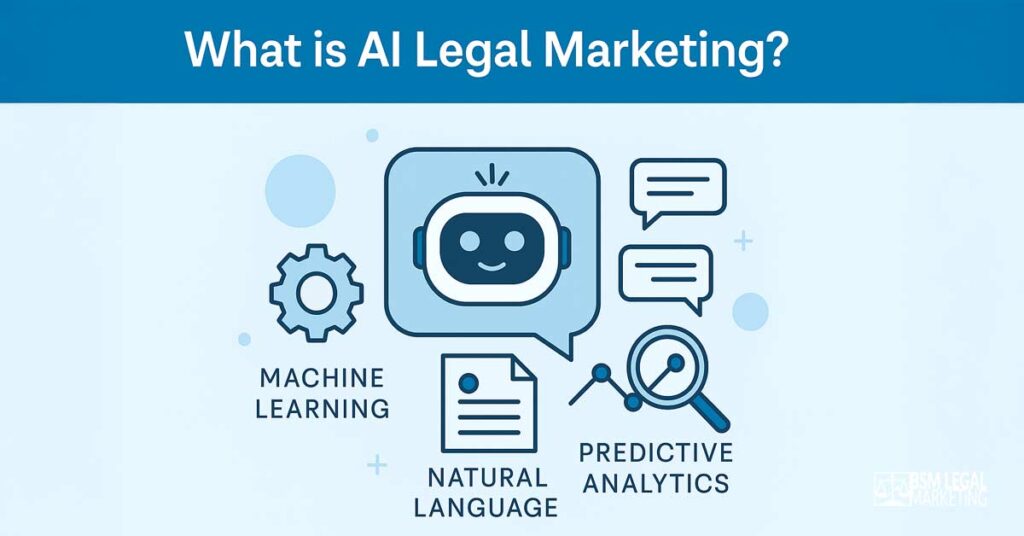
It’s using machine learning, natural language processing, and predictive analytics to handle the repetitive stuff in marketing. And optimise what you’re already doing.
Traditional marketing? That’s you sat there doing keyword research manually. Basic demographic targeting. Making decisions based on gut feeling. AI for legal work looks at thousands of data points, search patterns, how people use your website, past conversions, and works out which prospects will actually become paying clients. The tech handles the boring repetitive tasks. Bid adjustments. Email sequences. Content tweaks. You focus on strategy and talking to actual clients.
What are law firms actually using this for?
- Automated bidding on Google Ads.
- AI chatbots that screen initial client enquiries.
- Predictive lead scoring that ranks enquiries by how likely they are to convert.
- Content generators for blog posts and social updates.
- Many law firms are leveraging AI to improve their marketing efforts.
Here’s the thing, 31% of individual legal professionals now use generative AI at work. That’s up from 27% the year before [2]. Firm level? 21% have adopted legal-specific AI tools [2]. Using AI tools has become standard practice across the legal profession.
AI Adoption Rates by Practice Area (2025)
| Practice Area | Individual Use | Firm-Wide Adoption |
|---|---|---|
| Civil Litigation | 36% | 27% |
| Personal Injury | 37% | 20% |
| Family Law | 26% | 20% |
| Immigration | 47% | 17% |
| Criminal Law | 28% | 18% |
| Trusts & Estates | 25% | 18% |
Source: 2025 Legal Industry Report [3]
Civil litigation firms are leading adoption at 27%. Personal injury and family law practices? Both at 20% [3]. This isn’t some future prediction. AI is already reshaping the legal field.
How is Artificial Intelligence Law Firm Marketing Different from Traditional Methods?
Speed. That’s the first thing you’ll notice.
A PPC manager reviews campaigns weekly, right? Makes manual bid adjustments for maybe dozens of keywords. AI platforms? They’re checking performance every hour. Adjusting thousands of keywords at once. Based on conversion data, what competitors are doing, seasonal patterns. Machine learning and deep learning made up 63% of the legal AI market in 2024 [4]. New AI tools are fundamentally changing how legal teams approach content marketing.
Traditional methods test one thing at a time. Change your ad copy. Wait three weeks for results. AI tests multiple variables simultaneously. Finds winners in days.
Think about audience segmentation. A marketing team creates three client personas. AI-driven marketing segments audiences into dozens of groups. Based on search behaviour. Page views. Demographics. Each group gets tailored messages. Automatically. No separate manual builds needed.
Campaigns used to work like this: Launch. Run for weeks. Then review. AI campaigns? They’re improving hourly. Pausing weak ads. Moving budget to what converts. Adjusting targeting on the fly. AI can help optimise in ways that weren’t possible before.
The legal AI software market will reach $10.82 billion by 2030 [5]. Growing 28.3% yearly. Why? Because AI implementation helps firms save 1-5 hours weekly. Some save 6-10 hours [6]. Tools pay for themselves pretty quickly. The impact of AI on legal workflows is undeniable.
Comparison Table: Traditional vs AI Legal Marketing
| Aspect | Traditional Marketing | AI-Powered Marketing |
|---|---|---|
| Bid Management | Manual weekly adjustments | Automated hourly optimisation |
| Audience Segmentation | 3-5 broad personas | 20+ micro-segments |
| Campaign Testing | Sequential A/B testing | Simultaneous multivariate testing |
| Response Time | Days to weeks | Minutes to hours |
| Data Analysis | Sample-based insights | Complete data analysis |
| Cost Per Acquisition | Static over time | Continuously improving |
How AI Helps: Key Benefits of AI Marketing for Lawyers
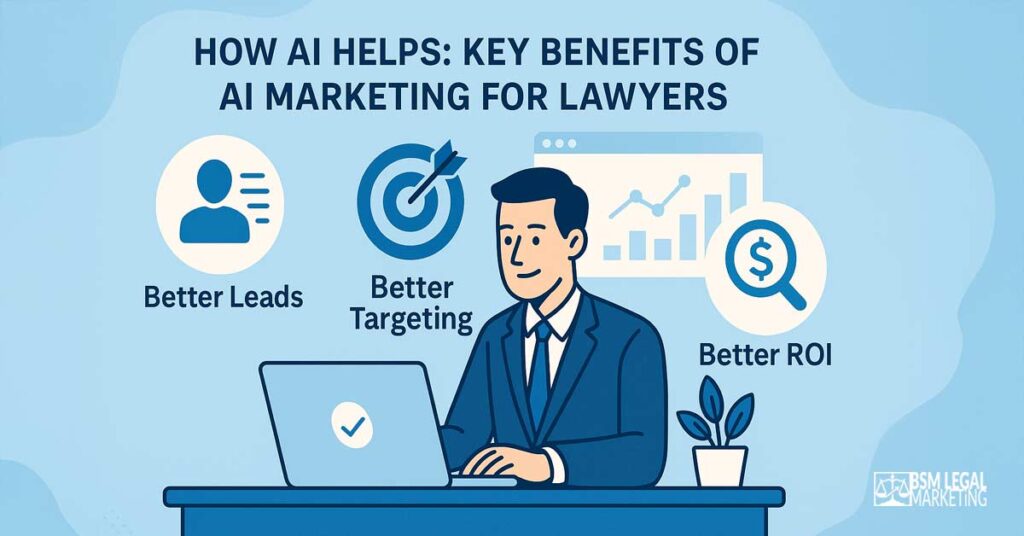
Better leads. Better targeting. Better ROI. That’s what the benefits of AI marketing actually deliver.
Start with lead scoring. AI looks at hundreds of signals, time on site, pages viewed, how they fill in forms. Ranks enquiries by conversion probability. You’re not treating every enquiry the same anymore. Personal injury firms? 37% of their lawyers use AI for work [7]. There’s a reason for that. AI tools can also help law firms identify which prospects are most likely to convert.
Targeting gets sharper. Your ads reach people searching for your specific services. AI finds long-tail keywords you’d miss doing it manually. You appear for “divorce solicitor [city]” without wasting budget on the wrong locations. Using AI in legal marketing means better budget allocation.
Content production used to be the bottleneck. Not anymore. AI can generate drafts. Suggests topics from trending searches. Optimises what you’ve already written. You add the professional insights. The tech speeds up everything else. AI technologies help legal professionals maintain consistent content marketing efforts.
Time Savings from AI Adoption
| Hours Saved Weekly | Percentage of Users |
|---|---|
| 1-5 hours | 65% |
| 6-10 hours | 12% |
| 11+ hours | 7% |
Source: 2025 Legal Industry Report [8]
Campaign data? Updates in real-time. Automated alerts flag problems. AI spots trends your competitors haven’t noticed yet. AI can also provide insights into legal data that help firms make better decisions.
Here’s what the numbers say: 61% of firms said AI “somewhat” increased efficiency. Another 21% saw big improvements [3]. But here’s the important bit, 82% of AI users found it increased efficiency [8]. Legal professionals believe AI will have a high impact on the future of law.
That’s time you get back. For client work. For business development. Not sitting there doing manual marketing tasks. Understanding AI usage patterns helps law firms plan effective law firm marketing strategies.
AI for Legal Lead Generation: How Does AI Improve Client Acquisition for Law Firms?
Let me tell you how AI actually improves lead generation, because it’s not magic, it’s maths.
Predictive lead scoring looks at past data. Spots patterns in successful conversions. What signals matched with clients who actually paid? Search terms they used. Pages they looked at. Time of day. Device type. New enquiries get scored automatically. You follow up on top prospects first. Makes sense, right?
Behavioural tracking watches how people use your website. Someone visits your “no win no fee” page three times. Downloads your injury claim guide. Reads solicitor profiles. They’re more interested than someone who bounced immediately. AI segments these behaviours. Triggers the right follow-up.
What AI Lead Scoring Evaluates
| Signal Type | Examples | Impact on Score |
|---|---|---|
| Engagement | Pages viewed, time on site, return visits | High |
| Content Interaction | Guide downloads, video views, form starts | Very High |
| Search Intent | Keywords used, ad clicked, search time | High |
| Demographics | Location, device type, referral source | Medium |
| Timing | Day of week, time of day, browsing pattern | Medium |
Automated sequences keep prospects warm without you lifting a finger. Someone downloads your employment tribunal guide? AI sends a follow-up three days later with related content. Another five days after with a consultation offer. Final reminder two weeks later. Each sequence adjusts based on opens, clicks, replies. No manual management needed.
Smart search ads adjust spending based on conversion likelihood. Personal injury searches spike during lunch? Bids increase automatically to capture that traffic. Late evening when conversions historically drop? Bids decrease to save budget.
Client profile matching compares new leads against your best clients. AI finds similarities in demographics, case types, engagement patterns. Then targets similar prospects. You spend budget on audiences most likely to become profitable clients.
Can Law Firms Really Use AI for SEO and Search Visibility?
Can they? They need to. Search engines use natural language processing now. Semantic understanding. If you’re not using AI for SEO, you’re already behind.
AI keyword research goes way beyond volume and competition numbers. Tools analyse search intent. Question patterns. How entities connect. Instead of targeting “divorce solicitor,” AI finds stuff like “can I get a divorce without my spouse’s consent UK” or “how much does a divorce cost with children involved.”
Content Types for AI Search Optimisation
| Content Format | Purpose | AI Visibility |
|---|---|---|
| FAQ Pages | Answer common questions directly | Very High |
| How-to Guides | Step-by-step processes | High |
| Comparison Articles | “X vs Y” legal options | High |
| Definition Content | “What is [legal term]” | Very High |
| Local Pages | “[Service] in [City]” | High |
| Case Study Outlines | Problem-solution format | Medium |
What is Content Optimisation for AI
Content optimisation means understanding how language models read your stuff. Structure information for Answer Engine Optimisation. Format it so AI can extract clear answers to legal questions. The legal research segment dominated the AI market in 2024 because of AI-powered natural language processing adoption [4].
Answer Engine Optimisation for lawyers? You need question-answer formatting. Featured snippet optimisation. Structured content AI systems can parse easily. When someone asks ChatGPT “What happens if I don’t respond to a letter of claim,” properly optimised content gets cited.
Semantic SEO connects related legal concepts. Builds topical authority. AI tools identify semantic relationships between terms. You create content clusters covering all aspects of employment law, family law, conveyancing. Not isolated blog posts.
Google’s AI Overviews affect click-through rates. Zero-click searches increased significantly. Focus on brand authority. Direct navigation. Being the source AI systems cite rather than competing for clicks.
AI-Driven Marketing Content: What About AI-Generated Content for Legal Marketing?
AI content needs oversight. Period.
Quality worries centre on accuracy. AI sometimes produces stuff that sounds right but isn’t, “hallucinations,” they call them. For legal content? Even small errors mislead clients or misstate law. A qualified solicitor must review every AI piece before it goes live. AI to assist with content creation, not AI to replace human expertise.
UK solicitors follow SRA guidance on marketing. Content must be accurate. Transparent. Not misleading. Doesn’t matter how it’s created. If AI generates content, your law firm is professionally responsible for accuracy. This is where responsible AI practices matter most.
AI Content Creation Workflow
| Stage | Action | Responsibility |
|---|---|---|
| 1. Brief | Define topic, keywords, audience | Human |
| 2. Draft | Generate initial content | AI |
| 3. Review | Check accuracy, add expertise | Qualified Solicitor |
| 4. Enhance | Add case examples, firm insights | Human |
| 5. Compliance Check | Verify SRA standards met | Human |
| 6. Final Edit | Polish tone, fix errors | Human |
| 7. Approval | Sign off for publication | Senior Solicitor |
Disclosure obligations? They’re evolving. Some places require stating when AI created content. Others focus on outcome, content must meet standards regardless of method. Until clearer guidance comes out, conservative firms disclose AI use. Others focus on quality checks. AI tools to ensure compliance remain essential.
Best practices look like this: use AI for drafts, not finished content. Have solicitors review and add to AI output. Fact-check all statistics and legal references. Add firm-specific insights and examples. Keep your firm’s voice. Legal software designed for legal professionals should integrate these checks.
Research shows 54% of legal professionals use AI for correspondence drafting. 47% for brainstorming [2]. AI speeds production. Legal expertise makes sure it’s accurate. Adds professional judgement. Lawyers and legal teams must maintain control over core legal tasks.
How Does Legal Marketing Automation Save Time on Legal Work?
Automation handles repetitive stuff. Keeps client communication consistent. Optimises campaigns. All without you touching it.
Email automation manages complex sequences you couldn’t do manually. Someone asks about conveyancing but doesn’t book? System sends educational content about house buying. Social proof from past clients. Reminders. All triggered by their behaviour.
Social media scheduling posts consistently across platforms. No daily effort needed. AI finds best posting times. Suggests content from trending legal topics. Creates variations for different platforms.
Lead nurturing keeps contact going over weeks or months. Not every enquiry converts immediately. Someone researching divorce might need months to decide. Automated workflows keep you top-of-mind with relevant content.
Campaign management gets way simpler. Instead of logging into multiple platforms to adjust bids, update copy, check performance? Work from unified dashboards. AI handles routine work. Problems trigger alerts. Major decisions need human input. Everything else runs itself.
Staff time shifts from doing to thinking. Marketing coordinators stop spending hours on manual social posts. Start analysing what content resonates. Practice managers stop reviewing PPC line-by-line. Start developing partnerships and referrals.
ROI is straightforward. AI tools cost £100-£500 monthly. If automation saves five hours weekly? The tool pays for itself at virtually any salary level. Most firms save way more.
What Are the Top AI Tools for Law Firm Marketing?
Top AI tools span PPC automation, content creation, marketing workflows, and analytics. Integration matters most. Large law firms and small practices alike need to integrate AI thoughtfully.
AI-powered PPC platforms include Google’s Performance Max campaigns and Demand Gen Ads. They use machine learning to test ad combinations, adjust bids, and optimise targeting across Google’s network. Microsoft Advertising offers similar features. These new AI tools help firms compete more effectively.
Content tools help produce consistent marketing materials. Jasper, Copy.ai, and Claude offer legal templates. SEO tools like Clearscope and MarketMuse use AI to optimise content for semantic search and topical authority. Enhanced AI capabilities make content marketing more efficient.
Marketing automation from HubSpot, ActiveCampaign, and Mailchimp includes AI for send-time optimisation, predictive lead scoring, and content recommendations. Legal-specific platforms like Clio Grow and LawRuler integrate with case management. AI in law firms works best when it connects to existing legal software.
Analytics powered by AI spot trends humans miss. Google Analytics 4 uses machine learning to predict behaviour and highlight unusual patterns. Legal-specific tools track which channels deliver highest-value clients, not just most enquiries. AI often reveals insights that traditional analytics miss.
Integration matters more than features. The 2025 Legal Industry Report found 43% of firms adopted AI tools because they integrated with software they already used [2]. AI that doesn’t connect to your website, CRM, and case management creates more work. Allow law firms to work smarter by choosing tools that integrate seamlessly.
Top AI Marketing Tools Comparison
| Tool Category | Primary Use | Integration Level | Typical Monthly Cost |
|---|---|---|---|
| Google Performance Max | PPC automation | Native to Google Ads | Budget-dependent |
| HubSpot Marketing AI | Marketing automation | Extensive | £702-£3000/month |
| Jasper AI | Content generation | Limited | From $59/month |
| Clearscope | SEO optimisation | Medium | From $129/month |
| Clio Grow | Legal client intake | High (legal-specific) | From £59/month |
Legal Industry Compliance: What About Ethical Concerns and Legal Compliance?

Law firms must understand bar rules, disclosure requirements, data privacy, and professional responsibility before using AI marketing.
AI Marketing Compliance Checklist
| Compliance Area | Key Requirements | Action Required |
|---|---|---|
| Content Accuracy | All claims must be verifiable and accurate | Solicitor review mandatory |
| SRA Standards | No misleading statements about success rates | Check all AI-generated claims |
| Data Privacy | GDPR compliance for client data processing | Use UK/EU servers |
| Disclosure | Varies by jurisdiction | Check local bar guidance |
| Professional Responsibility | Maintain independent judgement | Human oversight required |
| Security | Encryption and access controls | Verify vendor security |
The SRA emphasises marketing must be accurate, transparent, not misleading, regardless of how it’s created. Firms remain responsible for all marketing content even when AI generates it. The SRA’s warning on marketing prohibits unsolicited approaches, misleading claims, and inaccurate statements, all apply to AI materials [9].
Disclosure requirements vary. Conservative approaches state “This content was created with AI assistance and reviewed by qualified solicitors.” Others focus on meeting professional standards without mentioning creation process. Until clear guidance emerges, transparency reduces risk.
Data privacy is paramount. AI tools process client data, enquiry details, communications, conversion info. GDPR requires knowing where data is stored, how it’s processed, who has access. Tools must offer encryption, data sovereignty options, clear privacy policies.
Avoiding misleading claims matters especially with AI content. AI might create persuasive but inaccurate statements about success rates, outcomes, or guarantees. Every claim needs verification against actual firm data and SRA standards.
Professional responsibility extends beyond accuracy. Consider whether AI might create conflicts of interest, breach confidentiality, or compromise professional judgement. Technology should support, not replace, solicitor oversight.
Using AI in Legal Marketing: How Should Law Firms Personalise Marketing with AI?
Law firms personalise marketing through client segmentation, dynamic content, and behavioural targeting that addresses specific legal needs.
Client segmentation moves beyond demographics. AI analyses dozens of signals, practice area interest, urgency, budget, communication preferences. Someone searching “emergency injunction solicitor” receives different messages than someone researching “how to write a will.”
Traditional marketing creates three ad versions, one per persona. AI creates dozens of variations tailored to specific searches, locations, and legal needs, without manual builds for each.
Dynamic content adjusts website based on visitor behaviour. Someone from a “no win no fee personal injury” search sees relevant case studies and fee structures immediately. Someone from “business contract solicitor” sees commercial credentials and corporate testimonials.
Behavioural targeting tracks interactions across touchpoints. The person who visited employment law pages, downloaded your constructive dismissal guide, and attended your tribunal webinar shows clear intent. AI spots these patterns and triggers follow-up automatically.
Micro-conversion optimisation focuses on steps towards consultation bookings. Instead of only measuring consultation requests, AI tracks smaller actions, guide downloads, page scrolls, video views, that show growing interest. Marketing adjusts to encourage these steps, knowing they correlate with eventual clients.
AI segmentation should align with practice area specialisation. Immigration lawyers, personal injury solicitors, and family lawyers need different approaches because their clients have different needs, timelines, and decisions.
AI for Legal Marketing: Is Local SEO Different When Using AI?
Local SEO becomes more effective with AI, especially for law firms competing in specific geographic markets.
Local SEO Ranking Factors AI Optimises
| Factor | Impact | AI Application |
|---|---|---|
| Google Business Profile | Very High | Posting schedule, review responses |
| Reviews (quantity & quality) | Very High | Monitoring, response timing |
| Local Citations | High | Consistency checking, gap finding |
| Website Location Signals | High | Content optimisation, schema |
| Proximity to Searcher | High | Targeting adjustment |
| On-page Local Content | Medium | Keyword integration, entities |
AI analyses which local factors drive rankings and enquiries. It identifies whether reviews, proximity, or website content matters most for your practice area and location, then prioritises improvements.
Google Business Profile benefits from AI analysis of competitor listings, review patterns, and local trends. Tools identify which categories, services, and attributes correlate with higher visibility. They suggest posting frequencies, optimal images, and review response strategies.
Location-based targeting ensures advertising reaches prospects in your area. AI analyses which postcodes, neighbourhoods, and locations generate quality enquiries, then adjusts targeting to focus budget on high-value areas whilst reducing spend on low-converting locations.
Review management becomes systematic. AI monitors review sites, alerts you to new reviews, suggests reply templates that maintain professional tone whilst addressing concerns, and analyses content to identify service improvements clients value.
Local market positioning requires understanding how AI reads geographic expertise signals, city and neighbourhood mentions in content, local business partnerships and citations, community involvement, and structured data indicating service areas.
Multi-location firms face extra complexity. AI helps manage consistent brand presence across offices whilst allowing location-specific content. It ensures each office ranks locally without harming other locations’ visibility.
How Can Law Firms Compete with Large Law Firms Using AI?
Small law firms compete with larger firms using AI through niche specialisation, smarter budget allocation, and efficiency gains that level the playing field. View AI as a force multiplier, not a threat.
Small Firm Advantages with AI
| Advantage | How AI Helps | Result |
|---|---|---|
| Niche Focus | Identifies underserved markets | Higher conversion rates |
| Budget Efficiency | Prevents waste, optimises spend | Better ROI per pound |
| Fast Implementation | No bureaucracy delays | Quick competitive edge |
| Direct Client Contact | Better data for personalisation | Stronger relationships |
| Specialisation Depth | Comprehensive niche content | Authority positioning |
Niche specialisation with AI finds underserved markets large law firms overlook. AI keyword research reveals long-tail opportunities where volume seems low but conversion rates and client value run high. Immigration lawyers might target “spouse visa refused what next UK” rather than competing for “immigration solicitor” where large firms dominate. Legal professionals will need to think strategically about positioning.
Smarter budget allocation ensures every pound works harder. AI bid management prevents waste on low-intent searches whilst ensuring strong presence for high-value terms. Small firms spend £2,000 monthly as effectively as large firms wasting £10,000. Leveraging AI means doing more with less.
Better content positioning focuses on depth not breadth. Instead of thin content across dozens of areas, specialised firms create comprehensive resources on their niche. AI content tools speed production whilst maintaining quality, letting small teams compete with large departments. AI can also help firms provide legal help at scale.
Efficiency gains level the field dramatically. Large firms have more resources but also more bureaucracy. Small firms adopting AI gain big-firm capabilities, sophisticated targeting, automated follow-up, predictive analytics, without big-firm overhead. Firms with 50 or fewer solicitors report 20% AI adoption rates, compared to 39% in firms with 51 or more [6]. The rise of AI democratises marketing sophistication.
Key insight: AI democratises marketing sophistication. Technologies once available only to large firms with dedicated departments now cost hundreds monthly, with minimal technical expertise required. Make legal marketing accessible to all firm sizes.
The Future of Legal Marketing: What Does the Rise of AI Mean for Law Firms?

The future centres on AI search integration, predictive client acquisition, conversational interfaces, and changes in how clients find solicitors. The future of law depends on understanding AI.
Emerging AI will reshape client acquisition. Voice search continues growing, people asking smart speakers “find me a family law solicitor near me” expect immediate results. Visual search lets prospects photograph legal documents and find solicitors specialising in that document type. Predictive analytics will identify prospects likely to need legal services before they actively search. Surveyed legal professionals expect these legal changes to accelerate.
Search behaviour changes indicate zero-click results will dominate. Google’s AI Overviews, ChatGPT answers, and similar tools provide information without requiring click-throughs to websites. This shifts focus towards brand authority, direct navigation, and being the source AI systems cite. Marketing helps firms adapt to this new reality.
Law firm websites evolve from information repositories to interactive client portals. AI chatbots handle initial screening and booking. Dynamic content adjusts based on behaviour. Client dashboards provide case updates and document sharing. The line between “website” and “client relationship management” blurs. Legal help becomes more accessible through these platforms.
Client expectations shift based on AI experiences in other sectors. They expect immediate responses to enquiries, regardless of time. They want personalised information relevant to their situation, not generic overviews. They anticipate transparent pricing and timelines before committing. AI tools make meeting these expectations feasible for all firm sizes. A marketing expert would tell you this trend is unstoppable.
Staying ahead requires strategic AI adoption now, not waiting. The Thomson Reuters 2025 Future of Professionals Report found 80% of law firm professionals believe AI will transform their work, yet only 29% expect high levels of change at their firm this year [10]. This gap creates opportunity for early adopters who understand the benefits of AI.
Firms with clear AI strategies linked to goals are twice as likely to see revenue growth and 3.5 times more likely to experience critical AI benefits compared to those with informal approaches [10]. Legal professionals will need strategic thinking, not just AI tools, to succeed in this new landscape.
Ready to Transform Your Law Firm’s Marketing with AI?
Look, AI marketing isn’t optional anymore.
The solicitors gaining market share? They’re using predictive analytics to find high-value prospects. Automated workflows to nurture leads properly. AI content to stay visible in AI search. Those waiting? Already behind competitors who adopted this stuff months ago.
Three things you need to know.
- Start with one tool. Pick based on your biggest challenge, lead generation, content production, or campaign management.
- Keep quality control tight. Keep compliance tight. AI speeds things up. Human expertise makes sure it’s accurate and professional.
- Track ROI properly. Measure real outcomes, consultation bookings, client acquisitions, revenue per marketing pound. Not vanity metrics.
Quick check, are you ready for AI Marketing? Got clean data about which marketing generates clients? Can you identify your most profitable client types? Tracking which content drives engagement? AI needs quality data to deliver results.
The legal marketing landscape changed permanently in 2024. Firms embracing AI thoughtfully, with proper oversight, compliance awareness, strategic focus, they’re positioning themselves for growth. Whilst competitors struggle with outdated manual approaches.
Contact BSM Legal Marketing to discuss how AI marketing can transform your law firm’s client acquisition. We specialise in implementing AI tools for UK solicitors. Full compliance. Transparent reporting. Measurable ROI.
Book your FREE consultation here.
Frequently Asked Questions
How long does it take to see results from AI legal marketing?
Most law firms see measurable improvements within 4-8 weeks. Significant ROI typically takes 3-6 months as AI systems learn and optimise campaigns. Learning period varies based on data volume, firms with more historical data and higher traffic see results faster. Initial improvements appear in efficiency metrics like time saved, followed by lead quality improvements, then conversion rate increases.
Is AI marketing expensive to implement for a small law firm?
No. Many AI tools offer pricing based on firm size. Cost savings from automation often offset initial investment quickly. Small firms can start with one or two tools, Google’s Performance Max campaigns (using existing ad budget) plus a content tool at £50-100 monthly. Firms save 1-5 hours weekly through AI adoption, which at even junior marketer rates justifies several hundred pounds monthly in tool costs.
Will AI replace human marketers in law firms?
AI won’t replace, it augments. AI handles repetitive tasks, data analysis, and optimisation. Your team focuses on strategy, creativity, and client relationships. The technology excels at pattern recognition and data processing but lacks professional judgement, client understanding, and strategic thinking human marketers provide. Firms using AI effectively report their marketing teams become more valuable because they focus on high-impact activities, not manual execution.
Can AI handle sensitive client information securely?
Yes, if you choose compliant tools. Look for GDPR compliance, data encryption, and security certifications. Verify where data is stored (UK/EU servers for UK firms), how it’s processed, and who has access. Legal-specific AI tools typically include security features general tools lack. Always review vendor security documentation and consider legal-specific platforms over general consumer tools for client data.
What’s the difference between ChatGPT and legal-specific AI tools for marketing?
General AI tools like ChatGPT are useful for brainstorming and content ideas. Legal-specific platforms offer compliance features, practice-area targeting, and legal marketing expertise. Legal-specific tools understand professional requirements, they won’t make misleading success rate claims, they structure content appropriately for legal topics, and they integrate with legal practice management software. The 2025 Legal Industry Report found 43% of firms prioritised integration with trusted software when choosing AI tools [2].
Do I need to disclose that I’m using AI in my marketing?
Disclosure requirements vary by jurisdiction and are evolving. Check your bar association rules and consult with your compliance officer. Current conservative practice involves disclosing AI involvement whilst emphasising professional oversight. The more important question is ensuring content meets professional standards, accurate, not misleading, and compliant, regardless of creation method. Focus on quality and compliance first, then determine appropriate disclosure based on your jurisdiction’s current guidance.
How do I choose the right AI marketing tool for my firm?
Evaluate based on compliance features, integration with your systems, industry expertise, support quality, pricing model, and specific features you need. Start by identifying your biggest challenge, generating enough leads, converting enquiries to clients, or maintaining consistent marketing presence. Choose tools that address that specific problem. Consider legal-specific platforms over general tools when handling client data or creating regulated content. Request trials to test workflow fit before committing.
Can AI really understand legal marketing nuances better than humans?
AI excels at pattern recognition and data processing. Human expertise in legal marketing strategy is still essential. The best approach combines AI capabilities with human judgement. AI identifies which keywords convert, which ad variations perform best, and which content topics generate engagement, but humans decide brand positioning, strategic priorities, and how to translate legal expertise into compelling client communications. Think of AI as a highly capable research assistant that never sleeps, not as a replacement for professional marketing judgement.
Evidence & Metrics: How AI is Changing Legal Marketing
AI productivity in marketing
+5–15% efficiency
Independent research on generative AI in marketing suggests a realistic 5–15% productivity uplift when teams redesign workflows instead of just adding tools.
AI adoption in legal practice
Mainstream trend
Surveys from professional bodies show most larger law firms now use or plan to use AI, with time saving and quality gains as key drivers.
Lawyers’ expectations of AI
80–90% see impact
Research from major legal data providers reports that a large majority of lawyers expect generative AI to have a significant impact on how legal work is done.
AI in legal marketing tasks
Growing usage
Data from legal practice and marketing surveys shows AI is already being used for content drafting, campaign optimisation and intake, particularly in mid-size and larger firms.
Ethics, advertising & AI
Accuracy first
UK advertising guidance stresses that marketing using AI must still be accurate, fair and not misleading, and that firms remain responsible for claims made.
Data & privacy risk
Policy essential
Privacy and compliance bodies warn against feeding confidential client data into uncontrolled tools and recommend clear AI policies, tool approvals and training.
Implementation & Targets for AI in Legal Marketing
| What to implement | How to measure | Target / note |
|---|---|---|
| AI-assisted content & SEO | Qualified organic leads · key “service + city” rankings | 5–15% more qualified leads at the same or lower spend; retire pages that get visits but no serious enquiries. |
| AI-supported chat / intake | Time-to-response · out-of-hours enquiries saved | 25–40% faster first response and fewer prospects lost while waiting for a reply. |
| Email and nurture optimisation | Open rate · click-through · consultations booked | +20% opens and +30% clicks on key nurture journeys within 3–6 months of testing. |
| PPC with AI bidding & testing | Cost per lead · signed matters from paid | 10–25% lower CPL while signed matters remain stable or increase across core practice areas. |
| Governance, policy & training | Documented policy · trained users · approved tools | Short AI policy in place, marketing tools approved, and all users trained on do’s and don’ts. |
Key References
References
[1] Grand View Research – Legal AI Market Size, Share & Trends Analysis Report, 2030: https://www.grandviewresearch.com/industry-analysis/legal-ai-market-report
[2] American Bar Association – The Legal Industry Report 2025: https://www.americanbar.org/groups/law_practice/resources/law-technology-today/2025/the-legal-industry-report-2025/
[3] Federal Bar Association – The Legal Industry Report 2025: https://www.fedbar.org/blog/the-legal-industry-report-2025/
[4] Grand View Research – Legal AI Market Size, Share & Trends: https://www.grandviewresearch.com/industry-analysis/legal-ai-market-report
[5] MarketsandMarkets – Legal AI Software Market: https://www.marketsandmarkets.com/Market-Reports/legal-ai-software-market-88725278.html
[6] MyCase – AI Adoption in Law Firms Insights: https://www.mycase.com/blog/ai/ai-adoption-in-law-firms/
[7] MyCase – 2025 Guide to Using AI in Law: https://www.mycase.com/blog/ai/ai-in-law/
[8] MyCase – 2025 Guide to Using AI in Law: https://www.mycase.com/blog/ai/ai-in-law/
[9] Solicitors Regulation Authority – Warning Notice Marketing Services: https://www.sra.org.uk/news/news/press/2024-press-releases/warning-notice-unsolicited-approaches/
[10] Attorney at Work – The AI Adoption Divide 2025 Report: https://www.attorneyatwork.com/the-ai-adoption-divide-dominates-the-2025-future-of-professionals-report/
Previous Article
Next Article
AI Marketing Tools for Law Firms: The Complete Guide to Transforming Your Legal Marketing