
- Home
- SEO
SEO for Law Firms That Want to Rank, and Get Results
Getting traffic is easy. Getting the right traffic is what counts. SEO puts your firm in front of people who are actively looking for legal help, not just browsing.
If you’re not on page one, you’re invisible.
Why Law Firm SEO isn’t Optional Anymore
People trust Google. They search there first. “Conveyancing solicitor in [your town]” “Help with divorce near me” “Employment law firm in London”
That’s where your next client is. But if your site isn’t ranking for those searches, they’ll never find you. And the firm they do find might not even be as good as you, just better at SEO.
What’s Blocking Your Website Right Now?
SEO is like a courtroom argument. If something’s off, the structure, the evidence, the logic, you lose. And most law firm websites lose.
Here’s what we often find:
- Pages that don’t target real search terms
- No page titles, poor headers, and missing descriptions
- Slow site speed (especially on mobile)
- No clear internal linking
- Outdated or thin content
- No backlink strategy at all
- No tracking in place
If that sounds familiar, you’re not alone. But it can be fixed, and once it is, rankings start to rise.

What We Do: Law Firm SEO Services That Actually Move the Needle
No buzzwords. No vanity metrics. Just SEO work that brings in real, qualified traffic. Here’s how we help your firm rise up the rankings:
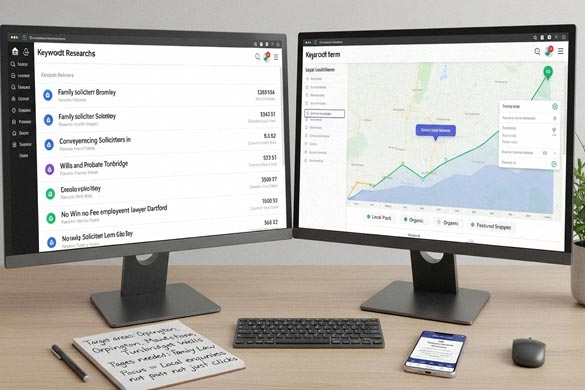
1. Keyword Research Based on Real Searches
- Find the exact terms potential clients are searching for
- Group keywords by service, topic and location
- Prioritise intent-based terms that drive enquiries
- Build a content plan using keywords that convert
2. On-Page SEO and Website Fixes
- Optimise page titles, meta descriptions and heading structure
- Add internal links that guide users and Google
- Improve mobile layout, load speed and accessibility
- Add CTAs to guide visitors to contact you faster
3. Content That’s Clear, Useful and SEO-Friendly
- Write helpful service pages that explain what you do
- Add location references and questions clients ask
- Use bullet points, FAQs and clear structure
- Keep the tone human, not academic or robotic
4. Ethical Link Building for Legal SEO
- Secure backlinks from law-related and trusted sources
- Remove or disavow low-quality or harmful links
- Focus on quality, not quantity
- Build authority without risking penalties
5. Local SEO Support for Search Visibility
- Add location keywords to key pages
- Optimise for “[service] in [location]” searches
- Create town- or area-specific content if needed
- Link SEO with your Google Business Profile
6. SEO Tracking, Reporting and Adjustments
- Monitor rankings, clicks and conversions each month
- Report on what’s improving, and what’s not
- Adjust strategy based on performance data
- Keep your SEO moving forward, not flatlined
Why SEO for Solicitors Is Different
Legal SEO is tricky.
You’ve got SRA rules to follow. You can’t say things that over-promise. And clients are cautious, they need to trust you before they call.
We get that. We’ve worked with legal professionals long enough to know what works, and what breaks trust.
So no gimmicks. No nonsense. Just smart, careful SEO that builds your visibility and reputation online.


SEO Keywords That Matter for Law Firms
Here’s a taste of the search terms we help you rank for:
- “[area] family solicitor”
- “conveyancing solicitors in [location]”
- “no win no fee solicitor [city]”
- “best employment lawyer near me”
- “wills and probate solicitor [town]”
- “law firm near me for [service]”
We don’t just chase traffic. We chase enquiries. Because that’s what keeps your practice growing.
What You’ll Get
- Higher rankings on Google
- Better quality leads
- More enquiries from people ready to take action
- A faster, clearer, easier-to-navigate website
- A content plan that supports long-term visibility
This is proper digital marketing for legal services, done right.

How This Helps Your Bottom Line
- Less reliance on referrals
- Lower cost-per-lead over time
- No need to run ads just to stay visible
- A stronger online brand, backed by trust and clarity
And yes, it means your competitors stop hoovering up the local Google traffic while you sit on page two.
Law Firm SEO FAQs: Complete Guide for UK Solicitors and Lawyers
74% of law firms believe they’ve wasted money on marketing campaigns that failed to deliver results.
Yet 96% of people seeking legal advice start with an online search.
This guide answers every SEO question you have, so you can finally get marketing that actually works.
What is SEO, and why is it important for law firms?
Search Engine Optimisation (SEO) is the process of improving your law firm’s website to rank higher in search results when potential clients search for legal services.
For law firms, SEO is crucial because 96% of people seeking legal advice begin their search online. If your firm doesn’t appear on the first page of Google, you’re invisible to potential clients.
The numbers speak for themselves:
- 66% of call conversions in the legal industry come from organic search
- Organic search generates 53% of all law firm website visitors
- The top 3 search results capture nearly 70% of all clicks
Without SEO, you’re handing potential clients directly to your competitors.
How does SEO work for law firm websites?
SEO works by making your website more attractive to search engines like Google. When someone searches for “personal injury solicitor Manchester” or “divorce lawyer near me,” Google scans millions of web pages to find the most relevant and trustworthy results.
Search engines look at three main factors:
Content Quality: Does your website answer the questions potential clients are asking? Google favours comprehensive, helpful content that demonstrates legal expertise.
Technical Performance: Does your website load quickly, work on mobile devices, and have clean code? 47% of law firm websites fail Google’s recommended page load speed of 3 seconds.
Authority and Trust: Do other reputable websites link to yours? Do you have positive reviews? 99.2% of top-ranking websites have at least one external link.
The process involves optimising your website’s content, structure, and technical elements whilst building your online reputation through reviews and backlinks.
Why do lawyers need SEO?
Lawyers need SEO because client behaviour has fundamentally changed. Traditional marketing methods like Yellow Pages adverts and networking events, whilst still valuable, are no longer sufficient for sustainable growth.
Consider these facts:
- 93% of web traffic comes through search engines
- 46% of all Google searches are location-based (perfect for local law firms)
- 58% of prospective clients use “near me” qualifiers when searching for legal representation
- 75% of users never scroll past the first page of search results
Law firms that invest in SEO consistently outperform competitors in client acquisition. The average 3-year ROI for law firm SEO is 526%, with some firms seeing a 266% increase in cases within the first year.
Without SEO, you’re invisible when potential clients need you most.
What are the key components of a successful law firm SEO strategy?
A successful law firm SEO strategy requires five essential components:
Local SEO and Google Business Profile: Critical for law firms since 46% of Google searches are local. Your Google Business Profile must be complete and optimised. Businesses with complete profiles are 70% more likely to attract visits.
Practice Area Content: Comprehensive pages covering your legal services. Law firms with blogs generate 68% more qualified leads than those without. Content should demonstrate expertise whilst remaining accessible to potential clients.
Technical SEO: Your website must be fast, mobile-friendly, and secure. 60% of searches are conducted on mobile devices, so mobile optimisation is non-negotiable.
On-Page Optimisation: Proper use of keywords, meta tags, headers, and internal linking. This helps search engines understand what your pages are about.
Link Building and Authority: Earning links from reputable legal directories, local businesses, and industry publications. High-authority backlinks remain one of the strongest ranking factors.
Each component works together to build your online presence and establish your firm as a trusted authority in your practice areas.
How long does it take to see results from SEO for law firms?
SEO is a long-term strategy that requires patience. Most law firms begin seeing initial results within 3-6 months, but significant improvements typically take 6-12 months.
The timeline depends on several factors:
Your starting point: New websites take longer than established ones. If you’ve never invested in SEO, expect a longer timeline.
Competition level: Personal injury and family law are highly competitive, requiring more time and investment. Niche practice areas may see faster results.
Investment level: Firms investing more in content creation and optimisation see faster results. It takes around 14 months for law firms to break even on SEO investments, but the long-term returns are substantial.
Consistent effort: SEO requires ongoing work. Firms that publish regular content and continuously optimise see better results than those with sporadic efforts.
Early indicators (1-3 months): Improved Google Business Profile visibility, better mobile performance, increased website speed.
Meaningful results (3-6 months): Higher rankings for some keywords, increased organic traffic, more website enquiries.
Significant growth (6-12 months): Top rankings for target keywords, substantial traffic increases, measurable ROI.
Remember: SEO builds momentum over time. The firms that start today will have a significant advantage over those that wait.
How much does SEO for law firms typically cost?
SEO costs vary significantly based on your firm’s size, location, and goals. Here’s what you can expect:
- Small firms: £1,000 – £3,000 per month
- Medium firms: £3,000 – £8,000 per month
- Large firms: £8,000 – £15,000+ per month
Factors affecting cost:
Practice area competition: Personal injury and family law require higher investment due to intense competition. Business law or niche areas typically cost less.
Geographic market: London firms face more competition than regional practices, requiring larger budgets.
Current website condition: Older websites needing technical fixes require additional investment upfront.
Scope of services: Basic local SEO costs less than comprehensive national campaigns with aggressive content creation.
Agency expertise: Experienced legal SEO specialists command premium pricing but deliver better results. The average cost per SEO lead is £456, making it cost-effective compared to other marketing channels.
What’s included: Professional SEO services should include technical audits, content creation, local optimisation, link building, and detailed reporting.
Avoid agencies offering SEO for under £500 per month – quality SEO requires significant time and expertise.
Can my law firm do SEO on its own, or should we hire experts?
Whilst basic SEO tasks can be done in-house, effective law firm SEO requires specialist expertise that most legal professionals lack.
Challenges of DIY SEO:
Time investment: SEO requires 10-20 hours per week minimum. The average lawyer charges £284-£306 per hour compared to £135 for SEO specialists – the opportunity cost is enormous.
Technical complexity: Modern SEO involves technical website optimisation, schema markup, page speed improvements, and mobile optimisation. 47% of law firm websites have poor mobile responsiveness due to technical oversights.
Regulatory compliance: Legal marketing has strict rules. The SRA prohibits unsolicited approaches and requires advertising to be accurate and not misleading. Many generalist SEO agencies don’t understand these requirements.
Algorithm changes: Google updates its algorithm hundreds of times yearly. Specialists stay current with changes that could affect your rankings.
Content expertise: Creating compelling legal content that ranks well and converts visitors requires understanding both SEO and legal marketing psychology.
Why hire specialists:
Faster results: Experienced agencies avoid common mistakes and implement proven strategies.
Better ROI: Firms working with experienced agencies see 21% higher annual organic traffic growth.
Compliance assurance: Legal SEO specialists understand SRA regulations and ensure compliant marketing.
Ongoing optimisation: SEO requires constant monitoring and adjustment based on performance data.
28% of legal businesses already outsource SEO to agencies or consultants, recognising the value of specialist expertise.
What are the best SEO techniques specifically for legal websites?
Legal websites require specialised SEO techniques that differ from other industries due to Google’s “Your Money or Your Life” (YMYL) classification for legal content.
E-E-A-T Optimisation: Google evaluates legal content based on Experience, Expertise, Authoritativeness, and Trustworthiness. Your content must demonstrate genuine legal expertise.
Practice Area Silos: Organise your website into clear practice area sections (family law, personal injury, business law) with comprehensive content for each service.
Local SEO Mastery: 93% of the time, Google’s local 3-pack appears before regular search results for local searches. Optimise for “solicitor near me” and location-specific terms.
Long-Form Content: Content exceeding 2,000 words performs 10x better in rankings than shorter pieces. Create comprehensive guides that answer common legal questions.
FAQ Pages and Schema: Answer common client questions and use FAQ schema markup to appear in featured snippets. 19% of search results contain featured snippets.
Client Testimonials and Case Studies: Incorporating testimonials improves conversion rates by 34%. These also provide local relevance signals to Google.
Mobile-First Design: 63% of organic search visits come from mobile users. Your website must provide an excellent mobile experience.
Local Citations: Ensure consistent NAP (Name, Address, Phone) across legal directories like Solicitors Regulation Authority directory, Law Society listings, and local business directories.
Video Content: Including video on landing pages increases conversion rates by 86%. Consider client testimonials, FAQ videos, and practice area explanations.
How do I find the best law firm SEO company or consultant?
Choosing the right SEO partner is crucial for your firm’s success. Here’s how to evaluate potential providers:
Look for legal specialisation: 28% of lawyers report that legal directory listings help attract clients. Choose lawyer marketing agencies that understand the legal industry’s unique challenges and opportunities.
Verify their expertise:
- Do they understand SRA advertising regulations?
- Can they provide case studies from law firms?
- Do they offer compliance-focused strategies?
Essential questions to ask:
What’s your experience with law firms? They should have multiple legal clients and understand practice area nuances.
How do you ensure SRA compliance? They should understand restrictions on unsolicited approaches and advertising requirements.
What’s included in your service? Comprehensive packages should include technical SEO, content creation, local optimisation, and link building.
How do you measure success? Look for agencies that track qualified leads, not just rankings or traffic.
Can you provide references? Speak to current law firm clients about their results and experience.
Red flags to avoid:
- Guaranteed rankings (no one can guarantee #1 positions)
- Extremely low prices (under £500/month)
- Lack of legal industry experience
- Unclear reporting or metrics
- No understanding of legal marketing regulations
Questions about their process:
- How do you conduct keyword research for legal terms?
- What’s your content creation process?
- How do you handle local SEO for multiple office locations?
- What link building strategies do you use for law firms?
Choose agencies that offer transparent communication, regular reporting, and proven experience with legal clients.
What keywords should law firms target in their SEO campaigns?
Effective keyword targeting requires understanding how potential clients search for legal services. 74% of consumers use search engines to find legal advice.
Types of keywords to target:
Service + Location keywords:
- “divorce solicitor Manchester”
- “personal injury lawyer Birmingham”
- “employment law specialist London”
“Near me” searches: 58% of legal service searches include location qualifiers
- “family lawyer near me”
- “criminal defence solicitor near me”
- “conveyancing solicitor near me”
Question-based keywords:
- “How much does divorce cost UK”
- “What to do after car accident”
- “Can I claim compensation for workplace injury”
Practice area keywords:
- “Medical negligence compensation”
- “Commercial property law”
- “Employment tribunal representation”
Long-tail keywords (3+ words):
- More specific, less competitive
- Higher conversion rates
- “No win no fee personal injury claims”
Keyword research process:
Start with your services: List every legal service you provide.
Add location modifiers: Include your city, region, and surrounding areas.
Consider client language: Use terms clients use, not legal jargon.
Analyse competitor keywords: See what successful competitors target.
Use keyword tools: Research search volume and competition levels.
Focus on commercial intent: Target keywords indicating someone ready to hire a solicitor.
Keyword targeting tips:
Primary keywords: 1-2 main keywords per page Supporting keywords: Related terms and variations Content depth: Content over 2,000 words performs 10x better User intent: Match content to what searchers actually want
Remember: Target keywords your ideal clients actually use, not terms that sound impressive to other lawyers.
Legal Marketing Services To Grow Your Law Firm
Ready to Rank Higher and Grow?
SEO doesn’t have to be complicated. It just has to be done properly, by people who understand how law firms work.
Book a Free Call. Let’s look at where you’re ranking, where you’re not, and what needs fixing to start bringing in leads.