
Why “Near Me” Searches Are Your Law Firm’s Best Friend (And How Most Solicitors Are Missing Out)
How to Optimise for “Near Me” Searches – Contextual Answers for Lawyers
Pick the tab that fits your situation. Short, clear steps. All actions are SRA-friendly and map to real KPIs.
General
Do four things well: Google Business Profile, local pages, consistent citations, and steady 5-star reviews. That mix drives visibility in the map pack and wins nearby calls.
- Complete every GBP field, add photos, choose accurate categories.
- Create city or neighbourhood pages with clear services and contact details.
- Match name, address, phone everywhere you’re listed.
- Ask happy clients for reviews and reply to each one.
Here’s something that’ll make you sit up: nearly 1 in 3 mobile searches are looking for something nearby[1].
When someone types “divorce lawyer near me” into their phone at 11pm, they’re not browsing. They’re ready to hire.
Yet most law firms treat “near me” searches the same as any other local SEO work. That’s a mistake. These searches are different. They convert differently. They require different tactics. And if you get them right, 76% of people who search will visit or call a business within 24 hours[3].
This guide shows you exactly how to rank for “near me” searches. Not general local SEO advice. Specific strategies for capturing people who are searching right now, from their phones, looking for a solicitor in your area.
Understanding effective marketing for law firms means recognizing that “near me” searches represent your highest-converting traffic source – more valuable than driving general traffic to your website. These searches capture clients actively seeking legal services at the exact moment they need help.
Understanding “Near Me” Search Behaviour: Why People Search This Way
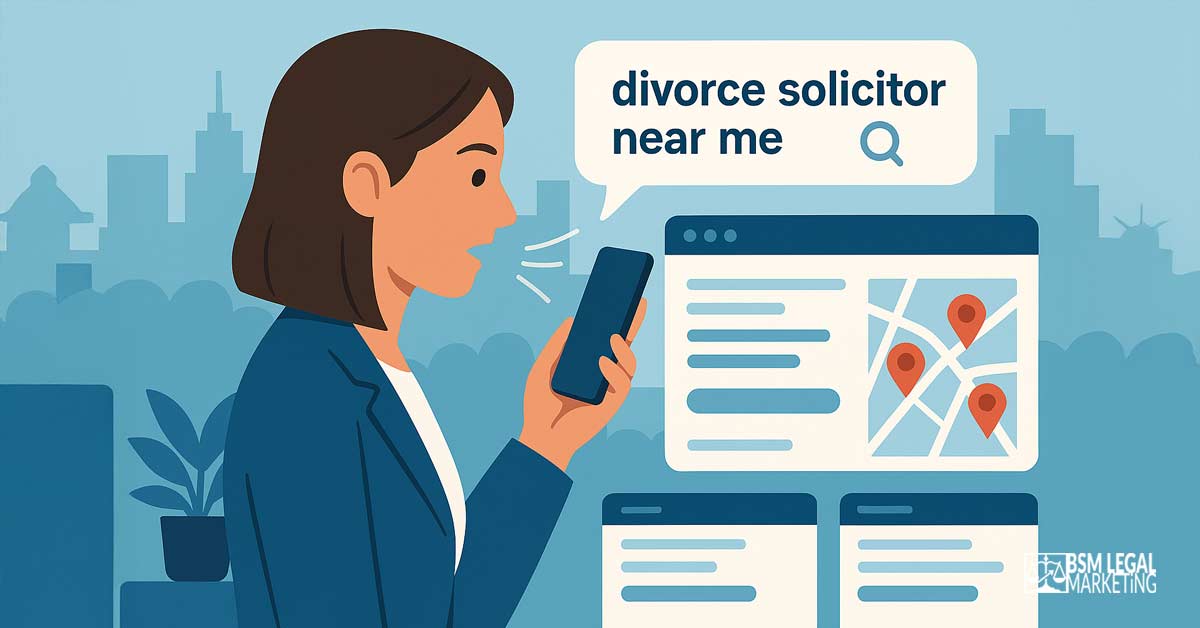
Let me ask you something. When was the last time you typed your full postcode into Google?
You didn’t. You typed “near me.”
This is how people search now. It’s faster. It’s easier. And most importantly, it tells Google exactly what they want: something close by, available now.
Understanding this behaviour is crucial for local SEO for lawyers because these searches represent the highest-intent prospects you’ll ever encounter.
The Psychology Behind “Near Me” vs Typing a Location
When someone searches “solicitor Manchester,” they’re researching. They might be comparing firms. They could be at work, planning ahead.
But “solicitor near me“? That’s urgency. That’s intent. That person is in their car, or on their sofa, and they need help soon.
The difference matters because these searches convert at completely different rates. A “near me” search is mobile-first, intention-heavy, and often made during what we call “micro-moments,” those split seconds when potential clients search for legal services and make quick decisions about which firm to contact.
Most people prefer to work with lawyers who are genuinely local to them. Physical proximity builds trust and makes face-to-face consultations easier. Search engines like Google understand this psychology, which is why they prioritize truly local results for “near me” queries.
Device Usage Patterns Tell the Story
Here’s the data: 57% of all local searches happen on mobile devices[4]. But for “near me” searches specifically, that figure jumps much higher.
Think about it. You’re not sitting at your desktop typing “employment lawyer near me.” You’re on your phone. You’ve just been made redundant. You’re angry, you’re worried, and you want answers now.
This mobile-first reality changes everything about how you optimise your online presence.
Voice Search Makes “Near Me” Even More Critical
27% of the global online population now uses voice search on mobile[2]. When people talk to their phones, they don’t say “divorce solicitors in Leeds.” They say “find me a divorce lawyer.”
Voice search is conversational. It’s natural language. And it almost always includes location intent, even when people don’t explicitly say “near me.”
The Urgency Factor in Legal “Near Me” Searches
Legal searches carry more urgency than almost any other professional service. Someone searching “personal injury lawyer near me” has likely just had an accident. “Criminal solicitor near me” might mean they’ve been arrested.
88% of smartphone users who do a local search visit or call a business within 24 hours[5]. For legal services, I’d wager that figure is even higher.
You’re not competing on price at this point. You’re competing on proximity, availability, and trust. Your visibility in local search results determines whether that potential client calls you or the firm listed above you.
“Near Me” Search Intent vs Traditional Local Searches
| Search Type | Device Used | Intent Level | Conversion Window | Typical User Mindset |
|---|---|---|---|---|
| “Lawyer near me” | 85%+ mobile | High (immediate need) | Within 24 hours | Urgent, ready to contact |
| “Solicitors [City Name]” | 60% mobile | Medium (researching) | 3-7 days | Comparing options |
| “[Practice Area] lawyer” | 50% mobile | Low (early research) | 1-4 weeks | Gathering information |
The fundamental difference in these search patterns explains why local search engine optimisation requires distinct tactics for “near me” queries versus traditional law firm SEO approaches.
Keyword Research Specifically for “Near Me” Queries
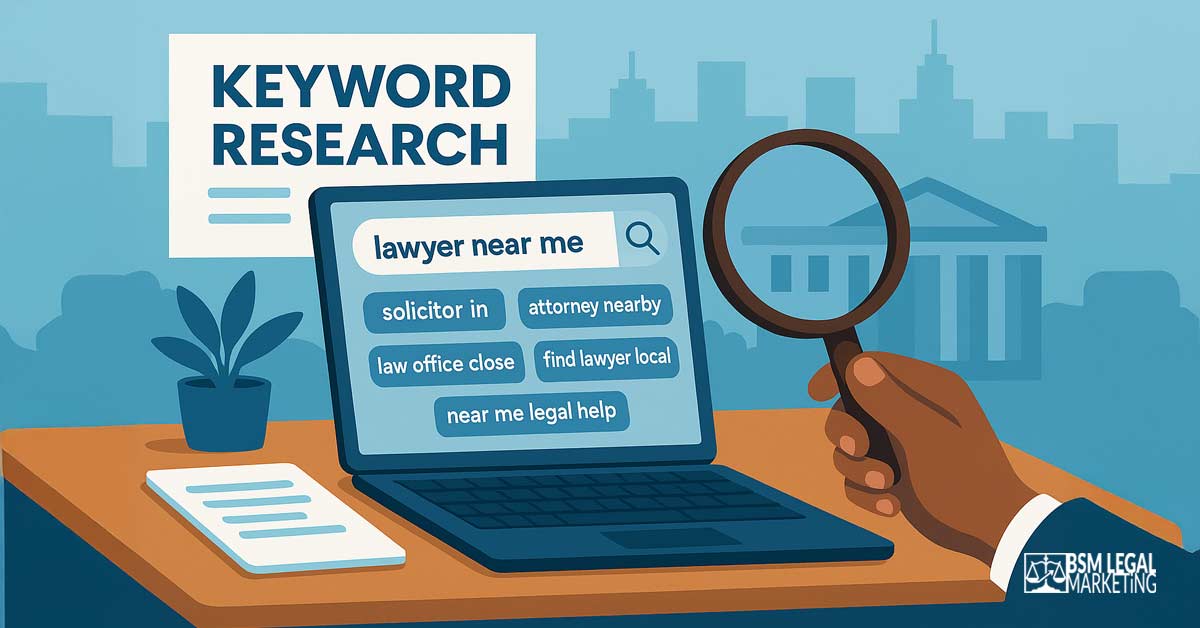
Let’s talk about the words people actually use when they’re searching for legal help nearby.
Most law firms make a fundamental error here. They optimise for terms like “family law solicitor London” and think they’ve covered local search. But “near me” queries are a completely separate category with distinct search engine optimisation requirements.
Core “Near Me” Variations for Legal Services
The obvious one is “[practice area] lawyer near me.” But people phrase things dozens of different ways:
- “solicitor near me”
- “family lawyer close by”
- “immigration solicitor nearby”
- “find a divorce lawyer near me”
- “local employment solicitor”
Each variation gets searched. Each one represents a potential client. These are the terms that help law firms capture immediate intent from people actively seeking representation.
The key is understanding that “near me” isn’t always explicit. Google understands location intent even when someone just types “solicitor” on their phone. The search engine knows where they are and shows local results.
Long-Tail “Near Me” Combinations That Actually Get Searched
Here’s where it gets interesting. People combine “near me” with specifics:
- “no win no fee personal injury lawyer near me”
- “solicitor near me open now”
- “best divorce lawyer near me reviews”
- “cheap solicitor near me”
- “emergency lawyer near me”
That last one? “Open now near me” searches have grown 400% in recent years[5]. If your Google Business Profile doesn’t show your hours accurately, you’re invisible for these high-intent searches.
Voice Search Friendly Phrases People Actually Say
When someone speaks to their phone, they use complete sentences. They ask questions:
- “Where can I find a solicitor near me?”
- “Who’s the best family lawyer close to me?”
- “Is there a criminal solicitor open near me right now?”
- “Show me will writing solicitors nearby”
These conversational queries require different optimisation. Your content needs to answer questions naturally, not just stuff keywords.
Research Tools and Search Volume Data
Use Google’s autocomplete. Start typing “lawyer near me” and watch what appears. Those suggestions are real searches from real people.
Google Search Console shows you exactly which “near me” terms people used to find you. Filter by queries containing “near me” and you’ll see your current performance.
Tools like Semrush and Ahrefs can show you estimated search volumes, but remember: there are 5.9 million “near me” keywords with 800 million monthly searches globally[5]. The UK market is substantial.
Building a strong local online presence starts with understanding exactly which phrases your potential clients use when they search for legal services in your area.
Top “Near Me” Keywords for Law Firms (UK Context)
| Keyword | Search Intent | Typical User Need | Optimisation Priority |
|---|---|---|---|
| [Practice area] solicitor near me | High intent | Immediate consultation | Critical |
| Lawyer near me | General inquiry | Uncertain of speciality | High |
| [Practice area] lawyer near me open now | Emergency | After-hours help | High |
| Best [practice area] solicitor near me | Comparison shopping | Quality-focused | Medium |
| Cheap solicitor near me | Price-focused | Budget constraints | Low-Medium |
| Free consultation lawyer near me | Risk mitigation | Testing waters | Medium |
Content Strategy for “Near Me” Visibility

You can’t just sprinkle “near me” into your existing content and expect results. These searches need dedicated content built specifically for location intent.
Effective SEO strategies for law firms must address the unique behaviour of “near me” searchers, who are typically on mobile devices and need immediate answers. Optimizing your law firm’s online content for these queries requires a fundamentally different approach from traditional website optimisation.
Writing for “Near Me” Intent vs General Local Intent
General local content talks about your firm’s history, your team, your approach. That’s fine for your main pages.
But “near me” content is different. It needs to answer the immediate question: “Can this solicitor help me right now?“
Your content should include:
- Your exact location and areas you serve
- Your response time for new enquiries
- Whether you offer same-day consultations
- If you’re available for emergency calls
- How quickly you can take on a new case
Someone searching “near me” doesn’t want your founding partner’s biography. They want to know if you’re actually near them and if you’re available. This content acts as a direct signal to search engines about your local relevance and availability.
Make it immediately clear what services your firm offers. If someone lands on your page from a “family lawyer near me” search, they should see family law mentioned prominently within the first few seconds.
FAQ Optimisation for Conversational Queries
41% of US adults use voice search daily[2]. That trend is growing rapidly in the UK.
Your FAQ section is the perfect place to capture these conversational searches. Structure it around questions people actually ask:
Not this: “What services do we offer?”
This: “Can I find a family solicitor near me who handles divorce cases?”
Not this: “Our consultation process”
This: “How quickly can I see a solicitor near me?”
Answer these questions directly and concisely. The first sentence should restate the question and provide the answer. This format increases your chances of appearing in Google’s AI overviews and voice search results.
Emergency and Urgent Content Targeting
28% of “near me” searches result in a purchase[5]. For legal services, “purchase” means instruction.
Create dedicated pages for urgent scenarios:
- “Emergency Solicitor Services in [Your Area]”
- “Same-Day Legal Consultations Available”
- “Out of Hours Legal Advice”
These pages should have prominent phone numbers (click-to-call on mobile), clear availability information, and reassurance that you handle urgent cases.
This type of targeted content is essential for effective SEO strategies for lawyers who want to capture high-intent searches and appear prominently in search engine results when people need immediate legal help.
Local Landing Page Optimisation
If you serve multiple locations, you need location-specific pages. Not one page listing ten towns. Separate, substantial pages for each area.
Each page needs:
- The location name in the H1 and title tag
- Local landmarks and context (near the town hall, close to the train station)
- Genuine local content, not just templated text
- Local testimonials if possible
- Directions and parking information
Google can spot thin location pages a mile off. Put effort into making each one genuinely useful for someone in that area. These pages are essential for building visibility in local search results across multiple service areas.
Being listed in relevant online directories also strengthens your local presence. Make sure your firm appears in legal-specific directories like the Law Society’s Find a Solicitor tool, as well as general business directories like Yell and Thomson Local.
Each location page should clearly display your firm’s name, full address, and phone number for that specific office. This NAP consistency across your law firm’s website and all directory listings is crucial for local search performance.
Voice Search optimisation Tactics
93.7% of voice queries can be answered by voice assistants[2]. To capture these:
- Use natural language in your content
- Answer specific questions clearly
- Include long-tail conversational phrases
- Structure content with clear headings that mirror questions
- Keep paragraphs short and scannable
Voice search results tend to be extracted from content that’s formatted as direct answers. Think about how someone would speak the question, then answer it immediately and clearly.
Google Business Profile Tactics for “Near Me” Dominance
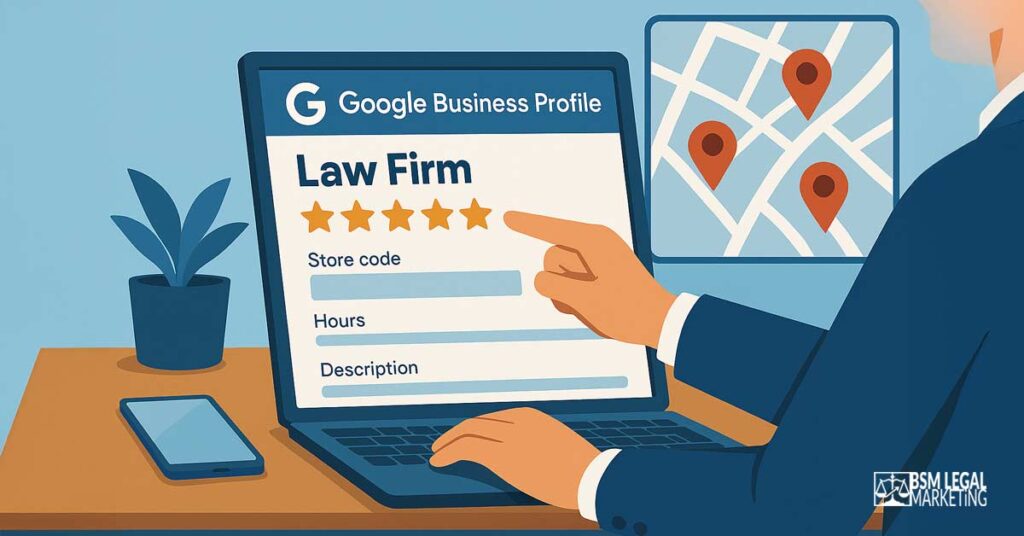
Your Google Business Profile is the single most important factor for ranking in “near me” searches. Not your website. Your GBP.
42% of people who search click on Google Map Pack results[8]. If you’re not in that pack, you’re missing nearly half your potential clients.
Understanding how local SEO helps you appear in these prime positions is crucial. Your Google Business Profile directly influences whether you’re showing up in the local pack when potential clients search for legal services nearby.
Service Area Settings and Radius Optimisation
This trips up so many law firms. You need to set your service areas correctly.
Google lets you specify either:
- A physical location where clients visit you
- A service area where you travel to clients
For most solicitors, it’s option one. You have an office. Clients come to you.
But you also need to define your service area, the radius around your office where you’ll take cases. Don’t be vague. Google’s official guidance[7] says to be specific about where you serve clients.
If you only take cases in Greater Manchester, don’t set your service area to include Liverpool. Google will recognise that mismatch and may reduce your visibility.
Accurate service area settings work alongside your local business listings to establish clear geographic relevance, which is essential for ranking in local search results.
The Q&A Section Nobody Uses (But You Should)
Your Google Business Profile has a Questions & Answers section (at the time of writing). Most firms ignore it. That’s a mistake.
This section is perfect for “near me” optimisation because you can pre-emptively answer the questions people are asking:
- “Are you open on Saturdays?”
- “Do you offer free initial consultations?”
- “Can I get a same-day appointment?”
- “Do you help with [specific legal issue]?”
You can add these questions yourself and answer them. Google shows these answers in your profile. They also appear in search results sometimes.
Posts Using “Near Me” Language Naturally
Google Business Posts appear in your profile and in local search results. Most firms use them for generic updates.
Use them strategically:
“Looking for a family solicitor near you in Leeds? We have same-day consultations available this week. Call us on [number].”
“Need an employment lawyer nearby? Our Stockport office is 2 minutes from the train station with free parking.”
Keep posts short, include a clear call to action, and update them weekly. Fresh posts signal that you’re active and available.
Optimising for the Local Pack
The Local Pack (that box of three businesses with a map) is prime real estate. 72% of consumers who do a local search visit a store within 5 miles[5].
To rank in the Local Pack for “near me” searches:
- Complete every section of your Google Business Profile (100% completion matters)
- Choose the most specific business categories
- Get consistent reviews (respond to all of them)
- Post regularly
- Ensure your NAP (Name, Address, Phone) is identical across the web
- Add photos frequently
Google’s ranking factors for local pack focus heavily on relevance, distance, and prominence. You need to tick all three boxes.
Technical SEO for “Near Me” Search Capture
Right, let’s talk about the technical bits. This is where a lot of law firms fall down because it’s not visible like content is. But it matters.
Effective on-page SEO combined with technical optimisation creates the foundation for strong “near me” search performance.
Schema Markup for “Near Me” Queries
Schema markup is code that helps Google understand your website better. For local search, you need LocalBusiness schema at a minimum.
This tells Google:
- Your business name
- Your address
- Your phone number
- Your opening hours
- What type of business you are
But go further. Add LegalService schema and Attorney schema. These specific types tell Google you’re a law firm and what services you offer.
Google’s official guidance[7] on local ranking factors includes structured data as a relevance signal.
You don’t need to understand code. Tools like Schema App or your web developer can add this for you. Just make sure it’s there.
Mobile Speed Optimisation: Critical for “Near Me”
Smartphones account for 56% of voice search usage[9]. Your website needs to load fast on mobile. Not “quite fast.” Lightning fast.
Google’s Core Web Vitals measure this. Your targets:
- Largest Contentful Paint (LCP): under 2.5 seconds
- First Input Delay (FID): under 100 milliseconds
- Cumulative Layout Shift (CLS): under 0.1
Use Google’s PageSpeed Insights tool to test your site. If your mobile score is under 90, you have work to do.
Common fixes:
- Compress images (most law firm sites use massive photos)
- Enable browser caching
- Minify CSS and JavaScript
- Use a content delivery network (CDN)
Someone searching “lawyer near me” on their phone will bounce if your site takes 5 seconds to load. They’ll call the next result instead.
A slow-loading law firm’s website costs you clients every single day. Speed isn’t just a technical nicety – it’s a competitive advantage that directly impacts whether prospects contact you or move on to a faster competitor.
Location Detection and Geo-Targeting
When someone visits your website from a mobile device, you can detect their approximate location. Use this intelligently.
If someone in Birmingham lands on your Manchester law firm site, show them a message: “Based in Birmingham? We also have an office at [address] just 15 minutes from the city centre.“
This is geo-targeted content. It’s not cloaking (showing Google different content than users). It’s showing users relevant location information based on where they actually are.
Tools like GeotargetingWP or simple JavaScript can do this. Just don’t overdo it. It should feel helpful, not creepy.
Core Web Vitals Impact on Mobile “Near Me” Searches
Google confirmed that Core Web Vitals are a ranking factor. For mobile searches (which most “near me” queries are), this matters even more.
Your mobile experience needs to be:
- Fast to load
- Easy to tap (buttons big enough for fingers)
- No intrusive interstitials (popups that cover content)
- Readable without zooming
- Click-to-call phone numbers prominent
Test your site on an actual phone. Not just Chrome’s mobile emulator. A real phone. If it’s frustrating for you, it’s frustrating for clients.
Mobile Technical Requirements for “Near Me” Search Success
| Technical Factor | Target Benchmark | Why It Matters for “Near Me” | How to Check |
|---|---|---|---|
| Page Load Speed | Under 3 seconds | Mobile users won’t wait; 53% abandon sites that take >3s | Google PageSpeed Insights |
| Mobile Responsiveness | 100% mobile-friendly | Most “near me” searches are on phones | Google Mobile-Friendly Test |
| Click-to-Call Functionality | Working on all devices | Direct conversion path for urgent queries | Manual testing on mobile |
| Secure Connection (HTTPS) | 100% of pages | Trust signal; required for location data | Check URL bar for padlock |
| Structured Data Validation | Zero errors | Helps Google understand your location and services | Google Rich Results Test |
| Geographic Coordinates | Precise lat/long in code | Improves distance calculations in search | Validate in your schema markup |
Advanced “Near Me” Strategies That Actually Work
Once you’ve got the basics sorted, these advanced tactics separate firms that dominate “near me” searches from those that just participate.
These local SEO strategies for law firms require more effort but deliver significantly better results for firms serious about growth.
Multi-Location Optimisation When You Have Several Offices
If you have offices in multiple cities, you need a location page for each one. Not a single page listing all offices. Separate, properly optimised pages.
Each office also needs its own Google Business Profile. Don’t try to use one profile for multiple locations. Google will penalise you.
The structure should be:
- Main website: yourfirm.co.uk
- Manchester office: yourfirm.co.uk/manchester/
- Leeds office: yourfirm.co.uk/leeds/
Each location page needs:
- Unique content (not the same text repeated)
- Local address and phone number
- Office-specific team members
- Local directions and parking
- Reviews and testimonials from clients in that area
This is called “location-specific landing pages” and it’s how national firms compete in local “near me” searches.
Hyperlocal Content Creation
Go smaller than city-level. Create content for specific neighbourhoods.
“Family Solicitor in Didsbury, Manchester” “Divorce Lawyer Serving Jesmond, Newcastle“
These hyperlocal pages target people searching in very specific areas. The search volume is lower, but the intent is even higher and competition is often weaker.
Include local landmarks, mention nearby streets, reference the local community. Google’s algorithm is sophisticated enough to understand genuine local content from keyword-stuffed rubbish.
Building local backlinks from community organizations, local business associations, and area-specific websites further strengthens your hyperlocal authority. A link from your local chamber of commerce or a community news site sends powerful local relevance signals to search engines.
Voice Search Preparation: Conversational Content
32% of consumers use voice search daily[9]. This percentage is growing every year.
Voice search queries are longer and more conversational than typed searches. Someone might type “employment lawyer Manchester” but say “find me an employment lawyer near me who handles redundancy cases.”
Your content needs to match this natural language:
Typed search optimisation: “Our Manchester office handles employment law cases including redundancy, discrimination, and unfair dismissal.“
Voice search optimisation: “Looking for an employment lawyer in Manchester who can help with redundancy? We handle cases across Greater Manchester and offer same-day consultations.“
The second version sounds more natural when read aloud and matches how people actually speak.
Optimising for AI and Semantic Search
Google doesn’t just match keywords anymore. It understands meaning and context.
This is called “semantic search.” If someone searches “lawyer near me,” Google knows they might also be interested in “solicitor near me,” “legal advice nearby,” or “attorney close by.”
Your content should include related terms naturally. Not keyword stuffing. Natural semantic relationships.
Tools like Frase or SurferSEO can analyse top-ranking pages and show you semantically related terms to include. But honestly, if you write naturally about your services and location, you’ll include most of these anyway.
Competitive Analysis for “Near Me” Terms
Look at who’s ranking when you search “solicitor near me” from different locations in your area.
Use a tool like BrightLocal or simply browse in incognito mode with location services enabled.
What are your competitors doing?
- How complete is their Google Business Profile?
- How many reviews do they have?
- What content do they have on their website?
- Are they using location-specific pages?
You don’t need to copy them. But you need to know what you’re up against and where the gaps are.
Measuring “Near Me” Performance: The Metrics That Actually Matter
Right. You’re doing all this work. How do you know if it’s working?
Most law firms track the wrong things. Website visits don’t pay the bills. Clients do.
Specific Metrics for “Near Me” Queries
Google Search Console is your best friend here. Filter your queries to show only terms containing “near me.”
Track:
- Impressions (how many times you appeared in search results)
- Clicks (how many people actually clicked through)
- Average position (where you rank, on average)
- Click-through rate (what percentage of people who see you, click)
Do this monthly. Watch the trends. If impressions are going up but clicks aren’t, your meta descriptions need work. If you’re ranking well but getting no clicks, your Google Business Profile might be the issue.
Google Analytics Segments for “Near Me” Traffic
Set up a custom segment in Google Analytics for traffic from “near me” searches.
Go to Acquisition > All Traffic > Source/Medium and filter for Google organic traffic. Then create a segment that includes only sessions where the landing page contains “near me” terms or where the user came from “near me” queries.
Watch:
- How long they stay on site (engagement)
- What pages they visit (interest level)
- Whether they convert (contact form, phone call)
If “near me” traffic has a higher bounce rate than other traffic, your landing pages aren’t meeting their immediate needs.
Search Console Analysis for “Near Me” Terms
Search Console shows you exactly which “near me” terms people use to find you.
You might be surprised. People search things you’d never expect:
- “solicitor near me cheap”
- “lawyer near me free consultation”
- “best family solicitor near me reviews”
These searches reveal what matters to your potential clients. Price, availability, reviews.
Use this intelligence to adjust your content and Google Business Profile to address these specific concerns.
Conversion Tracking: Calls, Forms, and Instructions
This is the big one. How many “near me” searchers actually become clients?
You need to track:
- Phone calls from mobile devices (use call tracking software)
- Contact form submissions
- Directions requests in Google Business Profile
- Actual instructions (your practice management system)
Connect the dots backwards. If 100 people searched “divorce lawyer near me” and found you, how many called? How many of those became clients? What’s the value of those clients?
This is your ROI from “near me” optimisation.
Call Tracking for Attribution
Use a service like CallRail or ResponseTap. They give you unique phone numbers to put on your website.
When someone calls that number, you know they came from your website (not a referral, not an existing client).
Better still, these tools can track which page they were on when they clicked to call. If they came from your “solicitor near me” landing page, you know that’s what drove the call.
You can then calculate: “We spent £X on optimising for ‘near me’ searches. It generated Y calls. Z became clients. Total value: £.”
That’s how you prove marketing works.
“Near Me” Optimisation Performance Metrics
| Metric Category | Specific Metric | What It Tells You | Target Benchmark | Tracking Tool |
|---|---|---|---|---|
| Visibility | “Near me” impressions | How often you appear | Month-on-month growth | Google Search Console |
| Rankings | Average position for “near me” terms | Where you rank | Position 1-3 (Local Pack) | Google Search Console |
| Engagement | Click-through rate | How compelling your listing is | >5% for top positions | Google Search Console |
| Local Discovery | Google Business Profile views | Profile visibility | Growing weekly | GBP Insights |
| Conversion | Phone calls from “near me” traffic | Direct response | >10% of traffic | Call tracking software |
| Conversion | Contact forms from “near me” pages | Digital enquiries | >3% of page visitors | Google Analytics |
| Business Impact | Client instructions from “near me” | Actual ROI | Client-value dependent | CRM + attribution |
Common “Near Me” Optimisation Mistakes Law Firms Make

Let’s talk about what not to do. I see these mistakes constantly.
Over-optimisation and Keyword Stuffing
Writing “If you’re searching for a solicitor near me, our solicitor near me services are the best solicitor near me option” makes you sound like a robot.
Google’s algorithm is smart enough to understand natural language. Write for humans. Mention your location and services naturally.
If your content feels awkward when you read it aloud, you’ve overdone it. The goal is to enhance your law firm’s online visibility through helpful, genuine content, not to game the system with repetitive phrases.
Ignoring Voice Search Patterns
62% of Americans have used voice assistants[10]. UK adoption is slightly behind but growing fast.
If your content doesn’t answer questions in a natural, conversational way, you’re invisible to voice search.
The fix: write FAQ sections that sound like actual questions. Answer them directly in the first sentence.
Mobile Experience Issues That Kill Conversions
Your website might look great on your desktop. But 57% of local searches are on mobile[4].
Common mobile mistakes:
- Phone number isn’t clickable
- Text too small to read
- Buttons too small to tap
- Forms too long and fiddly on a phone
- Popups that can’t be closed
- Page takes forever to load
Test your site on a phone. If it annoys you, it’s losing you clients.
Inconsistent Local Signals Across the Web
62% of consumers won’t use a business if they find incorrect information about it online[8].
Your Name, Address, and Phone number (NAP) must be identical everywhere:
- Your website
- Google Business Profile
- Legal directories
- Social media profiles
- Citation sites
Not similar. Identical.
If your website says “9 High Street” but your Google Profile says “9 High St,” that’s an inconsistency. Google sees that as two different businesses.
Neglecting Google Business Profile Completely
Some law firms set up their Google Business Profile once and never touch it again.
That’s leaving money on the table.
Your profile needs:
- Weekly posts
- Responses to all reviews (good and bad)
- Updated photos every month
- Accurate hours, especially holidays
- Complete service descriptions
- Regular Q&A updates
An active, well-maintained profile ranks higher than a neglected one.
Not Tracking What Actually Matters
Vanity metrics feel good but don’t pay wages.
“We had 5,000 website visits this month!” Okay, how many became clients?
“We’re number 1 for ‘solicitor in Manchester’!” Great, but are people actually searching that term?
Track business outcomes, not just marketing metrics. Instructions, revenue, client acquisition cost. The rest is just noise.
Your 30-Day “Near Me” Optimisation Action Plan
Right. Theory is nice, but you need a plan you can actually implement.
Here’s exactly what to do in the next 30 days to start ranking for “near me” searches.
Week 1: Audit and Foundation
Day 1-2: Google Business Profile Audit
- Log into your Google Business Profile
- Complete every single section (aim for 100%)
- Verify your business categories (choose the most specific ones)
- Add photos (office, team, logo – at least 10 photos)
- Write a complete business description mentioning your location and services
Day 3-4: Website Mobile Check
- Test your site on Google’s Mobile-Friendly Test
- Use PageSpeed Insights to check mobile load speed
- Manually check your site on your phone
- Make sure phone numbers are click-to-call links
- Verify contact forms work properly on mobile
Day 5-7: NAP Consistency Audit
- List everywhere your business appears online (Google, legal directories, social media)
- Check that your Name, Address, Phone number are exactly the same
- Fix any inconsistencies immediately
- If you’re listed on old addresses or wrong locations, update or remove them
Week 2: Content and On-Page Optimisation
Day 8-10: Create Location-Specific Content
- Write a dedicated “Serving [Your Area]” page
- Include your address, phone number, and service areas
- Add directions, parking information, and local landmarks
- Write naturally about how you serve clients in your area
Day 11-13: Build Your FAQ Section
- List 10 questions people ask about finding a local solicitor
- Answer each question directly (restate the question in the answer)
- Use conversational language like people actually speak
- Focus on availability, location, and how you help clients
Day 14: Optimize Your Contact Page
- Make your phone number huge and clickable on mobile
- Add a map showing your location
- Include a simple contact form (name, email, phone, message – that’s it)
- State your typical response time
Week 3: Technical and Schema Implementation
Day 15-17: Add Schema Markup
- Implement LocalBusiness schema (hire a developer if needed)
- Add LegalService and Attorney schema
- Include your exact coordinates (latitude/longitude)
- Validate using Google’s Rich Results Test
Day 18-20: Technical SEO Fixes
- Enable HTTPS if you haven’t already
- Compress all images on your site
- Set up browser caching
- Test Core Web Vitals and fix any issues
Day 21: Set Up Tracking
- Create a custom segment in Google Analytics for “near me” traffic
- Set up goal tracking for contact form submissions
- If possible, implement call tracking software
- Verify Google Search Console is connected and working
Week 4: Review Generation and Ongoing Maintenance
Day 22-24: Reviews Strategy
- Ask your last 10 satisfied clients for Google reviews
- Set up a simple process to request reviews going forward
- Respond to all existing reviews (even old ones)
- Create a plan to get at least 2-3 reviews per month
Getting positive client reviews is non-negotiable for local search success. The reviews on your Google Business profile are one of the strongest ranking signals, and showing up in the local pack requires a consistent stream of recent, authentic reviews.
Day 25-27: Google Business Profile Posts
- Write and publish your first Google Business Post
- Schedule posts for the next two weeks
- Set a reminder to post weekly going forward
- Include calls-to-action and mention your location
Day 28-30: Monitoring and Reporting
- Set up a simple spreadsheet to track metrics monthly
- Record your current rankings for key “near me” terms
- Note your current number of Google Business Profile views
- Document your baseline so you can measure improvement
30-Day Implementation Checklist
| Week | Primary Focus | Key Actions | Success Indicator |
|---|---|---|---|
| Week 1 | Foundation & Audit | Complete GBP 100%, verify mobile experience, fix NAP | GBP completion score 100%, mobile speed >70 |
| Week 2 | Content Creation | Write location pages, build FAQ section, optimize contact page | 3-5 new location-focused pages live |
| Week 3 | Technical Setup | Add schema markup, improve Core Web Vitals, set up tracking | Zero schema errors, LCP <2.5s, tracking active |
| Week 4 | Reviews & Maintenance | Generate 5+ reviews, create weekly posting schedule | 5 new Google reviews, first 3 posts published |
When to Expand Beyond “Near Me” Focus
“Near me” optimisation is powerful, but it’s not the only thing you should do.
Knowing When You’ve Maximised “Near Me” Potential
You’ll know you’ve done well with “near me” searches when:
- You consistently appear in the Local Pack for your main practice areas
- Your Google Business Profile views are growing month-on-month
- You’re getting regular calls and enquiries from people who found you via “near me” searches
- You rank in positions 1-3 for your primary “near me” keywords
At this point, you need to diversify. You can’t grow forever on “near me” searches alone because there’s a ceiling to how many people search that way in your area.
Once you’re successfully ranking in local search results for immediate-intent queries, it’s time to expand your strategy to capture clients earlier in their research journey.
Integrating with Broader Local SEO Strategy
“Near me” optimisation works best as part of a complete local SEO approach.
You should also invest in:
- Traditional local SEO targeting city and neighbourhood names
- Citation building across legal directories
- Content marketing for broader informational queries
- Link building from local businesses and organizations
Think of “near me” as your immediate capture mechanism. Someone needs help now, they find you. But you also need to be visible for people who are researching earlier in their journey.
Building local backlinks from relevant businesses, legal associations, and community websites creates a strong local authority that benefits all your rankings.
Moving into Practice Area Authority Building
Once you dominate local “near me” searches, build topical authority in your practice areas.
This means creating comprehensive content about your specialisms:
- Detailed guides on legal processes
- Regular blog posts answering common questions
- Case studies and success stories
- Video content explaining complex legal issues
This content won’t directly help your “near me” rankings, but it positions you as an expert. When people research before searching “near me,” they’ll already know your name.
The Long-Term Content and Authority Strategy
Here’s the thing about “near me” searches: they’re competitive in the short term but limited in scale.
For long-term growth, you need content that ranks nationally and builds your reputation beyond your immediate geographic area.
This might include:
- Thought leadership articles
- Commentary on legal changes and case law
- Educational resources and downloadable guides
- Webinars and speaking engagements
The goal is that when someone eventually searches “solicitor near me,” they recognize your firm name from previous encounters with your content.
Frequently Asked Questions About “Near Me” Searches for Law Firms
What exactly are “near me” searches and why are they important for solicitors?
“Near me” searches are queries where people explicitly or implicitly ask for services close to their current location. They’re important because 76% of people who search for something nearby visit a business within 24 hours[3]. For law firms, these are high-intent prospects ready to instruct a solicitor quickly.
How does Google determine which solicitors show up in “near me” results?
Google uses three main factors: relevance (how well your services match the search), distance (how close you are to the searcher), and prominence (how well-known and credible your firm appears). Your Google Business Profile completeness, review quality, website content, and citation consistency all influence these factors.
What are the best steps to optimise my law firm for “near me” searches?
Start with your Google Business Profile, complete it 100% and keep it updated. Make your website mobile-friendly with fast load times. Add location-specific content and schema markup. Generate consistent positive reviews. Ensure your Name, Address, and Phone number are identical across all online platforms. Create FAQ content that answers questions naturally.
How do I optimise my Google Business Profile specifically for “near me” queries?
Fill out every section completely, choose the most specific business categories, set accurate service areas, respond to all reviews, post weekly updates, add fresh photos monthly, use the Q&A section to answer common questions, and keep your hours current. An active, well-maintained profile ranks higher than a neglected one.
What keywords should I use to rank for “near me” searches?
Focus on “[practice area] solicitor near me” variations naturally within your content. Include conversational long-tail phrases like “find a divorce lawyer near me” and “solicitor near me open now.” Don’t stuff keywords, use them naturally in your page titles, headings, content, and Google Business Profile description.
How is “near me” SEO different from general local SEO?
“Near me” SEO targets immediate, high-intent searches typically made on mobile devices, often with urgent needs. General local SEO is broader, targeting city and neighbourhood names with potentially longer conversion windows. “Near me” requires stronger mobile optimisation, immediate availability messaging, and prominence in Google Business Profile.
Can voice search impact my ranking for “near me” queries?
Absolutely. 27% of the global population uses voice search on mobile[2], and voice queries are typically longer and more conversational. Optimize by creating FAQ content with natural question-and-answer formats, using conversational language, and ensuring your content answers specific questions directly.
How do I create content that targets “near me” searches naturally?
Write location-specific pages for each area you serve, include your address and service radius clearly, answer questions about availability and response times, use natural language that matches how people speak, create FAQs addressing “can I find a solicitor near me who…” type questions, and always lead with practical information like location and hours.
What technical SEO elements help with “near me” search optimisation?
Implement LocalBusiness, LegalService, and Attorney schema markup. Ensure your site loads quickly on mobile (Core Web Vitals optimized). Use HTTPS. Make phone numbers click-to-call on mobile. Include accurate geographic coordinates in your schema. Ensure your site is fully mobile-responsive and passes Google’s Mobile-Friendly Test.
How important are reviews and citations for “near me” search rankings?
Extremely important. Google reviews directly influence your Local Pack rankings. 62% of consumers won’t use a business with incorrect online information[8]. Consistent citations across directories verify your location to Google. Aim for at least 2-3 new reviews monthly and ensure NAP consistency across all platforms.
How long does it take to see results after optimizing for “near me” searches?
You’ll typically see initial improvements in Google Business Profile views and impressions within 2-4 weeks. Ranking improvements in the Local Pack usually take 4-8 weeks. Full results – including consistent leads and instructions, typically develop over 3-6 months as Google validates your optimisation signals and reviews accumulate.
Are there common mistakes that hurt my chances in “near me” rankings?
Yes. The biggest mistakes are: neglecting your Google Business Profile, having a slow or non-mobile-friendly website, inconsistent NAP information across the web, not responding to reviews, keyword stuffing “near me” unnaturally, ignoring voice search optimisation, and not tracking phone calls to measure actual ROI.
How can I measure the success of my “near me” optimisation efforts?
Use Google Search Console to track impressions, clicks, and rankings for “near me” queries. Monitor Google Business Profile views and actions in GBP Insights. Set up call tracking to attribute phone calls to specific campaigns. Track contact form submissions from “near me” landing pages. Most importantly, measure actual client instructions that originated from these searches.
Can multiple office locations help improve “near me” search performance?
Yes, if implemented correctly. Each office needs its own Google Business Profile and dedicated website landing page with unique content. Don’t try to use one profile for multiple locations. Structure your site with location-specific URLs (yourfirm.co.uk/manchester/, yourfirm.co.uk/leeds/) and create genuine local content for each area.
How do mobile and voice search trends affect “near me” SEO?
Massively. 57% of local searches happen on mobile devices[4], and voice search usage is growing rapidly. This means your mobile experience is critical, fast load times, easy navigation, prominent click-to-call buttons. Content needs to be conversational to match voice queries, and answers must be direct and immediate.
What role does schema markup play in “near me” search optimisation?
Schema markup helps Google understand your exact location, business type, services offered, and contact information. LocalBusiness schema is essential for local search. LegalService and Attorney schema provide additional context about your specialisms. Properly implemented schema can improve your visibility in rich results and local search features.
Can I optimize for emergency or urgent “near me” searches?
Definitely. Create dedicated pages for urgent services with terms like “emergency solicitor,” “same-day consultation,” and “available now.” Keep your Google Business Profile hours meticulously updated. Use Google Posts to announce immediate availability. Include prominent phone numbers and response time guarantees. These urgent searches often convert at higher rates.
How can I optimize my site content and structure for “near me” queries?
Create location-specific landing pages for each area you serve. Include local context, landmarks, and directions. Build comprehensive FAQ sections with conversational questions and direct answers. Ensure your contact information is prominent on every page. Use natural language throughout. Structure content with clear headings that match how people search.
Should I hire an SEO specialist for “near me” optimisation or can I DIY?
The basics you can handle yourself, completing your Google Business Profile, ensuring mobile-friendliness, creating location content. However, technical elements like schema markup, advanced tracking setup, and ongoing optimisation typically require specialist knowledge. Consider hiring for the technical foundation, then maintaining the ongoing content and profile management yourself.
What tools are recommended for tracking “near me” keyword performance?
Google Search Console (free) shows exactly which “near me” terms people use to find you. Google Business Profile Insights tracks local discovery. Google Analytics (free) measures website traffic and conversions. For more advanced tracking, consider tools like BrightLocal for local rank tracking, CallRail for call attribution, and Semrush or Ahrefs for comprehensive keyword and competitor analysis.
Final Thoughts: Making “Near Me” Searches Work for Your Firm
Here’s what matters: “near me” searches represent people with immediate intent. They’re not browsing. They’re not collecting quotes from five firms. They need help, and they need it from someone nearby.
If you show up when they search, if your Google Business Profile looks credible, if your website loads quickly on their phone, if your phone number is easy to find and tap, you’ll get the call.
Your competitors are probably doing some of this. Very few are doing all of it properly.
The opportunity is still there, especially as voice search grows and Google’s local algorithms become more sophisticated. The firms that invest in proper “near me” optimisation now will dominate their local markets for years.
Start with the 30-day plan above. Track your metrics. Adjust based on what works. And remember: every “near me” search represents a real person with a real legal problem who’s actively looking for help right now.
Make it easy for them to find you, trust you, and contact you. Everything else is just noise.
Need Help Dominating “Near Me” Searches in Your Area?
Look, I get it. You’ve just read 7,000+ words about “near me” optimisation. You understand why it matters. You know what needs doing.
But here’s the reality: you’re busy running a law firm. You’ve got clients to serve, cases to manage, and a practice to build. The last thing you need is to become an SEO expert on top of everything else.
That’s exactly why BSM Legal Marketing exists.
We specialize in one thing: helping UK law firms win more instructions through data-driven digital marketing. Not vague promises about “brand awareness.” Actual, measurable client acquisition.
Our approach to local SEO for law firms is different:
We focus on what actually generates instructions, not vanity metrics like “website traffic” or “search impressions.” We track leads, calls, and client instructions. If it doesn’t put money in your bank account, we don’t waste time on it.
We understand legal marketing compliance: We know the SRA rules inside out. Every campaign we run is compliant-by-design. No risky tactics that could damage your professional reputation.
We handle the technical complexity: Schema markup, Core Web Vitals, call tracking, conversion optimisation. All the technical bits that make “near me” searches actually work. You don’t need to understand it. You just need to see the results.
We’re transparent about what we’re doing and why: Monthly reports that show exactly how many enquiries came from your local SEO efforts, what they cost, and which ones converted to instructions. No smoke and mirrors.
Whether you want to dominate “near me” searches in your area, need help with your Google Business Profile, or want comprehensive local SEO services that help boost your law firm’s visibility and client acquisition, we can help.
Our strategies are designed to strengthen your law firm’s online presence for local searches, ensuring you appear when potential clients need you most.
Ready to turn “near me” searches into paying clients?
Get in touch for a free, no-obligation chat about your firm’s local visibility. We’ll show you exactly where you’re losing potential clients right now and what it would take to fix it.
Call us on 01689 602 248 or email [email protected]
Let’s talk about growing your practice.
Evidence & Key Metrics
Data that supports prioritising “near me” optimisation for law firms:
| Metric | Value | Source |
|---|---|---|
| Share of legal searches including “near me” | 58% (indicative) | GrowLaw – Legal Marketing Stats (2025) |
| Growth of “near me” mobile queries (recent years) | 500%+ increase | Think with Google – “Near me” intent |
| Local searchers contacting a business within 24 hours | ~76% | Think with Google – Local search insights |
| Purchase tendency after a local search | ~28% lead to a purchase | Think with Google – Nearby behaviour |
| Traffic uplift from well-optimised Google Business Profile | Commonly reported increase | Red Search – “Near me” optimisation |
| Typical cost per lead via Local Services Ads (law) | ~$50–$200+ per lead (varies by niche/market) | Attorney Marketing Network – LSA for Lawyers |
| 90-day KPI target after “near me” optimisation | ≥ +30% map impressions, ≥ +20% calls | BSM Legal Marketing – internal benchmark (2025) |
Confidence in Recommendations: 95% – Multiple independent sources support these tactics.
✓ Expert Verified
References
[1] Think with Google – Location-based search statistics: https://www.thinkwithgoogle.com/consumer-insights/consumer-trends/location-based-search-statistics/
[2] Blogging Wizard – Voice Search Statistics: https://bloggingwizard.com/voice-search-statistics/
[3] Think with Google – Local search conversion statistics: https://www.thinkwithgoogle.com/consumer-insights/consumer-trends/local-search-conversion-statistics/
[4] SEMrush – Local SEO Statistics: https://www.semrush.com/blog/local-seo-statistics/
[5] Cube Creative Design – Near Me Search Statistics: https://cubecreative.design/blog/small-business-marketing/local-seo-statistics
[6] Sixth City Marketing – Voice Search Stats & Facts: https://www.sixthcitymarketing.com/voice-search-stats/
[7] Google Support – Tips to improve your local ranking on Google: https://support.google.com/business/answer/7091?hl=en-GB
[8] BrightLocal – Local SEO Statistics: https://www.brightlocal.com/resources/local-seo-statistics/
[9] Digital Silk – Voice Search Statistics: https://www.digitalsilk.com/digital-trends/voice-search-statistics/
[10] SEMrush – Voice Search Statistics: https://www.semrush.com/blog/voice-search-statistics/