

What is Local SEO for Lawyers?
Short answer: Local SEO for lawyers is the process of improving a firm’s visibility in Google’s Map Pack and local organic results by optimising Google Business Profile, reviews, citations, and local content to generate qualified enquiries.
Contextual Variations
Optimise GBP (correct name, categories, hours), build consistent citations, earn 4.6★+ reviews, and publish location + practice pages. Track Map Pack impressions, calls, and enquiry rate; target +30% impressions and +20% calls in 90 days.
Open a compliant GBP for your staffed office, add services and service areas, then request reviews after each matter. Use UTM tagging to attribute calls and forms to GBP. Aim for five new reviews per month and a 4.7★ average.
Create one GBP per staffed office, each with unique photos and posts. Build distinct city pages with embedded Maps and FAQs. Audit citations quarterly to maintain NAP accuracy. Compare per-office leads to shift budget toward winners.
For PI, criminal, and immigration, prioritise review velocity, practitioner pages, and authoritative local links. Add conversion-first CTAs (click-to-call, forms). Measure signed-case rate from local pages to ensure visibility translates to revenue.
In the UK, complement organic local SEO with Local Services Ads where eligible. From 20 Oct 2025, Google consolidates LSA badging to a single “Verified” badge; align creative and tracking. Attribute LSA leads alongside GBP Insights.
Why Google Business Profile Optimization and Local Citations Drive More Client Instructions Than Expensive Google Ads
Local SEO turns your law firm into the obvious choice when people need legal help in your area.
Most solicitors think they understand local SEO. They don’t.
And the firms getting this wrong are losing £50,000+ in potential clients every month.
I’ve watched brilliant solicitors struggle because they can’t be found online. Meanwhile, average lawyers with good local SEO dominate Google and win the clients. It’s frustrating, but it’s fixable.
Here’s what 96% of people do when they need legal help: they search online first [1]. Not ask friends. Not flip through Yellow Pages. They grab their phone and search “solicitor near me” or “family lawyer Manchester.”
If you’re not showing up in those searches, you don’t exist to them.
Local SEO for Lawyers – It’s Not What You Think
Local SEO for lawyers isn’t just “being on Google Maps.”
It’s about becoming THE obvious choice when someone in your area needs legal help. Think of it like having the best shopfront on the busiest street in town. Except this street has millions of people walking down it every day.
Local SEO is the process of making sure your law firm appears when potential clients search for legal services in your area. It’s different from regular SEO for solicitors because it focuses on geography. Someone searching “divorce lawyer” could be anywhere. Someone searching “divorce lawyer Birmingham” is ready to book a consultation.
The numbers tell the story. 74% of people take immediate action after finding a lawyer online [1]. They don’t browse around for weeks. They pick up the phone or fill out your contact form.
But here’s the kicker: 72% of legal clients only contact one solicitor or attorney [1]. If they find you first, you win. If they find your competitor first, you lose.
With 83% of law firms now hiring external marketing firms [6] and the UK legal services market valued at £51.9bn in 2024 [7], the competition for local visibility has never been fiercer.
Local SEO for law firms involves several moving parts:
- Your Google Business Profile (the big one)
- Local citations across local directories
- Reviews from real clients
- Location-specific content on your law firm’s website
- Technical on-page SEO for local searches
Each piece matters. Miss one, and you’re fighting with one hand behind your back. That’s why this guide to local SEO covers everything you need to rank higher in local search results.
For busy solicitors, this SEO guide breaks down exactly how to show up in local searches when potential clients need you most.
Why Local Search Matters More Than Ever for Law Firms
People don’t ask their mates for lawyer recommendations anymore. I know it sounds mad, but it’s true.
The shift happened gradually, then all at once. Your potential clients now trust Google more than their neighbour’s advice. Why? Because Google shows them reviews, ratings, and detailed information about your services. Their neighbour just says “Bob’s alright, I think.”
The numbers are staggering:
- 58% of legal service searches include “near me” [1]
- 78% start their lawyer search on mobile phones [1]
- 76% of local searches result in phone calls within 24 hours [1]
- “Near me” searches have grown by over 900% [6]
Where Potential Legal Clients Actually Search:
| Search Type | Percentage of Users | Typical Action Time |
|---|---|---|
| “Solicitor near me” | 58% | Same day |
| “[Practice area] lawyer [city]” | 34% | Within 24 hours |
| Emergency legal searches | 28% | Within 1 hour |
| Voice searches on mobile | 22% | Immediate |
Where do your potential clients find you?
If you’re not online, they find your competitors. It’s that simple.
The urgency factor makes this even more critical. Legal problems don’t wait for convenient office hours. Someone facing divorce proceedings at 11 PM doesn’t wait until morning to start researching lawyers. They search immediately.
This creates a massive opportunity for local law firms. Your local audience is searching with high local intent, they need legal help right now, in your area. But you need visibility in local search results to capture these urgent searches.
The reality is stark: local SEO is essential for modern law firms. Without it, you simply won’t appear when clients search for legal help in your area.
This creates a massive opportunity. While your competitors are sleeping, you can be the lawyer they find at their moment of greatest need. But only if your local SEO is working.
Mobile search dominates legal queries because legal problems are often urgent and emotional. Someone gets served papers, has an accident, or faces a police interview. They immediately grab their phone and search for help.
Your local SEO strategy must account for this behaviour. Every element needs to work on mobile. Your Google Business Profile must load quickly. Your contact information must be one tap away. Your website optimisation must answer their urgent questions immediately.
This is where Google Local Services Ads (local services ads) can complement your organic SEO efforts. While you’re building long-term rankings, these pay-per-lead ads put you at the very top of local results for immediate visibility.
Google Business Profile – Your Digital Shopfront
Your Google Business Profile matters more than your website.
I know that sounds crazy. You spent £10,000 on your website. But here’s the reality: most potential clients will see your Google Business Profile before they ever visit your site.
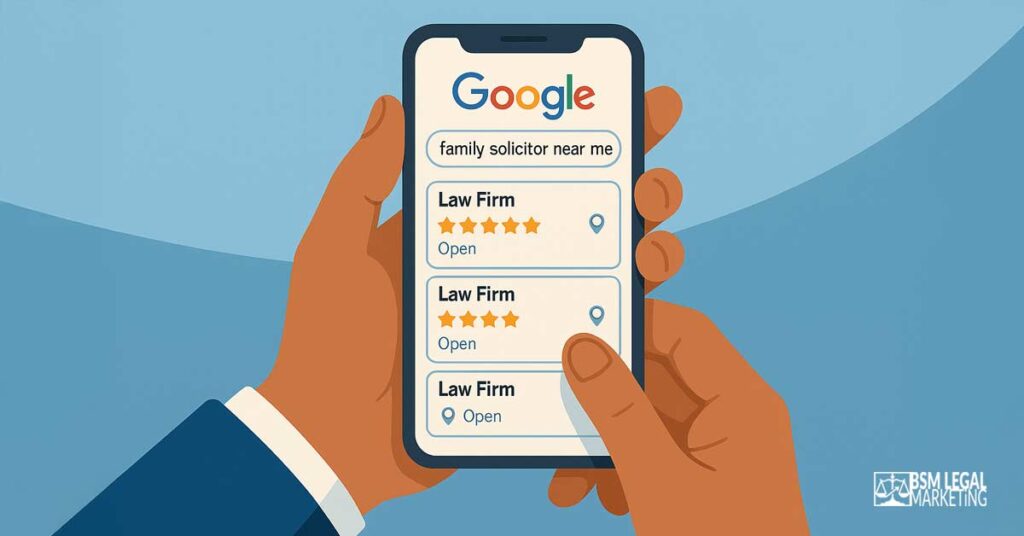
When someone searches “employment lawyer Leeds,” Google shows the “local pack,” three businesses right at the top of the results. These aren’t ads. They’re the businesses Google thinks are most relevant and trustworthy for that search.
Being in that google local pack is like having a prime retail location. Miss it, and you’re invisible. This is why law firm local SEO focuses heavily on local listing optimization and local ranking factors.
Your Google Business Profile is your digital shopfront. It shows your address, phone number, hours, photos, reviews, and services. It’s often the first impression potential clients get of your firm.
What happens when you’re not there? Your competitors win by default.
Here’s what you need to do:
Complete every section: Google rewards complete profiles. Fill out your business description, services, attributes, and hours. Don’t skip anything.
Upload professional photos: Include photos of your office, team, and even local landmarks. People want to see who they’re potentially hiring.
Get reviews the right way: Ask satisfied clients to leave reviews. Don’t incentivise or pressure anyone, but do make it easy for happy clients to share their experience.
Post regular updates: Share legal tips, firm news, or community involvement. It shows you’re active and engaged.
Google treats your Business Profile as a ranking factor. Complete profiles get 7 times more engagement than incomplete ones [2]. More engagement means better rankings. Better rankings mean more clients.
Research shows that law firms appearing in Google’s local pack can get about 44% of user clicks [6], while businesses ranking in local pack results see up to 400% increase in views [8].
The firms dominating top local search results understand these local SEO ranking factors and optimize accordingly. Appearing consistently in local search results becomes a competitive advantage that compounds over time.
The profile verification process matters too. Google needs to verify you’re a real business at your claimed location. This usually involves a postcard sent to your office address. Don’t skip this step. Unverified profiles don’t appear in local pack results.
Local Citations: The Trust Signals Google Loves
Local citations are mentions of your law firm’s name, address, and phone number (also referred to as NAP) scattered across the web. They’re like references on a CV, the more quality ones you have, the more trustworthy you appear.
Google uses citations to verify your business exists and serves your claimed location. It’s not enough to just say you’re a Manchester law firm. You need other websites to confirm it.
Consistency matters more than quantity for your firm’s local search engine optimization. Having your firm listed as “Smith & Partners Solicitors” on one site and “Smith and Partners Legal Services” on another confuses Google. Pick one name format and stick to it everywhere.
UK legal directories that matter:
- Law Society’s “Find a Solicitor”
- Chambers and Partners
- Legal 500
- Thomson Reuters (Practical Law)
- Waterlow Legal Search
The Law Society directory gives you a massive advantage. It’s the official directory of UK solicitors, and Google knows it. Getting properly listed here (which you should be as a practising solicitor) provides serious authority signals.
Essential Legal Directories for UK Law Firms:
| Directory | Authority Level | Cost | Key Benefit |
|---|---|---|---|
| Law Society “Find a Solicitor” | Very High | Free | Official SRA recognition |
| Chambers and Partners | Very High | Free basic listing | Professional credibility |
| Legal 500 | High | Free basic listing | Industry recognition |
| Waterlow Legal Search | Medium | Free | Specialist legal visibility |
| Thomson Reuters | High | Varies | Professional authority |
General business directories matter too:
These local business listings help establish your geographic authority and improve your chances to show up in local searches across multiple platforms.
Building citations isn’t glamorous work, but it’s necessary. Each citation acts like a vote of confidence in your business. The more quality votes you have, the more Google trusts you to appear in local search.
Many lawyers and law firms ignore this completely. They set up their Google Business Profile and think that’s enough. It’s not. Citation building is the foundation that everything else sits on.
You can build citations yourself or hire someone to do it. If you’re doing it yourself, budget several hours per week. If you’re hiring help, expect to pay £2-3 per citation for quality submissions.
Reviews: The Make or Break Factor
People trust online reviews more than personal recommendations. That might hurt to hear, but it’s true.
Reviews have become the modern equivalent of word-of-mouth referrals. Except they’re public, permanent, and searchable. One bad review can undo months of good work. One great review can win you a client worth thousands.
How many reviews does your law firm have?
If the answer is less than 40, you’re fighting an uphill battle. Businesses with 200+ reviews dominate the top positions in local search results [2].
The brutal reality: 50% of people who search locally for lawyers on mobile visit an office within 24 hours [6]. But they’ll only visit if they can find you first.
The SRA rules make review generation tricky for law firms. You can’t incentivise reviews or pressure clients into leaving them. But you can make it easy for satisfied clients to share their experience.
Here’s what works:
- Send a follow-up email after case completion asking for feedback
- Include review links in your email signature
- Add a simple review request to your invoices
- Train your team to mention reviews during positive client interactions
Don’t just focus on Google reviews. Diversify across platforms:
- Google Business Profile
- Trustpilot
- Reviews.io
- Legal industry sites like Chambers and Partners
Responding to reviews matters too. Thank people for positive reviews. Address negative reviews professionally and offer to resolve issues privately. This shows potential clients you care about service quality.
TIP: When responding to reviews, try to include your main keywords and location in your reply, but make sure it is natural sounding. Do not stuff keywords into your reply!
Bad reviews aren’t the end of the world. How you handle them can actually improve your reputation. A professional, empathetic response to criticism often impresses people more than a perfect 5-star rating.
The review velocity matters as much as the total count. Google prefers businesses that consistently generate new reviews over those with many old ones. Fresh reviews signal an active, current business.
Local Keywords: Speaking Your Clients’ Language
Most law firms get keywords completely wrong. They optimise for terms lawyers use, not terms clients search for.
Clients don’t search for “litigation services” or “dispute resolution.” They search for “help with employment dispute” or “unfair dismissal lawyer near me.”
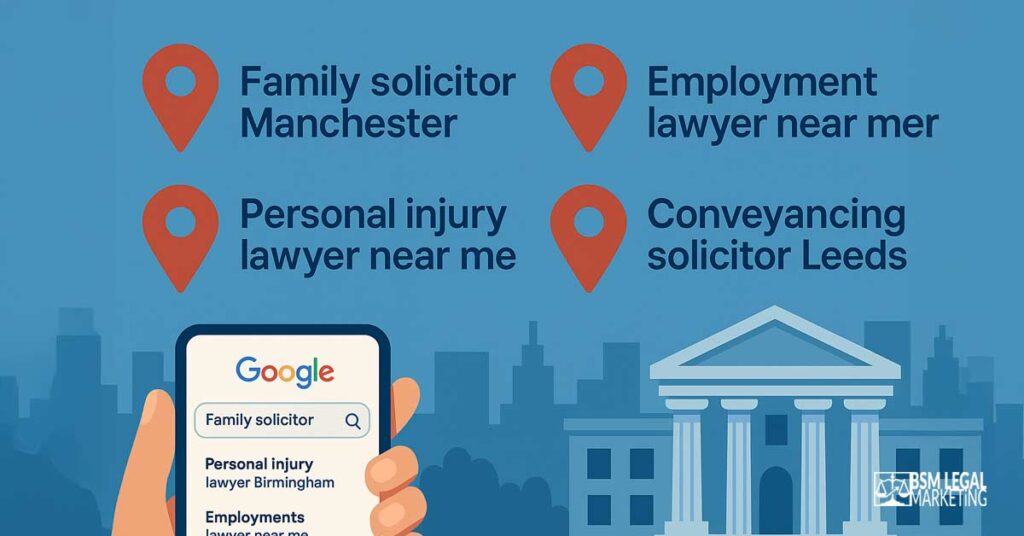
The winning formula: Practice area + Location = Success
Examples that work:
- “Family solicitor Manchester”
- “Personal injury lawyer Birmingham”
- “Employment lawyer near me”
- “Conveyancing solicitor Leeds”
“Near me” searches have exploded. They’ve grown 900% in recent years [1]. People expect to find local services without having to specify their exact location.
Local Keywords That Actually Convert:
| Keyword Type | Example | Search Volume | Conversion Rate |
|---|---|---|---|
| Practice + Location | “Divorce lawyer Manchester” | High | Very High |
| Practice + “Near Me” | “Family solicitor near me” | Very High | High |
| Urgent + Location | “Emergency solicitor London” | Medium | Very High |
| Question + Location | “How much divorce cost Leeds” | Medium | Medium |
| Court + Advice | “Manchester family court help” | Low | Very High |
Long-tail keywords convert better than short ones:
- “Divorce lawyer” (high competition, low conversion)
- “Divorce lawyer Manchester city centre” (lower competition, high conversion)
Question-based searches are huge:
- “How much does a divorce cost?”
- “What happens if I don’t pay council tax?”
- “Can I claim compensation for a car accident?”
Emergency variations matter for urgent legal needs:
- “Emergency solicitor”
- “24 hour legal advice”
- “Weekend family lawyer”
- “Urgent immigration help”
Your website content should target these real search terms. Create pages that directly answer common client questions using the language they actually use, not legal jargon.
Local keyword research tools help identify what people in your area actually search for. Google’s Keyword Planner shows search volumes by location. Answer The Public reveals question-based searches.
Don’t stuff keywords unnaturally into your content. Google’s too smart for that now. Focus on creating genuinely helpful content that naturally includes the terms your potential clients use.
Content That Connects with Local Clients
Generic legal content fails because it could apply anywhere. Your content needs to feel local to improve your local SEO.
Instead of “Understanding Employment Law,” write “Employment Law Changes in Manchester: What Workers Need to Know.” Instead of “Divorce Procedures,” write “Divorce Court Process in Birmingham: A Step-by-Step Guide.“
This guide to local content creation focuses on what actually works for building local search engine visibility.
Local legal guides that people actually read:
- Court-specific procedures and locations
- Local council policies affecting residents
- Regional variations in legal processes
- Community legal clinic information
This type of targeted content marketing for law firms works brilliantly because it demonstrates genuine local knowledge while helping anxious clients navigate unfamiliar processes.
Community involvement content builds local authority and helps you build local backlinks:
- Sponsorship of local sports teams
- Speaking at community events
- Pro bono work for local charities
- Participation in local business networks
- Hosting or sponsoring a local event
This content serves multiple purposes. It helps with law firm marketing, demonstrates community connection, and provides genuinely useful information for local clients. Plus, press releases to local media about your community work often generate valuable local backlinks.
Local news commentary positions you as the go-to expert for legal issues in your area. Comment on local planning disputes, council decisions, or community issues from a legal perspective.
FAQ sections work particularly well for local content:
- “How long do house purchases take in [location]?”
- “What are the court fees in [local court]?”
- “Which documents do I need for [local council process]?”
The key is relevance. Every piece of content should clearly relate to your local area and the people who live there. If someone from another city reads your content and finds it useful, you’ve missed the mark.
Strategic video marketing for law firms takes this local approach even further, filming explainer videos outside your local courthouse or discussing recent local legal developments creates powerful location-specific content that builds authority while serving your community.
Technical Stuff That Actually Matters
Website speed kills more potential clients than bad reviews. If your site takes more than 3 seconds to load, 40% of visitors leave [3].
Legal clients are often stressed and impatient. They won’t wait for a slow website when your competitor’s site loads instantly.
Test the speed of your website here, using Google PageSpeed Insights.
Mobile-first reality means your law firm’s website must work perfectly on phones. 78% of legal searches start on mobile [1]. If your site isn’t mobile-friendly, you’re losing most of your potential clients before they even see your content.
Schema markup is code that helps Google understand your business. It’s technical, but it matters. Legal schema markup tells Google you’re a law firm, what services you offer, and where you’re located.
Types of schema markup for law firms:
- LocalBusiness schema for location information
- LegalService schema for practice areas
- Review schema for client feedback
- FAQ schema for common questions
You don’t need to understand the code. You just need to make sure it’s implemented correctly. Most modern websites can add schema markup through plugins or built-in tools.
Learn more about schema markup here.
Local landing pages work when done properly. Create dedicated pages for each location you serve. Don’t just copy and paste content with different city names. Each page needs unique, valuable content about legal services in that specific area.
This is crucial for seo for law firm success, Google rewards authentic, location-specific content over thin, templated pages.
SSL certificates (the little padlock icon) are mandatory. Google won’t rank insecure websites well, and clients won’t trust them with sensitive legal information.
Core Web Vitals measure user experience through loading speed, interactivity, and visual stability. Google uses these as ranking factors. Poor scores mean lower rankings and fewer clients.
Website structure matters for local SEO. Your contact information should be clearly visible on every page. Include your full address, phone number, and email. Make it easy for potential clients to contact you immediately.
Your law firm website should be optimized for local search from the ground up, not just on a few dedicated location pages.
Measuring Success: Numbers That Actually Count
Vanity metrics like website traffic don’t pay your rent. Focus on numbers that directly impact your business.
How do you know if local SEO is working?
Track these metrics that actually matter:
Phone calls from organic search: The most important metric for most law firms. Use call tracking numbers to see which online activities generate phone calls.
New client consultations booked: Measure how many website visitors convert into actual consultations. This shows the quality of your traffic, not just quantity.
Revenue attribution:Track which new clients came from organic search and their total case value. One high-value client can justify months of SEO investment.
Local pack rankings: Monitor your position in Google’s local pack for key search terms. Being in the top 3 results dramatically increases visibility.
Google Business Profile engagement: Track views, clicks, calls, and direction requests through your GBP insights.
The goal is using local seo to get new clients, not just traffic. Track conversions that actually matter to your practice.
Google Analytics 4 provides detailed conversion tracking. Set up goals for form submissions, phone calls, and consultation bookings. This shows which content and keywords drive real business results.
Google Search Console shows which searches bring people to your website. Look for local search terms and track your rankings over time.
Call tracking software assigns unique phone numbers to different marketing channels. This proves which SEO activities generate phone inquiries.
Average law firm SEO investments range from £500-£5,000 monthly depending on practice size and competition level. ROI typically shows within 6-12 months for local campaigns.
The average UK law firm now spends approximately £150,000 annually on SEO [8], with the 3-year ROI averaging 526% [5].
Cost per lead from SEO averages £456 compared to £75-£150+ per click for Google Ads [4]. SEO leads also convert at higher rates because they found you through informational searches rather than being interrupted by ads.
This is why effective seo services for law firms focus on long-term organic visibility rather than just paid advertising. The compounding returns make it worthwhile.
Track your competitors’ performance too. Monitor their local pack rankings, review generation, and content publication. This helps identify opportunities and threats in your local market.
Common Local SEO Mistakes (And How to Fix Them)
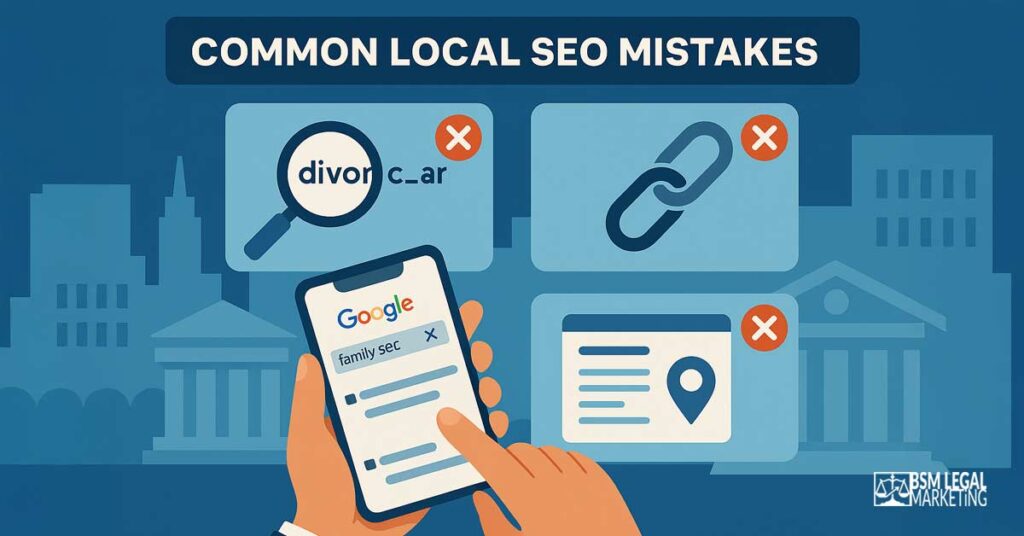
Most law firms make the same predictable mistakes. Avoid these and you’ll outperform 80% of your competitors.
1. The “set it and forget it” Google Business Profile mistake
You claimed your GBP two years ago and haven’t touched it since. Meanwhile, your competitors post weekly updates and actively manage their profiles.
Fix: Schedule 30 minutes weekly to update your GBP. Add posts, respond to reviews, and update your business information.
2. Playing citation roulette with your contact details
Your firm appears as three different names across various directories. Your address is formatted differently everywhere. Your phone number varies between sites.
Fix: Create a standardised business listing format and use it consistently everywhere. Audit existing citations and correct inconsistencies.
3. Desktop-first thinking in a mobile world
Your website looks great on your office computer but terrible on phones. Contact forms are impossible to complete on mobile. Phone numbers aren’t clickable.
Fix: Test your entire website on multiple mobile devices. Make sure every element works perfectly on small screens. This is fundamental to getting local results that convert.
4. Content that sounds like every other law firm
Your website copy could belong to any solicitor anywhere. Nothing indicates you understand local clients or local issues.
Fix: Rewrite your content to specifically address local clients. Include location-specific information and demonstrate local knowledge.
Additional mistakes to avoid:
Ignoring negative reviews instead of addressing them professionally. Buying fake reviews instead of encouraging genuine feedback. Focusing on search volume instead of local relevance. Neglecting website speed and user experience.
Using the same content across multiple location pages. Forgetting to update business hours for holidays or special circumstances. Missing opportunities to showcase local community involvement.
Getting Your Legal Local SEO Started: Your First 30 Days
Local SEO feels overwhelming when you look at everything at once. Break it into manageable weekly chunks.
Week 1: Claim and complete your Google Business Profile
- Verify your business location
- Fill out every section completely
- Upload high-quality photos
- Set up regular posting schedule
Week 2: Audit and fix your citations
- Search for existing mentions of your business
- Identify inconsistencies in name, address, phone
- Start correcting the most important directories
- Claim listings on major platforms
Week 3: Create location-specific content
- Write one piece of content targeting local keywords
- Update your homepage to include location information
- Add location pages for each area you serve
- Optimise existing content for local searches
Week 4: Start your review generation system
- Set up email templates for review requests
- Add review links to invoices and email signatures
- Train team members on appropriate review requests
- Respond to existing reviews professionally
Your Local SEO Action Plan:
| Week | Priority Tasks | Expected Time | Success Metric |
|---|---|---|---|
| Week 1 | Complete Google Business Profile | 3-4 hours | Profile 100% complete |
| Week 2 | Citation audit and cleanup | 4-5 hours | Top 10 directories consistent |
| Week 3 | Create local content | 2-3 hours | 1 location page published |
| Week 4 | Review generation system | 2 hours | System in place, 3+ new reviews |
This timeline assumes you’re working on local SEO part-time alongside your legal practice. If you can dedicate more time or hire help, you can accelerate the schedule.
Don’t try to do everything perfectly from day one. Start with the basics and improve over time. A complete Google Business Profile beats a perfect SEO strategy you never implement.
Month two focuses on content creation and link building. Month three expands into advanced tactics like schema markup and conversion optimisation.
The key is consistency. Regular, sustained effort beats sporadic bursts of activity. Set aside dedicated time each week for local SEO tasks.
When to Get Help (And When to DIY)
Some local SEO tasks you can handle yourself. Others require specialist knowledge and tools.
You can handle:
- Google Business Profile setup and management
- Basic citation building
- Writing location-specific content
- Review generation and response
- Local keyword research
You need help with:
- Technical website issues
- Schema markup implementation
- Advanced citation building across hundreds of sites
- Competitive analysis and strategy
- Local link building
This is where professional local seo services become valuable. The time saved and expertise gained often justify the investment.
Red flags when choosing an SEO agency:
- Guarantees first-page rankings
- Refuses to explain their methods
- Focuses only on rankings, not business results
- Uses automated tools for everything
- Charges suspiciously low prices
Quality law firm marketing agencies should explain their approach clearly, provide regular reporting, and focus on business metrics that matter to you.
For law firms, solicitors and lawyers serious about dominating their local market, working with a specialist legal marketing consultant who understands both SRA compliance and local SEO complexities often delivers better results than attempting DIY approaches or hiring generalist agencies.
Investment expectations vary by market competition and practice size. Sole practitioners in smaller towns might see results with £500 monthly investment. Large firms in competitive cities need £2,000+ monthly budgets.
Local SEO Investment Guide for Law Firms:
| Firm Size | Monthly Budget | Timeline for Results | Expected ROI |
|---|---|---|---|
| Sole practitioner | £300-£800 | 3-6 months | 3:1 to 5:1 |
| Small firm (2-5 lawyers) | £500-£1,500 | 4-8 months | 4:1 to 8:1 |
| Mid-size firm (6-20 lawyers) | £1,200-£3,000 | 6-12 months | 5:1 to 12:1 |
| Large firm (20+ lawyers) | £2,500-£5,000+ | 8-18 months | 8:1 to 15:1+ |
ROI timelines depend on starting position and competition level. Initial improvements typically show within 2-3 months. Significant results usually require 6-12 months of consistent effort.
The decision often comes down to time and expertise. If you have time to learn and implement local SEO yourself, start with the basics. If you’d rather focus on practising law, hire qualified help.
According to recent research, 65% of lawyers don’t know which metrics to measure in their marketing campaigns [6], while 74% believe their firm has wasted money on marketing campaigns that don’t deliver results [6]. This highlights why specialist expertise matters.
Don’t split the middle by hiring cheap, inexperienced providers. Either do it properly yourself or pay for quality help. Half-measures waste money and time.
Conclusion
Local SEO isn’t optional anymore. It’s the foundation of modern legal marketing.
The numbers don’t lie. 96% of people start their legal search online. 74% take immediate action after finding a lawyer. 72% contact only one attorney.
If you’re not visible in local search, you don’t exist to potential clients.
The good news? Most of your competitors are getting this wrong. They’re stuck in old marketing approaches while local search dominates client acquisition.
Start with your Google Business Profile. Complete every section. Add professional photos. Generate reviews the right way. Post regular updates.
Build consistent citations across legal directories. Create location-specific content. Optimise your website for mobile users. Track metrics that actually matter to your business.
The work isn’t glamorous, but the results speak for themselves. Law firms implementing proper local SEO see 526% ROI over three years [5]. That’s not a typo.
Your potential clients are searching for legal help right now. The question is: will they find you or your competitors?
The choice is yours.
Ready to dominate your local legal market? Contact BSM Legal Marketing for a compliant, ROI-focused local SEO strategy that actually works.
FAQ Section
What is local SEO for lawyers?
Local SEO for lawyers is the process of optimising your law firm’s online presence to appear in local search results when potential clients search for legal services in your area. It includes Google Business Profile optimisation, local citations, reviews, and location-specific content.
Why is local SEO important for law firms?
96% of people seeking legal advice start with an online search [1], and 74% take action immediately after finding a lawyer online. Local SEO puts your firm in front of these potential clients when they’re actively looking for help.
How does local SEO work for attorneys?
Local SEO works by optimising your Google Business Profile, building local citations across legal directories, generating client reviews, and creating location-specific content that helps Google understand where you serve clients and what services you offer.
What are the top benefits of implementing local SEO for lawyers?
Local SEO generates higher quality leads at lower cost than paid advertising, builds long-term authority and trust, helps you dominate your local market, and provides measurable ROI averaging 526% over three years.
How can law firms optimise their Google Business Profile for local SEO?
Complete every section with accurate information, add professional photos of your office and team, encourage satisfied clients to leave reviews, post regular updates about your services, and ensure your contact information matches everywhere online.
How long does it take to see results from local SEO?
Initial improvements in local visibility can be seen within 2-3 months of consistent effort. Significant results including increased leads and revenue typically occur within 6-12 months of implementing a complete local SEO strategy.
What are citations and why do they matter in local SEO for lawyers?
Citations are mentions of your law firm’s name, address, and phone number across websites and directories. They help Google verify your business exists and serves your claimed location. Consistent citations across quality legal directories improve local search rankings.
Which keywords should law firms use for local SEO campaigns?
Focus on practice area plus location combinations like “family solicitor Manchester” or “personal injury lawyer Birmingham.” Include “near me” variations and question-based searches that potential clients actually use rather than legal jargon.
How do reviews impact local SEO for attorneys?
Reviews directly influence local search rankings and client decisions. Businesses with 200+ reviews typically dominate local search results. Reviews also provide social proof that encourages potential clients to contact your firm.
How can lawyers get more local clients through SEO?
Create location-specific content addressing local legal concerns, optimise for mobile users, maintain complete and active Google Business Profile, build consistent citations, generate genuine client reviews, and track metrics that matter to your business growth.
Evidence & Guidance
| Claim | Supporting Source |
|---|---|
| GBP accuracy/eligibility is foundational; avoid virtual offices. | Google: Eligibility |
| Service areas don’t directly boost rankings; focus on proximity/relevance/prominence. | Whitespark test |
| Reviews materially influence Map Pack performance. | Whitespark LSRF |
| Consumers heavily read and rely on reviews for local choices. | BrightLocal 2025 |
| Definition and pillars of local SEO. | Search Engine Land |
| UK LSAs badging change to “Verified” from 20 Oct 2025. | Google LSAs |
Metrics to Track (Monthly)
| Metric | Target / Note |
|---|---|
| Map Pack impressions (GBP) | +30% in priority locations |
| Calls from GBP | +20% QoQ |
| Average rating & review velocity | ≥4.6★; 5–10 new reviews/month |
| Citation accuracy | 100% NAP match on top legal directories |
| Local page enquiries | +15% MoM sustained |
| LSA qualified leads (if eligible) | Cost per signed case trending down |
Reviewed by a Legal SEO Specialist using Google guidelines, industry surveys, and UK LSA policy updates (updated: 22 Sep 2025).
Basis: Multiple authoritative sources, recent policy updates, and consensus on ranking factors.
References
[1] Legal SEO Statistics: Must-Know Data for 2025, https://growlaw.co/seo-for-lawyers/legal-seo-statistics
[2] 18 Top Google Business Profile Statistics (2025 Data), https://bloggingwizard.com/google-business-profile-statistics/
[3] Legal SEO Statistics: Must-Know Data for 2025, https://growlaw.co/seo-for-lawyers/legal-seo-statistics
[4] Google Ads for Law Firms: Costs, Strategies, and ROI in 2025, https://bigdogict.com/ppc-lsa-blog/google-ads-cost-strategy-roi-law-firms/
[5] 1:12 ROI in 3 Months: How We Helped a Private Client Firm Generate £455K in Revenue, https://intellistart.co.uk/case-studies/12x-roi-legal-marketing/
[6] 79 Legal Marketing Statistics for 2025, https://seoprofy.com/blog/legal-marketing-statistics/
[7] UK Legal Services Market Report 2025: Consumer Law Market was Valued at £19bn in 2024, with Personal Injury/Accident/Medical Negligence Work the Largest Segment at £4.4bn, Despite Weak Recent Growth – ResearchAndMarkets.com, https://www.businesswire.com/news/home/20250303634682/en/UK-Legal-Services-Market-Report-2025-Consumer-Law-Market-was-Valued-at-%C2%A319bn-in-2024-with-Personal-InjuryAccidentMedical-Negligence-Work-the-Largest-Segment-at-%C2%A34.4bn-Despite-Weak-Recent-Growth—ResearchAndMarkets.com
[8] 48 Insightful Legal Marketing Statistics & Trends, https://persuasion-nation.com/legal-marketing-statistics/