
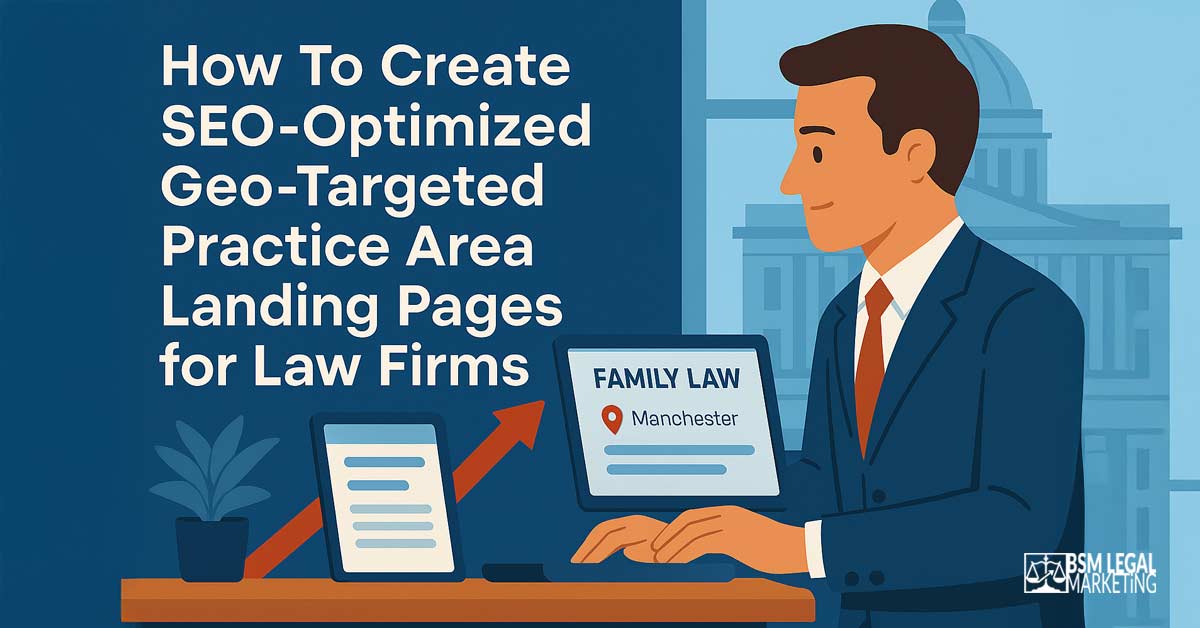
Why location landing pages actually matter for law firms
Geo-Targeted Practice Area Pages — Context & Quick Wins
-
Define the page
One page per service+location. Example: “Conveyancing Solicitors in Bromley”.
-
Add local proof
NAP, map, reviews, lawyer bios tied to that office, local FAQs, case examples.
-
Linking
Cross-link hub↔service and add a footer city list to avoid orphan pages.
-
Avoid doorway patterns
Don’t clone text across towns. Make each page genuinely helpful.
Why this works: people search “service + city,” and useful, people-first pages win. Strong local intent, strong conversions.
Hub per office
Create an office hub with full NAP, directions, parking, staff.
Child service pages
Attach top services for that city as child URLs.
City signals
Landmarks, courts served, local testimonials, council info.
Measurements
Track visits→leads→instructions per page.
Use service-area pages
No office? Don’t fake one. Explain coverage and typical response times.
Content to include
Coverage map, local case examples, on-site visit policy, clear CTAs.
Structured data
Use LocalBusiness where relevant and describe serviceArea.
Pattern library
Reusable blocks: reviews, team module, map, local FAQs, awards.
Helpful content
Prune low-engagement pages. Expand winners. Report people-first signals.
Internal links
Build clusters: main service → city service → related FAQs/cases.
46% of all Google searches are local.[1]
That’s not a trend. That’s how your next client finds you.
If you’re not showing up when someone searches “divorce lawyer Manchester” or “personal injury attorney Brooklyn,” you’re invisible. Your competitors with proper location pages? They’re getting the calls.
Location-specific practice area pages work because they match what people actually search for. Nobody types “lawyer” into Google. They search “criminal defence solicitor Birmingham” or “estate planning attorney Chicago.”
These pages give you a fighting chance in local search results. One for each city you serve. One for each practice area you offer. Done right, they bring qualified leads who are ready to hire, not just browse.
And the numbers prove it: law firms appearing in Google’s local pack can capture 44% of user clicks.[2] That’s nearly half of all people searching for legal help in your area.
This isn’t just about search engine optimization. It’s about your law firm’s online presence in the markets that matter most. When your target audience searches for legal help in their area, effective practice area pages ensure you’re there. Creating effective localized landing pages helps law firms reach clients effectively in competitive markets.
The compliance minefield UK solicitors must navigate
The SRA (Solicitors Regulation Authority) doesn’t mess about with marketing rules.
Rule 8.9 is clear: you cannot make unsolicited approaches to members of the public.[2] That includes cold calling, door knocking, and targeted online messages to specific individuals.
Here’s where location pages get tricky.
SRA Compliant vs Non-Compliant Geographic Marketing
| Marketing Activity | SRA Compliant? | Why? |
|---|---|---|
| Radio ads targeting Manchester listeners | ✅ Yes | Broad geographic area, not targeted individuals |
| Billboards in Birmingham city centre | ✅ Yes | General public advertising |
| Google Ads for “divorce lawyer London” | ✅ Yes | Responds to user’s search, not unsolicited |
| Leaflets to ALL homes in specific postcode | ✅ Yes | Non-targeted geographic distribution |
| Facebook ads to people who changed status to “separated” | ⚠️ Risky | Could be seen as targeting individuals based on known circumstances |
| Purchasing list of recent car accident victims | ❌ No | Targeted approach based on known legal need |
| Door-knocking homes after local accident | ❌ No | Unsolicited approach to specific individuals |
| Cold calling list of recently arrested individuals | ❌ No | Prohibited unsolicited approach |
You CAN send leaflets to all homes in a broad geographic area. That’s compliant. You CANNOT target specific individuals based on information about their legal needs. That’s prohibited.
The SRA gave this example in their December 2024 Warning Notice: A firm finds people who were recently in car accidents from online media. They send letters offering compensation claims help. That’s a breach. It’s targeted and intrusive.[2]
For your location pages, this means:
- Radio, TV, and billboard ads targeting geographic areas? Fine.
- Google Ads showing to everyone in Birmingham searching “divorce lawyer“? Fine.
- Facebook ads targeting people who recently changed relationship status to “separated”? Risky territory.
- Buying lists of accident victims to email directly? Absolutely not.
Every advertisement needs your firm name, at least one lawyer’s name, and your principal office address.[2]
All publicity must be accurate and not misleading, especially about charges.[2]
If you use third-party lead generators, you’re responsible for how they acquire clients. The SRA expects you to conduct regular spot checks asking new clients how they were contacted.[2]
US state bar rules vary wildly
US State Bar Advertising Requirements Comparison
| State | Required Labels | Contact Info Requirements | Special Rules | Virtual Office Rules |
|---|---|---|---|---|
| California | “Advertisement” or “Solicitation” on written ads | At least one lawyer’s name and address | Case results need factual disclosure or disclaimer | Must disclose if not bona fide office |
| New York | “ATTORNEY ADVERTISING” on homepage and email subjects | Principal office address and phone number | Email to specific individuals = solicitation (must file with disciplinary committee) | Subject to same disclosure rules |
| Florida | Standard disclaimer required | City/town/county of bona fide office locations | “Hiring decision” disclaimer mandatory | Must qualify as “Available for consultation” – cannot claim as bona fide |
| Texas | Disclaimer must match prominence of claims | Standard contact information | Cannot use actors as clients, specialization needs board certification | Must disclose nature of office |
| Illinois | No specific label required | Standard contact information | Relatively permissive compared to others | Must accurately represent office status |
California requires “Advertisement” or “Solicitation” labels on written ads. You need at least one lawyer’s name and address. If you mention case results, you must disclose the factual circumstances or state that results depend on specific facts.[3]
New York demands “ATTORNEY ADVERTISING” on your website home page and in email subject lines. Your principal office address and phone number must appear prominently.[3]
Florida is strictest. You can only list “bona fide” offices, physical locations with signage, staff, regular lawyer presence, and where you actually provide substantial legal services. Virtual offices must be labelled “Available for consultation” or “Available by appointment,” never as bona fide offices.[3]
Florida also requires: “The hiring of a lawyer is an important decision that should not be based solely upon advertisements. Before you decide, ask us to send you free written information about our qualifications and experience.”
Texas prohibits using actors to portray clients. Specialization claims need certification from the Texas Board of Legal Specialization.[3]
If you’re licensed in Illinois but marketing in Florida, you must state “Not a Member of Florida Bar” or “Admitted in Illinois Only.”
Every location page needs:
- Attorney name and contact details
- Geographic location disclosure
- States where you’re licensed
- “Information is for informational purposes only, not legal advice” disclaimer
- “No attorney-client relationship” disclaimer
- Result disclaimers if mentioning case outcomes
URL structure best practices that actually work
Keep it simple. Seriously.
URL Structure Examples – Good vs Bad
| Purpose | ❌ Bad Example | ✅ Good Example | Why Good Wins |
|---|---|---|---|
| City office page | lawfirm.com/locations/offices/usa/illinois/chicago | lawfirm.com/chicago-office | Short, clear, memorable |
| Practice area + city | lawfirm.com/legal-services/areas-of-practice/personal-injury/illinois/chicago | lawfirm.com/chicago-personal-injury-lawyer | Focused keyword placement |
| Neighbourhood focus | lawfirm.com/loc/tx/dallas/downtown/family-law | lawfirm.com/downtown-dallas-family-lawyer | Natural, easy to read |
| Multiple services | lawfirm.com/uk/england/greater-manchester/manchester/divorce | lawfirm.com/manchester-divorce-solicitor | Direct and scannable |
| Service-first format | lawfirm.com/p/injury/location/nyc | lawfirm.com/personal-injury-lawyer-nyc | Readable by humans |
| Location-first format | lawfirm.com/offices-we-serve/birmingham/area/injury | lawfirm.com/birmingham/personal-injury | Clean hierarchy |
Your URLs should be clean and obvious. Use: lawfirm.com/chicago-office or lawfirm.com/locations/manhattan/divorce-lawyer
Don’t create nested nightmares like lawfirm.com/locations/usa/tx/austin/family-law/divorce. Nobody benefits from that complexity.
For practice area combinations, pick your priority. Service-focused? Use lawfirm.com/divorce-lawyer-chicago. Location-focused? Use lawfirm.com/chicago/divorce-lawyer.
The format matters less than consistency. Pick one structure and stick with it across all pages.
Title tags that get clicks
You have 50-60 characters. Use them wisely.
Put your primary keyword first: “Chicago Personal Injury Lawyers | Smith Law Firm“
Every page needs a unique title. Never recycle the same structure across locations. Google notices. Users notice.
Bad example: “Personal Injury Lawyers | Smith Law Firm” on every city page
Good example: “Manchester Personal Injury Solicitors | Smith Law Firm” and “Birmingham Personal Injury Solicitors | Smith Law Firm“
Meta descriptions need 155-160 characters. Use action verbs and location hooks. This is where you can naturally incorporate relevant keywords that appeal to your target audience without stuffing.
Example: “Need a Denver divorce lawyer? Our family law team brings 30 years of experience to your case. Free consultation. Call today.“
Well-crafted title tags directly impact your search ranking by signalling relevance to both search engines and potential clients scanning results pages.
Learn more about local SEO for law firms, solicitors, lawyers and attorneys here.
Headings that guide readers and Google
One H1 per page. It must contain your primary keyword and location.
Example: “Personal Injury Lawyers in Chicago, Illinois“
H2s break up main sections: “Why Choose Our Chicago Personal Injury Team?“
H3s handle subsections under each H2.
Never skip heading levels. Going from H1 to H3 without an H2 signals poor structure to Google.
Don’t stuff keywords in every heading. Modern algorithms penalize that. One heading that says “Chicago Personal Injury Lawyers” and another that says “Chicago Personal Injury Attorneys Near You” and another that says “Top Chicago Personal Injury Law Firm” looks manipulative.
The duplicate content trap that kills practice area page rankings
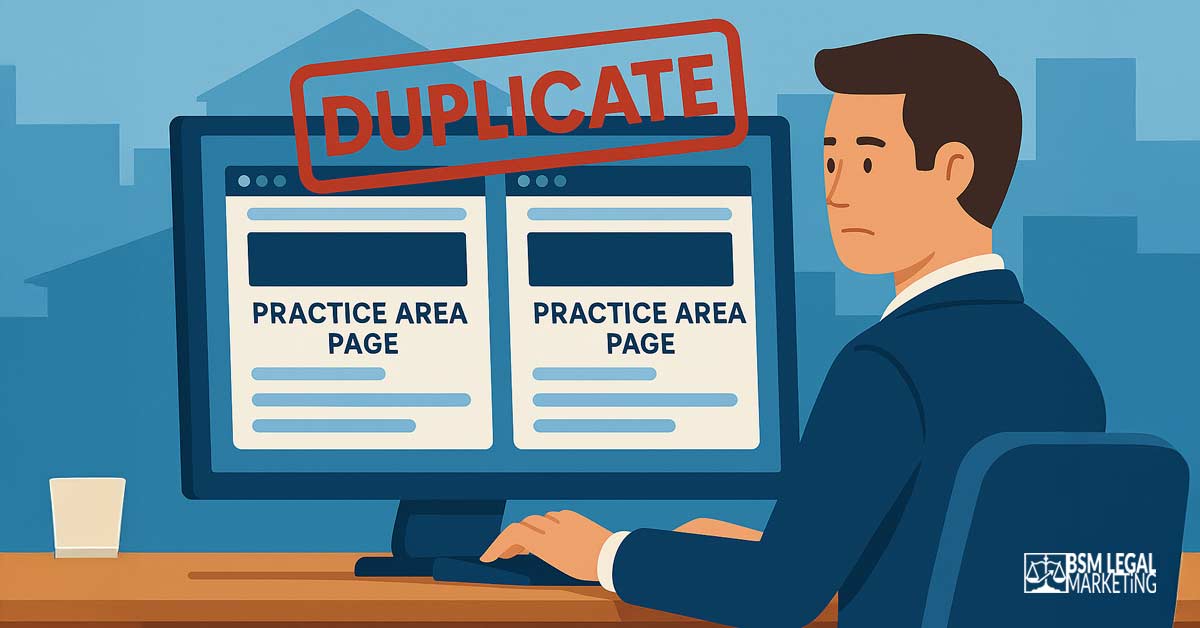
Here’s the killer: Google’s John Mueller explicitly warned that service area pages with identical content except for city names get filtered from search results.[4]
You need minimum 70% unique content per location page.
Most law firms fail this test. They create a template, swap city names, and call it done. Google sees through it instantly.
When creating practice area landing pages for different cities, you must provide genuinely distinct value on each page. Search engines understand semantic similarity and will group near-identical pages together, showing only one in search engine results pages.
Seven ways to create genuinely unique content:
Content Differentiation Strategies for Multiple Location Pages
| Strategy | What to Include | Example: Chicago | Example: Miami |
|---|---|---|---|
| State-Specific Laws | Local statutes and regulations | Illinois’s modified comparative fault system (735 ILCS 5/2-1116) | Florida’s pure comparative negligence standard (Fla. Stat. § 768.81) |
| Local Court Systems | Court names, procedures, filing requirements | Cook County Circuit Court procedures, Daley Center location | Miami-Dade Circuit Court filing requirements, 73 W Flagler St |
| Geographic Statistics | Accident rates, crime data, demographics | 117,000+ car accidents annually in Cook County | 67,000+ car accidents annually in Miami-Dade County |
| Office-Specific Info | Different attorneys, staff, office details | Profile Sarah Johnson (15 years Chicago), office at 123 State St | Profile Miguel Rodriguez (20 years Miami), office at 456 Biscayne |
| Unique Imagery | Real photos of location | Photos of Chicago office, Loop area, nearby courthouse | Photos of Miami office, Brickell area, local courthouse |
| Local Case Studies | Client testimonials from that area | “After my accident on I-290…” – John M., Naperville | “When I was hit on I-95…” – Maria S., Coral Gables |
| Community References | Landmarks, hospitals, local events | Northwestern Memorial Hospital, dangerous Loop intersections | Jackson Memorial Hospital, I-95 construction zones |
The Chicago personal injury page talks about dangerous Loop intersections and Northwestern Memorial Hospital. The Miami page mentions I-95 construction zones and Jackson Memorial Hospital.
That’s genuinely different content. Not just “Chicago” swapped for “Miami.”
Local landmarks without keyword stuffing
Use points of interest as practical navigation aids, not SEO tricks.
Good example from a London solicitor: “Our solicitors are based at 48/49 Russell Square, London, WC1B 4JP. The nearest London Underground station is Russell Square, approximately a 4-minute walk. Green Park station is a 7-minute journey.”[5]
That’s helpful. It establishes location naturally while helping clients find the office.
For Manhattan offices: “Located just blocks from City Hall, Civil Court, and Federal Court.”
For Camden solicitors: “Our solicitors can assist if you have ongoing proceedings at Camden County Court.”
Personal injury firms can reference dangerous local intersections. “If you were treated at Northwestern Memorial Hospital after an accident, we can meet you there or at our office two miles away.”
Estate planning attorneys in Mayfair might mention: “We serve clients throughout Westminster, with convenient parking near Berkeley Square.”
Notice how landmarks emerge naturally from useful information. Not forced. Not repetitive. Just genuinely helpful context that strengthens your law firm’s local connection while improving your law firm’s visibility in geographic searches.
Internal linking best practices that build authority
Your homepage links to main practice areas and primary location pages.
Practice area pages link to location-specific variations and related pages that provide additional context.
Location pages interconnect with related services and nearby offices. This helps law firms build a strong internal link structure that guides both users and search engines through your site’s hierarchy.
Vary your anchor text extensively. Exact-match anchors should be under 5% of total links.
Mix these types:
- Branded: “Contact Smith Law Firm”
- Location-specific: “Denver office”
- Natural language: “learn more about our experienced divorce attorneys in Denver”
If every internal link says “Chicago divorce lawyer” with that exact phrase, Google’s algorithm flags it as manipulation.
Schema markup essentials for practice area pages

LegalService schema replaced the deprecated Attorney schema in 2024.[6]
Use JSON-LD format in your page head. Include:
- Name
- Complete PostalAddress (every field matters)
- Geo coordinates (latitude/longitude)
- Telephone
- Opening hours
- AreaServed (use GeoCircle)
- MakesOffer (list specific services)
For multi-location firms, implement Organization schema at domain level with subOrganization array. Each office gets its own LegalService entity with unique @id URL.
FAQPage schema increases featured snippet chances. Include 3-5 question/answer pairs where questions reflect real searches.
Example: “What is the statute of limitations for personal injury claims in Illinois?“
Answer in 200-300 words on the page. Wrap both in proper FAQPage schema.
Validate everything through Google’s Rich Results Test using tools like Google’s Structured Data Testing Tool or Schema Markup Validator. Monitor via Search Console’s Enhancements tab.
Proper schema implementation is a foundational law firm SEO strategy that positions your law firm as a credible, structured data source that search engines understand and can easily parse to feature in rich results.
Mobile-first means mobile-only now
Google crawls exclusively with mobile Googlebot as of July 2024.[7]
Your mobile version must contain identical content, headings, metadata, and structured data as desktop. No exceptions.
Performance targets:
- Largest Contentful Paint: under 2.5 seconds
- Interaction to Next Paint: under 200ms
- Cumulative Layout Shift: below 0.1
Use responsive design with CSS media queries. Separate mobile URLs create duplicate content nightmares.
Google Business Profile integration
Each GBP location needs its own dedicated landing page. Never link multiple profiles to your homepage. Optimizing your Google Business Profile with proper page connections is fundamental to local search success.
The landing page must display:
- NAP information matching GBP exactly
- Office hours
- Parking and directions
- Practice areas at that specific location
- Attorneys working from that office
- Embedded Google Map
Pages in the top 3 organic results for a location query see higher map pack rankings. It’s a reinforcing effect.[7]
When you’re optimizing your Google presence for each law firm practice area, ensure your GBP categories match the services described on the linked location page. This consistency signals relevance to both Google and potential clients searching for specific legal services in their area.
Integrating your GBP with well-structured landing pages on platforms like your WordPress or custom-built website creates a seamless user experience that can enhance local SEO performance significantly.
Citations and NAP consistency
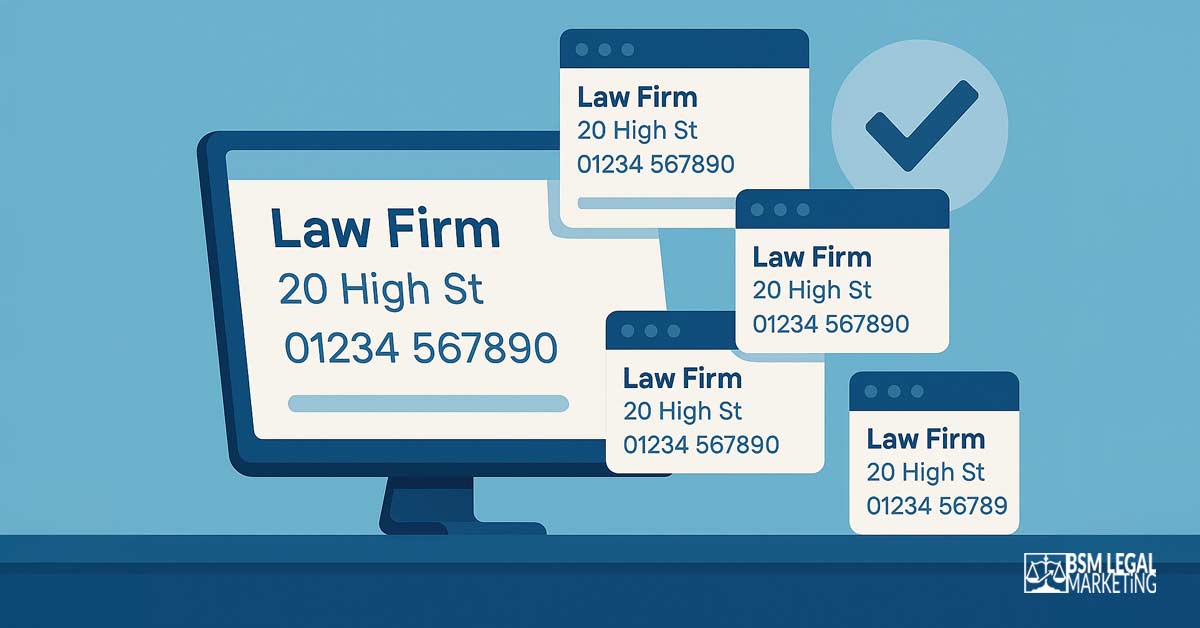
Local SEO Ranking Factors Survey identifies citations as a top-5 ranking factor for both local pack and organic local results.[8]
Priority Citation Platforms for Law Firms
| Platform Type | Platform Name | Domain Authority | Why It Matters | Action Required |
|---|---|---|---|---|
| Universal | Google Business Profile | N/A | #1 local ranking factor | Claim, verify, complete 100% |
| Universal | Bing Places | N/A | 2nd largest search engine | Claim and optimize |
| Universal | Apple Maps | N/A | Default iOS maps | Claim via Apple Business Connect |
| Universal | Yelp | DA: 95 | Trusted review platform | Create business listing |
| Legal-Specific | Avvo | DA: 94 | #1 legal directory | Create attorney profiles |
| Legal-Specific | Justia | DA: 94 | Extensive legal reach | Claim firm listing |
| Legal-Specific | FindLaw | DA: 93 | Thomson Reuters owned | Premium or free listing |
| Legal-Specific | Martindale-Hubbell | DA: 90 | Peer-reviewed ratings | Create detailed profile |
| UK-Specific | Law Society Find a Solicitor | N/A | Official UK directory | Automatic if SRA registered |
| UK-Specific | Chambers and Partners | N/A | Legal rankings | Submit for consideration |
| UK-Specific | Legal 500 | N/A | Independent research | Submit for consideration |
Standardize one exact NAP format. Decide now:
NAP Consistency Decision Matrix
| Element | Option A | Option B | Pick ONE and use everywhere |
|---|---|---|---|
| Street abbreviation | “Street” | “St.” | Choose: _____________ |
| Suite/floor | “Suite 300” | “Ste 300” | Choose: _____________ |
| Phone format | +1-312-555-1234 | (312) 555-1234 | Choose: _____________ |
| City/Town | “St. Louis” | “Saint Louis” | Choose: _____________ |
| Post-city format | London, Greater London | London, England | Choose: _____________ |
| Website protocol | https://www.lawfirm.com | https://lawfirm.com | Choose: _____________ |
Use that exact format everywhere. NAP discrepancies reduce local search performance by 16%.[8]
Law firm website content that demonstrates local expertise
State and local legal distinctions
Florida’s no-fault approach to car accidents versus California’s pure comparative fault system. That’s substantive difference.
Filing procedures in Cook County Circuit Court versus navigating Los Angeles Superior Court. Different processes, different content.
When you create content for each location, localize it with genuine legal distinctions. Don’t just swap city names in generic templates.
Effective law firm content strategy means creating practice area pages tailored to each jurisdiction’s unique legal landscape. This helps law firms connect with potential clients by demonstrating genuine understanding of local legal challenges.
Local statistics
Include real data about:
- Accident rates in that specific city
- Divorce rates for that county
- Crime statistics for criminal defence pages
- Local court processing times
“Cook County processes divorce filings in an average of 11 months” versus “Los Angeles Superior Court averages 14 months for contested divorces.”
Community-focused content
Write about local court decisions and their impact on residents. Create hyperlocal guides like “Understanding Chicago Personal Injury Laws” or “How to File a Claim in Cook County Courts.”
Document local event sponsorships with photos. Interview local officials. Cover local legal developments.
This demonstrates embedded local knowledge while naturally incorporating location keywords. It’s content marketing that actually serves your target audience rather than just trying to game search engines.
Your law firm practice area pages should reflect genuine expertise in both the legal practice and the local community you serve.
Landing page conversion optimization essentials
Call-to-action placement for conversions
Primary CTA must appear above-the-fold. 90% of legal traffic arrives on mobile.[9]
Use action language addressing specific needs:
- “Get My Free Case Evaluation” (not “Submit”)
- “Schedule Your Consultation Now” (not “Contact Us”)
- “Call Now: (312) 555-1234” (with tel: link)
Button requirements:
- High-contrast colours
- Minimum 44×44 pixels (thumb-tappable)
- Multiple placements: upper right (desktop), after headline (mobile), following testimonials, floating header
Design buttons to be visually appealing without sacrificing functionality. Clean, professional aesthetics combined with clear action verbs convert significantly better than generic contact buttons.
Click-to-call functionality
Implement tel: links throughout: <a href="tel:+13125551234">Call Now: (312) 555-1234</a>
Dynamic Number Insertion (DNI) enables call tracking while maintaining NAP consistency. CallRail and Ruler Analytics lead the market.
46% of consumers immediately turn away from businesses whose calls go unanswered.[9] Consider 24/7 availability or after-hours messaging for criminal defence and personal injury.
Contact forms that convert
Reduce fields to essentials:
- Name
- Phone (optional, not required)
- Brief message
Each additional field decreases conversion by 10-20%.[9]
For personal injury, consider a 30-60 second qualification quiz:
- “How were you injured?”
- “When did it occur?”
This pre-qualifies leads while gathering case information.
Trust signals positioned strategically

Display near CTAs and form fields:
- Client testimonials with names and photos (92% of consumers read testimonials)[10]
- Google review ratings and aggregate count above-the-fold
- Bar memberships and accreditations
- Case results (where ethically permitted) with required disclaimers
- Professional attorney photos (real team members, not stock)
- Client testimonial videos (highest trust signal)
Local social proof priorities
Google Business Profile is most critical, 79% trust online reviews as much as personal recommendations.[10]
Secondary platforms:
Generate reviews systematically:
- Follow up after successful case outcomes
- Send direct links to preferred platforms
- Respond to ALL reviews within 24-48 hours
- Thank positive reviewers
- Address concerns in negative reviews professionally
Never incentivize reviews with discounts or payments. That triggers platform penalties and ethical violations.
Building a strong review profile across multiple platforms like these directories and Google helps establish credibility. Law firms can significantly improve their local visibility through consistent, authentic client feedback that potential clients see when researching local legal services.
Make it easy for satisfied clients to leave reviews by sending follow-up emails with direct links 7-10 days after case resolution. The simpler the process, the higher your response rate.
Conversion rate benchmarks
Median conversion rate for legal services: 6.3%[11]
Bottom 10%: 0.8%
Top 10%: 21.4%
Mobile converts at 21% versus desktop’s 15.9%.[11]
By channel:
- Google Ads: 8.6%
- Bing Ads: 2.8%
- Instagram: 13%
- Paid search overall: 8.3%
Legal Services Conversion Benchmarks
| Metric | Bottom 10% | Median | Top 10% |
|---|---|---|---|
| Overall Conversion Rate | 0.8% | 6.3% | 21.4% |
| Mobile Conversion Rate | — | 21% | — |
| Desktop Conversion Rate | — | 15.9% | — |
| Google Ads Conversion | — | 8.6% | — |
| Instagram Ads Conversion | — | 13% | — |
Essential metrics to track
Rankings and visibility:
- Local pack positions (top 3, 4-7, or absent)
- Organic rankings for “practice area + city”
- Google Maps positions via geo-grid tracking
- Visibility score trends
Traffic metrics:
- Organic traffic to location pages
- Traffic by geographic region (city, county, state)
- Mobile versus desktop split
- Bounce rates for local versus non-local visitors
Conversion metrics:
- Form submissions
- Phone calls (via call tracking)
- Live chat initiations
- Email inquiries
- Appointment bookings
- Conversion rates by traffic source and area
Business outcomes:
- Cost per lead
- Lead-to-client conversion rate
- Average case value by source
- Client acquisition cost
- Client lifetime value
Local rank tracking tools
Local Falcon ($24.99-$199.99/month): AI-powered analysis, nine grid size options (1×1 to 7×7 miles), heatmap visualizations.[12]
BrightLocal ($39-$59/month): Best all-in-one combining rank tracking, citation management, review monitoring, and reporting.[12]
GeoRanker ($99-$490/month): Excels for international tracking with heatmaps and citation discovery.
Semrush Local ($30-$40/month): Integrates with broader SEO suites.
Local Viking ($39-$200/month): Comprehensive Google Business Profile management alongside ranking.
When you use geo-targeted tracking tools, you gain precise visibility into how each of your location pages performs in its specific market. This data-driven approach follows SEO best practices by letting you optimize based on actual performance rather than assumptions.
ROI calculation
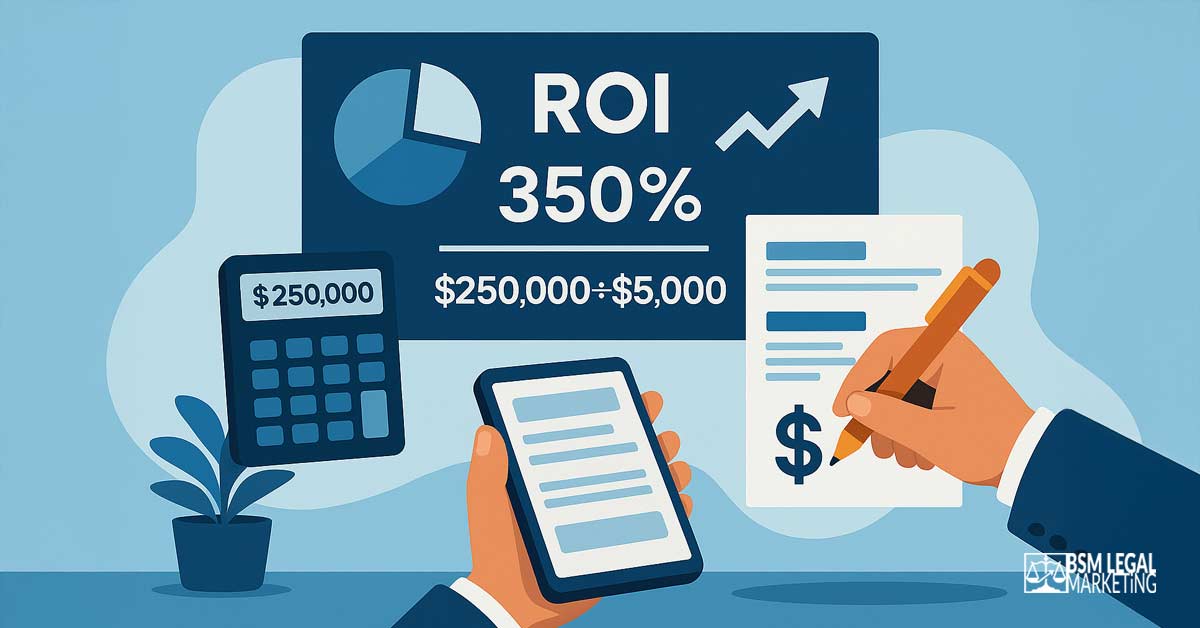
Formula: [(Revenue – Investment) / Investment] × 100
Track all investments:
- SEO services and agency fees
- Content creation and optimization
- Technical development and maintenance
- Link building and citation management
- Tool subscriptions (analytics, rank tracking, call tracking)
- Paid advertising spend
- CRM software
Calculate revenue attribution:
- Average case value per practice area
- Client lifetime value for repeat services
- Percentage of leads converting to signed clients
Expected ROI:
- Year 1: 200-400%
- Years 2+: 400-700%
Timeline: 6-12 months before meaningful measurement. SEO typically requires 3-6 months to show results.[13]
Law firm website mistakes that sabotage rankings
Over-optimization patterns:
Keyword stuffing in titles: “Chicago Divorce Lawyer | Chicago Divorce Attorney | Best Chicago Divorce Lawyers | Top Chicago Family Law“
Business name stuffing: Naming your firm “Smith Law Firm Best Personal Injury Lawyers Chicago” violates Google guidelines.
Content stuffing: “Our Chicago personal injury lawyers in Chicago help Chicago residents with Chicago car accidents. Contact our Chicago law firm for Chicago legal help.”
Google’s March 2024 spam update specifically targets these patterns.[14]
Thin content problems:
- Under 300 words per page
- Identical templates across 50+ cities with only names swapped
- No local legal information
- Generic stock photos only
Google’s Helpful Content Update rewards pages created for users, not search engines.[14]
Solutions:
- Consolidate thin pages into fewer comprehensive resources with 301 redirects
- Substantially enhance each page to 1,000+ words with genuine local information
- No-index duplicates while keeping them for user navigation
False location claims:
- Claiming offices where you have no physical presence violates Florida Rule 4-7.12
- Using virtual offices without “Available by appointment” qualifiers breaches multiple state bar rules
- Marketing services in states where you’re not licensed without clear disclaimers risks unauthorized practice charges
Your 12-month implementation roadmap
Month-by-Month Location Page Implementation Plan
| Month | Priority Actions | Expected Output | Budget Needed | Key Metrics |
|---|---|---|---|---|
| 1 | Audit existing pages, identify service areas, calculate total pages needed, flag duplicate content | Gap analysis document, priority list | £0-500 (audit tools) | Pages with 70%+ duplicate content |
| 2 | Set up call tracking, geo-grid rank tracking, GA4 conversion tracking, verify all GBPs | Technical foundation complete | £100-200/month | Baseline rankings, current traffic |
| 3 | Create 4-6 high-priority location pages (1,000-1,500 words each, schema, unique images) | 4-6 live optimized pages | £1,500-3,000 (content) | New page impressions |
| 4-6 | Create 8-12 additional pages, add testimonials, implement review generation, begin A/B testing | 8-12 more pages, review system live | £2,000-4,000 (content) | Reviews per month, page conversions |
| 7-9 | Build local backlinks, create location blogs, update existing pages, expand reviews | 6-12 local backlinks, 6-9 blog posts | £1,000-2,000 (outreach) | Backlink count, domain authority |
| 10-12 | Complete remaining pages, compliance audit, calculate ROI, identify top performers | All pages live, ROI report | £1,500-3,000 (content) | ROI by location, cost per lead |
| Total Year 1 | Complete location page strategy | 20-30 optimized pages | £7,600-14,200 | 200-400% ROI target |
Month 1: Audit and plan
Identify all cities/areas you genuinely serve with physical presence or regular court appearances. List all practice areas you want to promote. Calculate: locations × practice areas = total pages needed. Audit existing location pages for duplicate content issues using Copyscape or Siteliner. Flag pages under 500 words or with 70%+ identical content.
Month 2: Technical foundation
Implement call tracking (CallRail Starter $45-$95/month). Set up geo-grid rank tracking (Local Falcon $24.99+/month or BrightLocal $39+/month). Configure Google Analytics 4 conversion tracking. Verify or claim all Google Business Profiles. Standardize NAP format across all properties.
Month 3: Content creation begins
Create 4-6 high-priority location pages (most profitable practice areas in highest-revenue locations). Each page: 1,000-1,500 words genuinely unique content, proper schema markup (LegalService + FAQPage), unique images of that office/area, location-specific attorney bios, local statistics and court information, compliant disclaimers, and strong CTAs.
Focus your initial SEO efforts on pages that will generate the quickest return. This means targeting cities with the highest search volume for your most profitable law firm practice area. Don’t try to build everything at once. Strategic rollout always beats rushed completion.
Months 4-6: Expand and optimize
Create 8-12 additional location pages. Add client testimonials to existing pages (2-3 per page). Implement systematic review generation process. Optimize high-traffic pages through A/B testing (headlines, CTA copy, form fields). Build local citations on priority directories.
Months 7-9: Link building and authority
Pursue local backlinks (chamber of commerce, local media, community organizations). Create location-specific blog content addressing local legal issues. Update existing pages with fresh content. Expand review generation across platforms.
Months 10-12: Scale and refine
Complete remaining location pages. Conduct comprehensive compliance audit. Calculate ROI by location and practice area. Identify top-performing combinations. Create quarterly review schedule. Plan next year’s expansion based on performance data.
Budget recommendations:
Tool Stack Investment Levels
| Investment Level | Monthly Cost | Tools Included | Best For | What You Get |
|---|---|---|---|---|
| Minimum Viable | £100-200 | BrightLocal Basic (£39-59), CallRail Starter (£45-95), GA4 (free), Search Console (free) | Solo practitioners, 1-3 locations | Basic tracking, call attribution, local rank monitoring |
| Professional | £300-500 | Local Falcon Pro (£99), CallRail Professional (£145), BrightLocal (£49), Semrush Local (£40) | Small firms, 3-10 locations | Comprehensive geo-grid tracking, advanced call analytics, citation management |
| Enterprise | £500-1,000+ | Local Falcon Premium (£199), CallRail Ultimate (£245+), BrightLocal Premium (£149+), white-label reporting | Multi-office firms, 10+ locations | Full automation, client reporting, API access, priority support |
Minimum viable ($100-200/month): BrightLocal Basic ($39-59), CallRail Starter ($45-95), Google Analytics 4 (free), Google Search Console (free)
Professional ($300-500/month): Local Falcon Pro ($99), CallRail Professional ($145), BrightLocal ($49), Semrush Local ($40)
Enterprise ($500-1,000+/month): Local Falcon Premium ($199), CallRail Ultimate ($245+), BrightLocal Premium ($149+), white-label reporting tools
Landing page structure that converts visitors to clients
Personal injury landing pages
Emphasize free consultations and contingency fees prominently. “No fees unless we win” should appear above-the-fold and near every CTA.
Include qualification quizzes gathering case details:
- How were you injured?
- When did the incident occur?
- Have you seen a doctor?
- Are you currently working?
Use emotional appeals to justice and fair compensation. Create urgency around statute of limitations without being aggressive.
Feature local accident statistics and dangerous intersections. Reference area hospitals and treatment facilities.
Family law pages
- Use empathy-focused language. Divorce and custody battles are emotionally charged.
- Emphasize privacy and confidentiality. Many people searching for divorce lawyers don’t want anyone to know.
- Less aggressive urgency compared to personal injury. Family law matters resolve over months, not days.
- Provide clear explanations of local processes and realistic timelines. “In Cook County, contested divorces typically take 11-14 months.”
- Include information about mediation and collaborative law options.
Criminal defence pages
- Display 24/7 availability prominently. People get arrested at 2am and need help immediately.
- Strong confidentiality assurances throughout the page.
- Time-sensitive urgency for arraignments and hearings. “Call within 24 hours of arrest for best results.”
- Immediate response systems, live chat, instant call-back forms.
- Address specific charges with local context. “Manchester Crown Court handles serious criminal cases including…”
- Include information about local police stations and magistrates’ courts.
Estate planning pages
- Educational tone. Most visitors are researching, not ready to hire immediately.
- Less urgency, more authority. Focus on expertise and credentials.
- Address common concerns: “What happens if I die without a will in Illinois?“
- Include local probate court information and state-specific estate laws.
- Feature older attorney photos and testimonials from established community members.
- Mention community involvement, speaking engagements, and published articles.
Practice Area Content Focus
| Practice Area | Primary Emotion | Urgency Level | Key Features | Typical Timeline |
|---|---|---|---|---|
| Personal Injury | Justice/Compensation | High | Free consultation, contingency fees, injury statistics | Days to weeks |
| Family Law | Empathy/Support | Medium | Privacy emphasis, process explanation, mediation options | Months |
| Criminal Defence | Fear/Protection | Urgent | 24/7 availability, confidentiality, immediate response | Hours to days |
| Estate Planning | Security/Legacy | Low | Educational content, credentials, community involvement | Weeks to months |
| Employment Law | Fairness/Rights | Medium-High | Free case review, discrimination focus, workplace rights | Weeks |
A/B testing priorities
Start with high-traffic pages. Test one element at a time.
Headline variations:
Test benefit-focused versus authority-focused headlines.
- Example A: “Manchester Divorce Lawyers Who Fight for Your Future”
- Example B: “30 Years Protecting Manchester Families Through Divorce”
CTA button colours and text:
Test contrasting colours against your site design. High-contrast typically wins.
- Example A: “Schedule Free Consultation” (blue button)
- Example B: “Get Your Free Case Review” (orange button)
Form field requirements:
Test removing optional fields. Fewer fields almost always increases conversions.
- Example A: Name, Email, Phone, Message (4 fields)
- Example B: Name, Email, Message (3 fields, phone optional)
Trust signal placement:
Test testimonials above versus below the fold.
- Example A: Testimonials immediately after headline
- Example B: Testimonials after practice area description
Video presence:
Test pages with versus without video.
- Example A: Attorney introduction video above-the-fold
- Example B: No video, more text content
Run tests for minimum 2-4 weeks or until reaching statistical significance (95% confidence, 100+ conversions per variation).
Tools: Optimizely, VWO, or Google Optimize (though Google Optimize shut down in September 2023, use alternatives).
The reality check
Most law firms will never do this properly.
They’ll create templates. Swap city names. Call it done.
Google sees through it. Clients see through it.
The firms winning local search in 2025 are putting in actual work. Real content. Genuine local knowledge. Proper compliance.
They’re treating each location page like it matters. Because it does.
If you serve Manchester, Birmingham, and Liverpool in three practice areas, you need nine genuinely different pages. Not nine variations of the same template.
That’s 9,000-13,500 words of unique content. Plus local images. Plus local testimonials. Plus proper schema. Plus location-specific legal information.
Is it worth it?
Personal injury firms see 200-400% ROI in year one from proper local SEO. Family law practices generate 5-15 qualified leads monthly per well-optimized location.
The average personal injury case is worth £15,000-£50,000. The average divorce case is worth £5,000-£15,000.
Do the maths.
One extra case per month from better location pages pays for the entire digital marketing investment. Everything after that is profit.
Your SEO efforts compound over time. A well-optimized law firm’s website continues generating leads years after the initial investment. That’s the power of owning your law firm practice area pages rather than renting visibility through ads.
Implementing comprehensive SEO strategies that include properly structured, compliant, and localized landing pages positions your law firm as the obvious choice in each market you serve.
What actually works in SEO for law firms in 2025
Voice search is changing everything. People ask questions differently.
Typed search: “divorce lawyer manchester“
Voice search: “Who’s the best divorce lawyer near me in Manchester who handles high-net-worth cases?“
Your content needs to answer those longer, more conversational queries.
AI overviews are pulling information from pages with clear, direct answers. Structure your content with question-based headers and concise answers in the first paragraph below each question.
Example:
What is the statute of limitations for personal injury claims in Illinois?
In Illinois, you have two years from the date of injury to file a personal injury lawsuit. This deadline is strictly enforced by Illinois courts under 735 ILCS 5/13-202. If you miss this deadline, your case will likely be dismissed regardless of its merits.
[Continue with more detailed explanation…]
That format feeds AI overviews, voice search results, and featured snippets.
Mobile-first indexing means mobile IS your website now. If your desktop site is beautiful but your mobile site is slow or clunky, you don’t rank.
Test everything on actual mobile devices. Not just Chrome’s mobile emulator. Real phones with real 4G connections.
The compliance audit checklist
Review every location page quarterly for:
- [ ] Attorney name and contact information present
- [ ] Geographic location clearly disclosed
- [ ] States where licensed explicitly stated
- [ ] “Information only, not legal advice” disclaimer visible
- [ ] “No attorney-client relationship” disclaimer included
- [ ] Case result disclaimers if outcomes mentioned
- [ ] UK: No unsolicited approach language or tactics
- [ ] UK: No targeting specific individuals based on known legal needs
- [ ] US: State-specific required disclosures present
- [ ] US: “Advertisement” or “Attorney Advertising” labels if required
- [ ] No false location claims (offices you don’t actually have)
- [ ] Virtual offices properly qualified as “by appointment only”
- [ ] Third-party marketing reviewed if using lead generators
- [ ] Pricing transparency (UK SRA requirement for certain practice areas)
Document this audit. Keep records. The SRA and state bars are increasing enforcement.
The Bottom Line
Creating proper geo-targeted practice area pages takes genuine effort. Most firms won’t do it. That’s your opportunity. Build real pages with real local content, comply with regulations, and watch qualified leads roll in while your competitors wonder why their templated pages aren’t ranking.
The difference between effective practice area pages and templates that waste time? About 70% unique content, genuine local knowledge, and treating each location like it deserves its own digital marketing strategy. That’s what separates firms dominating local search from firms invisible to their target audience.
Your law firm’s website is either an asset generating cases or an expense collecting dust. Location pages done right turn it into the former. Your law firm’s online presence depends on it.
Ready to dominate local search in your markets?
Look, you’ve just read 5,000+ words on how to create location pages that actually work. The strategy is clear. The compliance requirements are mapped out. The technical details are covered.
But here’s the reality: Most law firms don’t have the time to implement this properly while running their practice.
That’s where we come in.
BSM Legal Marketing specialises in digital marketing for solicitors, lawyers, and law firms across the UK and US. We don’t just understand SEO, we understand the legal sector. SRA compliance, state bar rules, the specific challenges of marketing legal services.
We’ve helped law firms like yours:
- Increase qualified leads by 200-400% in year one
- Rank in the top 3 local results for their most profitable practice areas
- Build compliant, conversion-focused location pages that generate cases, not just traffic
- Track every lead back to specific campaigns with transparent ROI reporting
Whether you need help with local SEO, Google Local Services Ads, video marketing, or a complete digital strategy, we deliver measurable results. Not vanity metrics. Actual cases.
Book Your Free Law Firm Marketing Consultation Today:
Let’s turn your website into your best business development tool.
FAQs: Common Questions About Geo-Targeted Pages
What are geo-targeted practice area pages for law firms?
Geo-targeted practice area pages are location-specific web pages that combine your legal services with geographic targeting. For example, “Divorce Lawyer Manchester” or “Personal Injury Attorney Brooklyn.” Each page targets both a practice area and a specific city or region where you provide services.
How do geo-targeted pages improve local SEO?
They match exactly what potential clients search for. When someone types “criminal defence solicitor Birmingham,” Google prioritizes pages specifically optimized for that location and service combination. These pages signal to Google that you genuinely serve that area, improving your chances in both organic results and the local map pack.
Local SEO is vital for law firms because it connects you with clients actively searching in your service area. Well-optimized pages on your website targeting specific locations consistently outperform generic practice area pages in search engine results.
Why should law firms create location-specific pages?
Because 96% of people seeking legal help start with an online search, and they search with location-specific terms. Without dedicated location pages, you’re competing against every law firm in the country. With them, you’re competing only against firms in that specific city, and you’re showing Google you’re relevant to that local searcher.
How do I optimize practice area pages for different locations?
Create genuinely unique content for each location, minimum 70% different from other location pages. Include state-specific laws, local court procedures, area statistics, different attorney bios, unique photos, and local community references. Use the location name naturally in your title, H1, URL, and throughout the content without stuffing keywords.
What keywords should I use for geo-targeted legal pages?
Start with your practice area plus city name: “divorce lawyer Manchester” or “personal injury attorney Chicago.” Add neighbourhood variations: “divorce lawyer Williamsburg” or “criminal defence Southside Birmingham.” Include natural variations and long-tail phrases like “how to file for divorce in Manchester” or “what to do after car accident in Chicago.”
How can location-specific pages attract more clients?
They appear when people search for help in their area. When someone needs a lawyer, they want someone nearby who understands local laws and courts. Your location page proves you serve their area, know their local legal system, and can meet them in person. That builds trust and generates qualified leads ready to hire, not just browse.
What’s the difference between general practice pages and geo-targeted ones?
A general practice page targets “divorce lawyer,” competing against every divorce lawyer online. A geo-targeted page targets “divorce lawyer Manchester,” competing only against Manchester divorce lawyers. The geo-targeted page includes Manchester-specific information: local court procedures, Manchester statistics, area landmarks, and community references that a general page wouldn’t have.
How many geo-targeted pages should a law firm have?
Create one location page for each city you genuinely serve, multiplied by each practice area you offer. A firm serving three cities (Manchester, Birmingham, Liverpool) with three practice areas (divorce, personal injury, criminal defence) needs nine location pages. Quality matters more than quantity – only create pages for areas you actually serve with physical presence or regular court appearances.
Typical configurations law firms include:
- Solo practitioner, one office: 3-5 practice area pages for that single location
- Small firm, 2-3 offices: 6-15 location-specific pages
- Regional firm, 5-10 offices: 15-50 location-specific pages
- Multi-state firm: 50+ location-specific pages
What content should be on geo-targeted practice area pages?
Include your practice area description with local context, state/local laws affecting that area, local court system information, office location and contact details, attorney bios (those serving that location), client testimonials from that area, local statistics, community involvement, local landmarks and directions, and FAQ section with location-specific questions. Aim for 1,000-1,500 words of genuinely useful content.
When you create content for law firm practice area pages, think about what questions your target audience actually asks. What keeps them up at night? What local legal nuances matter in their specific city? That’s what belongs on the page, not just keywords, but answers.
Are there compliance issues with geo-targeted legal marketing?
Yes. UK solicitors must follow SRA Rule 8.9, no unsolicited approaches to individuals. US attorneys must follow state bar rules varying by jurisdiction. Common requirements: attorney name and contact information, geographic location disclosure, jurisdictional licensing information, legal information disclaimers, no attorney-client relationship disclaimers, and past results disclaimers. Never claim offices where you have no genuine physical presence.
How do I track performance of geo-targeted pages?
Use Google Analytics 4 to track traffic by location, conversion rates per city page, and behaviour metrics. Implement call tracking (CallRail, Ruler Analytics) with unique numbers per location. Use geo-grid rank tracking tools (Local Falcon, BrightLocal) to monitor local pack and organic rankings. Track Google Business Profile insights for each location. Calculate cost per lead and ROI by attributing closed cases to specific location pages.
Can geo-targeted pages improve Google Maps rankings?
Yes. Each Google Business Profile should link to its dedicated location landing page. Pages ranking in top 3 organic results for location queries see higher map pack rankings. The connection between your organic ranking and map pack visibility creates a reinforcing effect, strong location pages boost your profile, and optimized profiles drive traffic to pages.
What are common mistakes with geo-targeted pages?
Duplicating content across locations with only city names changed, thin content under 300 words, keyword stuffing with location names, claiming offices where you have no physical presence, ignoring mobile optimization, neglecting state-specific legal information, using identical templates for all pages, failing to include unique local photos and testimonials, over-optimizing with unnatural keyword density, and missing required compliance disclaimers.
How often should geo-targeted pages be updated?
Review quarterly for:
- Updated local statistics
- Recent case results (with compliant disclaimers)
- New attorney additions
- Changed local laws or procedures
- Fresh client testimonials
- Current local developments
- Accurate business hours and contact details
Update immediately when:
- Opening or closing an office
- Adding or removing practice areas
- Changing contact information
- Significant local legal developments occur
Should my law firm use different strategies for different locations?
Yes. High-population urban areas (London, Manchester, NYC, LA) have intense competition requiring more content depth, stronger backlink profiles, and aggressive review generation. Smaller cities and towns need less content depth but benefit from community involvement emphasis and local media coverage. Adjust your content length, competitive positioning, and budget allocation based on each market’s competitive landscape.
How important are backlinks for geo-targeted pages?
Very important. Local backlinks from authoritative sources signal relevance to Google. Target local chamber of commerce websites, local news coverage, community organization sites, local business directories, and area law associations. A link from “Manchester Business Journal” to your Manchester office page carries more weight for local rankings than a generic national legal directory link.
Can PPC campaigns be tied to geo-targeted pages?
Yes. Create dedicated landing pages matching your ad messaging. If your Google Ads target “divorce lawyer Birmingham,” send that traffic to your Birmingham divorce page, not your homepage. Use location-specific ad copy, match keywords between ads and landing pages, and implement conversion tracking per location. This improves Quality Score, reduces cost-per-click, and increases conversion rates.
What role does Google My Business play in geo-targeted SEO?
Critical role. Each location needs a verified, optimized Google Business Profile linked to its dedicated landing page. Ensure NAP information matches exactly between profile and page, post regular updates to your profile, respond to all reviews within 24-48 hours, and add practice areas, services, photos, and posts regularly. Your GBP directly influences local pack rankings, which appear above organic results.
How do I create a geo-targeted content strategy for multiple practice areas?
Start with your most profitable practice areas in your highest-revenue locations. Create those pages first with exceptional quality, 1,500+ words of genuinely useful content. Then expand to secondary practice areas and locations. Develop a content calendar creating 2-4 location pages monthly. Use consistent templates for structure but completely unique content for each combination. Track which combinations generate the best ROI and prioritize similar markets.
Evidence, Metrics, and Verification
Local search demand
Roughly 46% of Google searches show local intent. “Service + city” queries are common.
Sources: recognised local search studies.
Action after search
Up to ~76% of “near me” searchers visit a nearby business within a day. High conversion intent.
Source: Google-reported behaviour studies.
Compliance signal
Google warns against doorway pages. Thin, cloned city pages are risky. Keep pages genuinely useful.
Source: Search Central policy pages.
Quality signal
People-first content is rewarded. Use unique local info, proof, and clear next steps.
Sources: industry analysis of helpful content signals.
| What to implement | How to measure | Target / note |
|---|---|---|
| One page per service+location with unique local proof | Visit→lead rate; tracked calls per page | 3–6% visit→lead on mature pages |
| Office hub + child service pages per city | Index coverage; internal link graph | No orphan pages |
| Service-area pages for non-office coverage | Eligible impressions; CTR on “service in [area]” | Scale pages with highest CTR |
| Structured data (LocalBusiness where applicable) | Rich results; consistent NAP/schema | Consistency across site & citations |
| Quarterly doorway risk audit | Content similarity; engagement metrics | Remove thin/duplicate pages |
Citations
- Local demand & behaviour: established local SEO industry reports.
- Doorway policy: Google Search Central, doorway pages guidance.
- Helpful content signals: well-known industry explainers and timelines.
Resources and references
[1] Grow Law – Legal Marketing Statistics 2025
[2] SRA – Marketing Your Services to Members of the Public
[3] Jonathon Bray – SRA Warning Notice on Marketing
[4] Rocket Clicks – Best Practices for Multiple Location Pages
[5] Sundown Marketing – Creating Geo-Specific Practice Area Pages
[6] BigDog ICT – Generative Engine Optimization for Law Firms
[7] Constellation – Local SEO for Lawyers
[8] Insidea – Local SEO Tips for Law Firms
[9] DesignRush – Local SEO for Lawyers 2025
[10] One400 – Geo-Targeted Marketing for Law Firms
[11] Grow Law – Law Firm Website Content That Converts
[12] On The Map – Local SEO for Attorneys
[13] Rankings.io – On-Page SEO for Law Firms
[14] Vibrant Web – Location-Based Service Pages 2025
Previous Article
How To Optimise for “Near Me” Searches: A Targeted Guide for Lawyers