
The Search Behaviour Shift Every Solicitor, Lawyer and Attorney Must Understand
The way people find legal help just changed fundamentally. And most law firms haven’t noticed yet.
A Higher Visibility study of 1,500 people conducted in February and August 2025 reveals a dramatic shift happening in real-time.
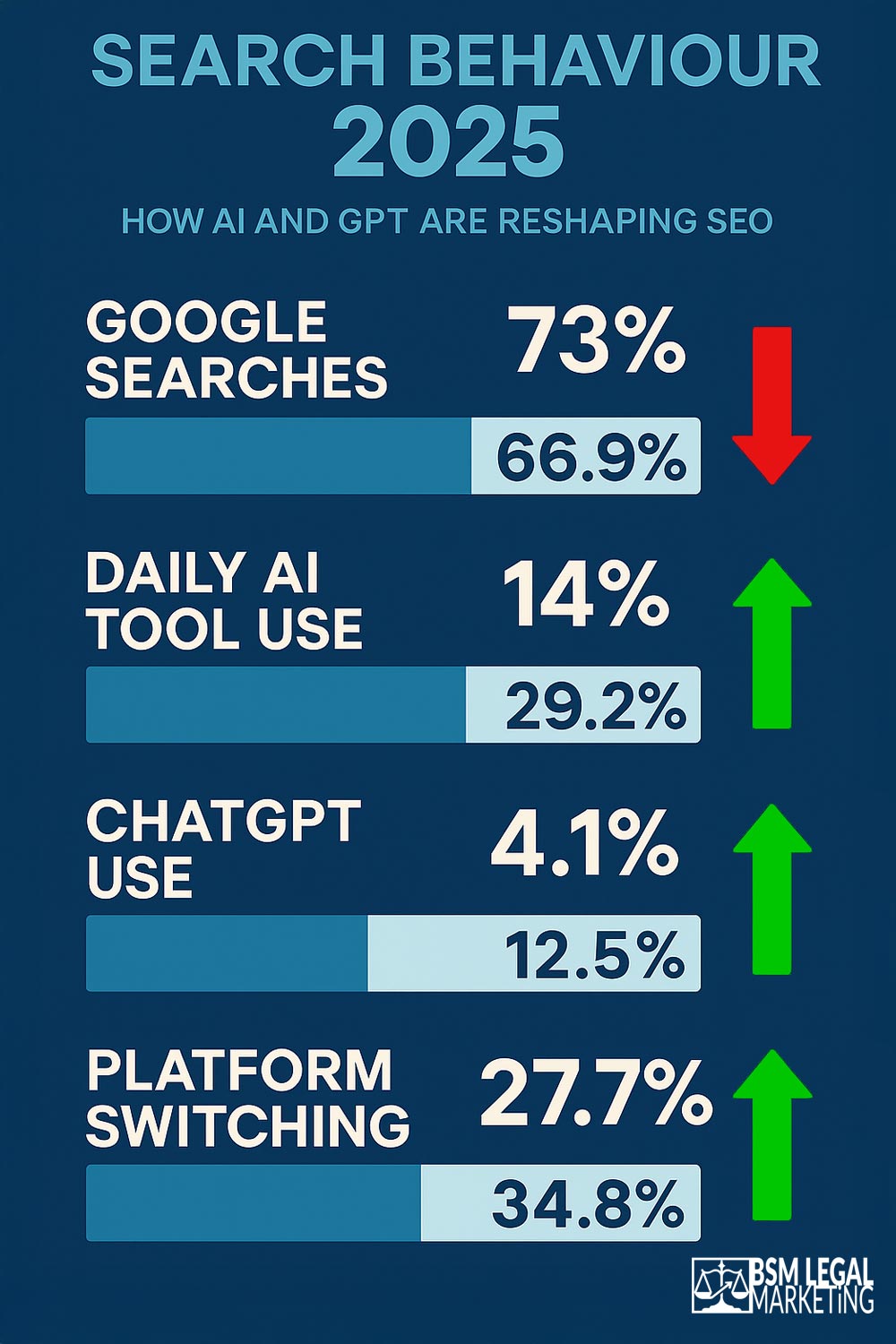
- Google’s share of general searches dropped from 73% to 66.9% in just six months.
- ChatGPT use nearly tripled, jumping from 4.1% to 12.5%.
- Daily AI tool use more than doubled, from 14% to 29.2%.
This isn’t a tech trend. It’s a client acquisition crisis waiting to happen.
How Potential Clients are Searching for Law Firms in 2025 Infographic
Here’s what’s actually going on in your potential clients’ search behaviour:
The Fragmentation Effect
People aren’t abandoning Google entirely. They’re fragmenting their search behaviour across multiple platforms. Platform switching surged from 27.7% to 34.8% in six months.
Think about it. Someone who’s just been unfairly dismissed doesn’t just type “employment solicitor near me” into Google anymore.
They might start on ChatGPT asking “what are my rights if I’ve been sacked unfairly?” Then verify the information on Google. Check reviews on Facebook. Watch explainer videos on YouTube. Read real case experiences on Reddit.
Your firm needs to be visible at every stage of that journey, not just the final Google search.
The “Never AI” Crowd Is Disappearing
The percentage of people who have never used AI tools plummeted from 28.5% to 16.3% in just six months. That’s a 43% drop in AI skeptics.
Your clients are adopting AI faster than you think. Even in local search, Google’s traditional stronghold, AI tool usage doubled to 10%.
This is particularly critical for optimising your law firm for “near me” searches, where mobile and voice search behaviour has become increasingly fragmented across platforms.
What This Means for Your Law Firm’s Marketing Strategy
Right now, 74% of law firms believe they’ve wasted money on marketing campaigns. That figure is about to get worse if you ignore this shift.
Here’s what you need to do:
1. Google SEO Still Matters (But It’s Not Enough)
Google is still sending the majority of traffic. 66.9% of general searches still happen on Google. Your local SEO, Google Business Profile, and website optimisation remain critical.
But it’s no longer the only game. If you’re putting 100% of your digital marketing budget into Google alone, you’re leaving money on the table.
2. Your Content Needs to Work Across Multiple Platforms
The same content strategy doesn’t work everywhere:
- For AI platforms (ChatGPT, Perplexity): Write conversational, question-and-answer content. Clear, direct answers to specific legal questions. Think “What happens if I don’t have a will?” rather than “Comprehensive Estate Planning Services.“
- For Google: Structured, authoritative content with proper schema markup. E-E-A-T signals (Experience, Expertise, Authoritativeness, Trustworthiness) matter more than ever for legal content. A comprehensive SEO strategy for law firms must address both traditional ranking factors and AI discoverability.
- For Social/Visual platforms: Short-form video content, client testimonials, behind-the-scenes firm culture. Younger clients are increasingly starting their search on TikTok or Instagram. Strategic video marketing can capture this audience early in their decision-making journey.
3. Track Referral Sources Beyond Google
Are you seeing traffic from ChatGPT yet? Perplexity? Claude? Most law firms aren’t even monitoring these sources.
Set up your analytics to track:
- Direct referrals from AI platforms
- “No referrer” traffic (often AI-sourced)
- Changes in how people find your contact page
- Which content formats drive actual enquiries
4. Position Your Content to Be Cited by AI Platforms
AI platforms are increasingly citing sources. To be referenced, your content marketing needs:
- Clear, authoritative answers: Don’t bury the answer five paragraphs deep. Lead with it.
- Structured data: Schema markup helps AI understand your content’s context and authority.
- Author credentials: Make sure your solicitors’ qualifications and experience are clearly displayed.
- Up-to-date information: AI models prioritise recent, current information.
The Compliance Angle You Can’t Ignore
Here’s where it gets tricky for law firms. The SRA has strict rules about unsolicited approaches and misleading marketing. Many generalist marketing agencies don’t understand these nuances.
When optimising for AI platforms and social media, you must ensure:
- You’re not making unsolicited approaches that breach SRA rules
- Your marketing material isn’t misleading about success rates or likely outcomes
- “No win, no fee” claims clearly explain all potential costs
- You’re not targeting individuals based on recent events (like accidents)
This is why you need a specialist legal marketing consultant who understands both the technical SEO requirements and the regulatory framework you operate within.
The Mistake Most Law Firms Are Making Right Now
Ignoring this shift until it’s too late.
By the time ChatGPT or Perplexity becomes your second-largest traffic source, your competitors who optimised early will already own the visibility. They’ll have the case studies. The client reviews on multiple platforms. The authoritative content that AI platforms cite.
You’ll be playing catch-up in a market that’s already moved on.
The Reality Check
Let’s be honest. Most law firms are still struggling to get basic local SEO right. Google Business Profiles aren’t fully completed. Websites load slowly on mobile. Content is written for search engines, not humans.
Now you’re being told you need to optimise for AI platforms too?
Yes. Because your clients aren’t waiting for you to catch up.
Search behaviour is fracturing. Your strategy needs to follow.
Here’s What to Do This Week:
1. Audit your current visibility
Search for your key practice areas on ChatGPT, Google, and any social platforms your target clients use. Where are you showing up? Where are you invisible?
2. Check your analytics
What percentage of your traffic comes from non-Google sources? If you don’t know, you’re already behind.
3. Review your content strategy
Is your content written in a way that AI platforms can easily cite? Are you answering specific questions clearly?
4. Assess your compliance
Is your marketing material compliant across all platforms? Social media posts that are fine on LinkedIn might breach SRA rules if they’re targeted incorrectly.
The Bottom Line
Search behaviour fundamentally shifted between February and August 2025. This isn’t speculation. This is measurable, documented change happening to your potential clients right now.
Law firms that adapt early will dominate local search across multiple platforms. Those that wait will watch their cost-per-acquisition rise as competition for the remaining Google-only traffic intensifies.
The choice is yours. But the clock is ticking.
FAQs
How has Google’s search market share changed in 2025?
Google’s share of general searches dropped from 73% to 66.9% between February and August 2025, a decline of 6.1 percentage points in just six months. This represents a significant erosion of Google’s traditional search dominance as users increasingly adopt AI-powered search platforms and engage in multi-platform search behaviour.
What is ChatGPT’s current usage for search queries?
ChatGPT usage for search queries nearly tripled between February and August 2025, jumping from 4.1% to 12.5% of respondents. This rapid adoption demonstrates mainstream acceptance of AI-powered search as a viable alternative or supplement to traditional search engines for legal research and solicitor discovery.
How many people are using AI tools daily for search?
Daily AI tool usage more than doubled from 14% to 29.2% of respondents between February and August 2025. This indicates that nearly one in three people now use AI-powered search tools on a daily basis, representing a fundamental shift in search behaviour that law firms must address.
What is platform switching behaviour and why does it matter?
Platform switching refers to users changing between different search platforms during their research journey. This behaviour surged from 27.7% to 34.8% of users in six months. For law firms, this means potential clients may start on ChatGPT, verify on Google, check reviews on Facebook, and watch videos on YouTube before making contact, requiring visibility across all these platforms.
How should law firms adapt their SEO strategy for 2025?
Law firms should implement a multi-platform SEO strategy that includes traditional Google SEO with local optimization and Google Business Profile management, AI platform optimization with conversational question-and-answer content, social media presence with video marketing, structured data implementation via schema markup, and E-E-A-T signal development. All strategies must remain SRA-compliant.
What type of content works best for AI search platforms?
AI platforms like ChatGPT and Perplexity respond best to conversational, question-and-answer formatted content with clear, direct answers that don’t bury the key information. Content should include structured data via schema markup, display author credentials prominently, provide up-to-date information, and use natural language that matches how people actually speak when asking legal questions.
How has AI scepticism changed among users?
The percentage of people who have never used AI tools plummeted from 28.5% to 16.3% in just six months, representing a 43% decline in AI skeptics. This rapid mainstream adoption means law firms can no longer ignore AI platforms, as the majority of potential clients are now comfortable using these tools for legal research.
What are the SRA compliance considerations for multi-platform marketing?
The Solicitors Regulation Authority has strict rules that apply across all marketing platforms. Law firms must ensure they’re not making unsolicited approaches that breach SRA rules, marketing material isn’t misleading about success rates or outcomes, ‘no win no fee’ claims clearly explain all potential costs, and they’re not targeting individuals based on recent events like accidents. A specialist legal marketing consultant who understands both technical SEO and SRA regulations is essential.
Should law firms stop investing in Google SEO?
No. Google still accounts for 66.9% of general searches and remains the largest single source of search traffic. Local SEO, Google Business Profile optimization, and website optimization remain critical. However, law firms should no longer put 100% of their digital marketing budget into Google alone, as they’ll miss the growing percentage of clients discovering solicitors through AI platforms, social media, and video content.
How can law firms track traffic from AI platforms?
Law firms should configure their analytics to track direct referrals from AI platforms like ChatGPT, Perplexity, and Claude, monitor ‘no referrer’ traffic which is often AI-sourced, analyse changes in how people find their contact page, and assess which content formats drive actual enquiries. Most law firms aren’t currently monitoring these sources, creating a competitive opportunity for early adopters.