
Why Artificial Intelligence is Reshaping Legal Content Strategy in 2025
AI-Overview Optimised
How Can Law Firms Use AI Content Creation?
Fast drafts. Human checks. Clear governance. Measurable KPIs.
Law firms use AI to draft first-pass blogs, FAQs, ads and client updates, then apply human review for legal accuracy, confidentiality and compliance. With a documented workflow, many teams cut drafting time by 30–50% while keeping quality controlled.
What AI content creation looks like in a law firm
- Drafting: AI produces first drafts of blogs, FAQs, service pages, newsletters and ad copy.
- Repurposing: one article becomes 6–12 assets, including social posts and email snippets.
- Consistency: prompts keep tone, terminology and structure steady across authors.
- Speed: you spend less time staring at a blank page, more time improving quality and conversion.
My rule of thumb: AI does the first 60%, humans do the final 40% that protects trust.
AI content creation isn’t about writing faster, it’s about writing smarter, reaching more clients, and finally proving marketing ROI.
Most solicitors I speak to are drowning in marketing tasks. You you need regular blog posts, consistent social media, client newsletters. But who has time?
The legal profession faces unique challenges. Law firms need to demonstrate expertise while remaining compliant with legal ethics standards. Traditional agencies don’t understand the practice of law.
96% of people seeking legal advice start with an online search.[1] If your law firm isn’t creating content, you’re invisible to them. Yet hiring a full-time content writer costs £30,000-£45,000 annually. Agencies charge £500-£2,000 per blog post.
AI changes this equation completely. The use of AI in the legal profession has become a practical necessity for law firms to stand out in competitive markets. Tools like ChatGPT and Claude can draft blog posts in minutes, not hours. Generate social media content for an entire month in one sitting. Write email campaigns that sound human, not robotic.
This isn’t about replacing lawyers. It’s about giving you back time to practice law while still maintaining the content presence your firm needs to compete.
This guide shows you exactly how to use AI marketing for law firms, from choosing the right AI tools to writing prompts that produce genuinely useful content. You’ll learn which tasks AI handles brilliantly and which still need your legal expertise. Most importantly, you’ll discover how to measure whether AI content brings in new clients.
TL;DR: AI Content Creation for Lawyers
- The Problem: 96% of legal clients start with online search. Hiring content writers costs £30,000-£45,000/year. Agencies charge £500-£2,000 per blog post.
- The Solution: AI tools (ChatGPT, Claude, Jasper) draft blog posts in minutes, generate month-long social media calendars, and write client emails that sound human. AI for law firms, AI chatbots, and AI-powered legal research tools transform content creation. Legal teams use AI solutions and AI-driven tools to maintain competitive advantage.
- What Works: Blog post drafts, social media content, email sequences, SEO keyword research, content calendars.
- What Doesn’t: Legal advice, client-facing documents, complex case analysis. AI hallucinates facts, always verify.
- The Process: Write specific prompts → Generate content → Verify all facts → Add your expertise → Edit for voice → Publish. AI can also assist with keyword research. AI tools can help streamline this workflow. Tool for lawyers must integrate seamlessly into existing systems.
- Cost Savings: 70% time reduction on content tasks. £50-£100/month for AI solution vs £30,000+/year for staff. AI offers substantial benefits of AI including AI automation of repetitive tasks. These research tools and AI capabilities help lawyers work efficiently.
- Compliance: Never publish unverified AI content. Check ABA Model Rule 8.4 (US) and Law Society guidelines (UK). You’re liable for AI errors. AI to assist with legal marketing requires supervision. AI for legal marketing must meet ethical standards. Lawyers and law firms share responsibility for AI output.
- ROI Metrics: Track website traffic, form submissions, consultation bookings, time saved, cost per lead, client acquisition from content. AI tools can also measure content performance. To integrate AI successfully requires tracking these metrics. The future of law depends on data-driven marketing decisions.
What is AI Content Creation for Lawyers, and How Does It Work?
Generative AI tools and generative artificial intelligence transform content creation. AI-powered tools like ChatGPT help law firms produce content faster. These AI tools for lawyers leverage AI technology to assist legal service providers. AI can help lawyers create content for your law firm without hiring expensive agencies.
AI content creation isn’t magic. It won’t write perfect legal advice without your input.
AI-powered tools use large language models, these AI models are sophisticated prediction engines trained on billions of words.[2] When you ask ChatGPT to write about employment law, it’s predicting which words typically follow each other in employment law content.
How is AI Content Creation Different from Traditional Legal Writing?
Traditional legal writing requires research, drafting, multiple revisions. Hours of work.
Generative AI flips this process. You provide a detailed prompt, and the AI produces a first draft in seconds. Not a final draft. A starting point.
The key difference? AI tools like GPT-4 and Claude don’t “understand” law in the way you do. They recognize patterns in legal language. They can explain how discrimination claims typically work, but they might miss recent case law or jurisdiction-specific nuances.[3]
There’s AI-assisted writing, where you use AI to improve your own drafts, checking grammar, suggesting better phrasing, expanding ideas. Then there’s AI-generated content, where the AI creates the entire first draft based on your instructions.[4]
Most successful law firms use a hybrid approach. AI generates the foundation. Lawyers add the expertise.
What Types of Legal Content Can AI Create?
I’ve tested dozens of AI tools with legal content. Here’s what works:
Blog posts: AI excels at explanatory articles. “What is constructive dismissal?” or “How long does probate take?” These rank on Google when properly optimized.
Social media content: LinkedIn posts about legal updates. Twitter threads explaining new legislation. Facebook posts that build trust without being salesy.
Email campaigns: Welcome sequences for new clients. Monthly newsletters summarizing legal changes. Follow-up emails nurturing prospects who aren’t ready to instruct yet.
Multimedia scripts: Video scripts for YouTube. Podcast outlines. Even infographic copy that explains complex legal processes visually.
What AI struggles with? Highly technical legal analysis. Court submissions. Anything requiring recent case law or precise statutory interpretation. Client-specific advice.
How Does AI Understand Legal Terminology and Nuance?
This is where things get interesting, and where you need to stay cautious.
AI tools use natural language processing to identify relationships between words and concepts. They “learn” that “negligence” connects to “duty of care” and “breach” and “causation.” They recognize legal structure and terminology patterns.[5]
But here’s the critical limitation: AI can grasp concepts without truly understanding them. It might confidently cite a case that doesn’t exist, what’s called an “AI hallucination.”[6] It might apply English law principles to a Scottish legal question. It might miss that a 2024 Supreme Court decision changed everything.
Jurisdiction-specific rules trip up AI constantly.[7] You can’t assume AI knows the difference between how defamation works in England versus the US.
This is why AI content for lawyers always requires human review. Always.
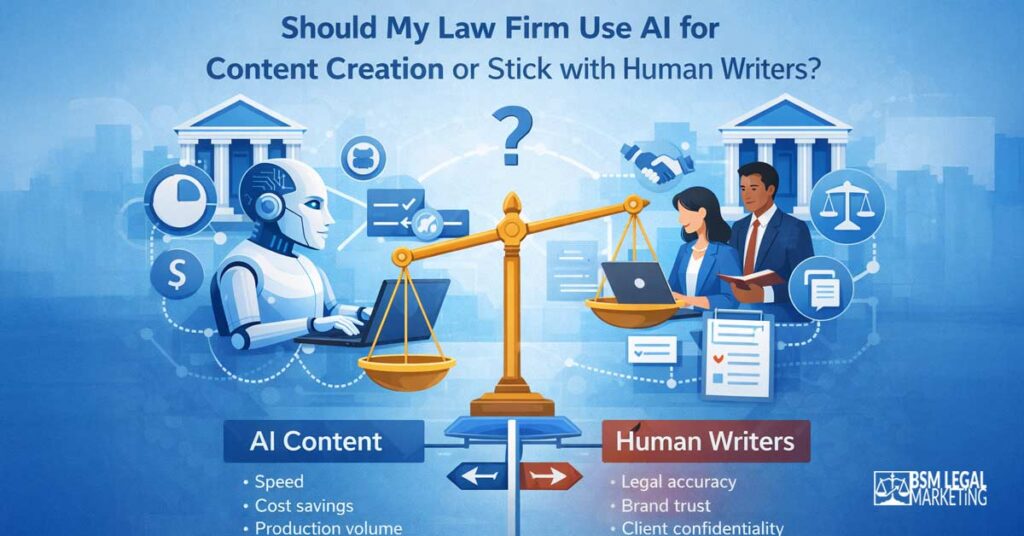
Should My Law Firm Use AI for Content Creation or Stick with Human Writers?
This question comes up in every conversation I have with practice managers and managing partners.
The answer isn’t binary. It’s not AI versus humans. It’s AI plus humans, deployed strategically.
What are the Main Benefits of Using AI for Legal Content?
Time savings are massive. A 2,000-word blog post that takes a human writer 4-6 hours (depending on the complexity of the subject)? AI drafts it in 10 minutes. You still need 30-60 minutes to fact-check, edit, and add your expertise. But you’ve collapsed hours into minutes.
Smaller firms suddenly compete. A two-partner practice can produce content like a 20-lawyer firm. You’re not limited by headcount anymore. You’re limited by how you use the technology.
Cost difference is dramatic. A freelance legal writer charges £200-£500 per article. An agency bills £500-£2,000. ChatGPT Plus costs £20/month for unlimited content.
I’m not saying fire your writers. I’m saying AI lets you produce 10x more content for the same budget.
| Content Type | Traditional Cost | AI-Assisted Cost | Time Saved |
|---|---|---|---|
| Blog Post (1,500 words) | £300-£600 | £20/month (unlimited) | 75% |
| Social Media (30 posts) | £400-£800 | £20/month + 2 hours | 80% |
| Email Newsletter | £150-£300 | £20/month + 30 mins | 70% |
| Video Script (5 mins) | £200-£400 | £20/month + 20 mins | 85% |
What Content Should Always Be Written by Lawyers vs. AI?
Understanding the power of AI requires knowing its limitations. AI for lawyers works best for specific content types. These tools can help lawyers save time while maintaining quality. AI adoption in legal departments must balance efficiency with accuracy.
This is where professional judgment matters.
AI is appropriate for:
- Explanatory content.
- Process guides.
- FAQs.
- General legal information.
- First drafts of everything.
Lawyers must write:
- Specific legal advice.
- Content referencing recent cases.
- Anything going to court.
- Client letters with legal implications.
- Opinion pieces where your professional reputation is on the line.
The test is simple: if getting this wrong could harm a client or expose you to negligence claims, a lawyer needs to review it before publication.
Balancing AI efficiency with your law firm’s voice requires experimentation. You need to train the AI on your style. Feed it examples of your best content. Tell it how you want things phrased. Over time, AI output starts sounding more like you.
| Content Type | AI Suitability | Human Input Required | Risk Level |
|---|---|---|---|
| Blog posts (general topics) | High – AI drafts well | Edit, fact-check, add examples | Low |
| Social media posts | High – AI handles easily | Brand voice adjustment | Low |
| Email newsletters | High – Good at structure | Personalization, offers | Low |
| Practice area guides | Medium – Needs verification | Legal accuracy check, local laws | Medium |
| Case studies | Low – Lacks specifics | All details, outcomes, context | Medium-High |
| Client advice | Not suitable | Lawyer must write entirely | Very High |
| Court documents | Not suitable | Lawyer must write entirely | Very High |
| Legal opinions | Not suitable | Lawyer must write entirely | Very High |
Will AI-Generated Content Hurt My Law Firm’s Credibility?
Yes, if you use it carelessly. But with proper oversight, AI can actually enhance your credibility by allowing you to publish more consistently and comprehensively.
Courts now hold law firms fully accountable for AI-generated errors in filings. [8] While marketing content faces less scrutiny than court documents, the reputational damage from publishing inaccurate AI content can be severe.[9]
Five Credibility Risks of Careless AI Use
1. Hallucinations and Fake Citations: AI invents plausible-sounding case law and statistics. Publishing these makes you look incompetent.[4] A single fake citation discovered by a prospect destroys trust immediately.
2. Generic, Soulless Writing: AI produces content that sounds like every other law firm. Overly generic writing signals you haven’t invested real thought. Clients question whether you’ll bring that same lack of care to their case.
3. Confidentiality Breaches: Inputting client details into public AI tools like ChatGPT risks exposing sensitive information. Most firms’ professional indemnity insurance doesn’t cover AI-related data breaches.
4. Ethical Violations: Publishing AI content without verification can violate SRA guidance on ensuring marketing is accurate and not misleading.[10] You remain personally liable for everything AI produces in your firm’s name.
5. Erosion of Trust Through Inconsistency: If your blog posts vary wildly in quality, some thoughtful, some obviously AI-generated filler, clients notice. It suggests your firm lacks standards and attention to detail.
How to Protect Your Firm’s Reputation
Implement Mandatory Human Oversight: Every piece of AI-generated content must be reviewed, edited, and verified by a qualified lawyer before publication. This isn’t optional. Treat AI output as a first draft that requires your expertise to become client-ready.
Create an AI Usage Policy: Document which tools are approved, what content types can use AI assistance, who verifies outputs, and how you handle data privacy. This protects you if something goes wrong and demonstrates diligence to regulators.
Add the Human Element Always: Share your perspective. Include real examples from your practice. Edit AI’s formal phrasing into conversational language. The content should sound like you wrote it, because you refined it.
Focus AI on Supporting Work: Use AI for research, initial drafts, and content structure. Reserve your time for critical thinking, legal analysis, and adding insights only you can provide. This maximizes efficiency without compromising quality.
Consider Transparency About AI Use: While there’s no legal requirement to disclose AI use in marketing content, transparency can build trust. A simple footer note, “We use AI tools to enhance our research and drafting efficiency. All content is reviewed and verified by qualified solicitors“, reassures clients that you’re using technology responsibly rather than cutting corners.
Research shows that 77% of consumers want to know when they’re interacting with AI, and 86% believe companies should be transparent about AI usage [11]. For professional services like law, where trust is paramount, voluntary disclosure can differentiate you from competitors who hide their AI use.
The key principle: treat AI as a tool to assist, not replace, human judgment. Clients don’t care if you used AI to draft content, provided the final product is accurate, helpful, and demonstrates genuine legal expertise.
The credibility question isn’t about AI. It’s about quality control.
How Can AI Transform Law Firm Blog Writing?
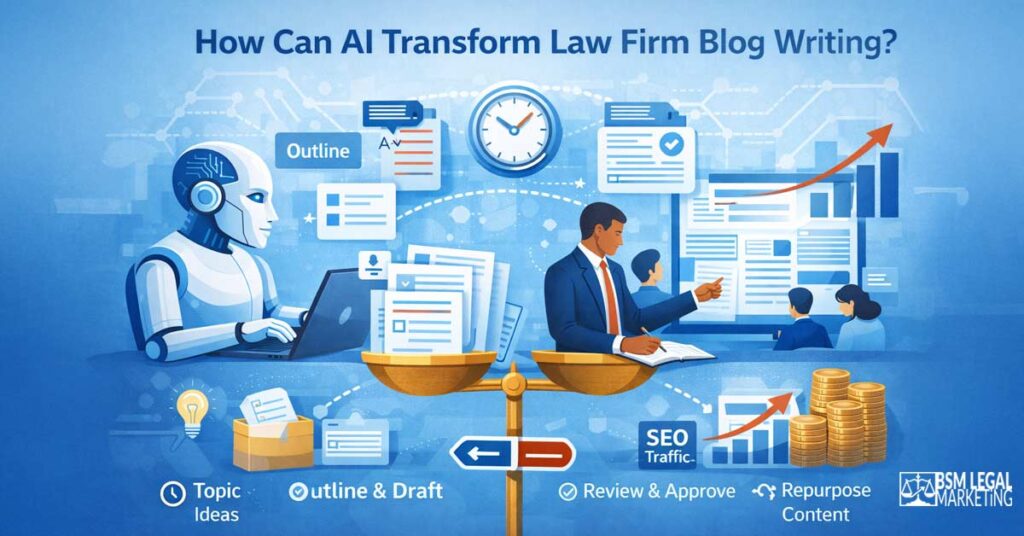
Blogging separates growing firms from stagnant ones.
Law firms with blogs get 97% more inbound links to their websites.[12] They rank higher on Google. They attract more organic traffic. But producing 2-4 high-quality blog posts monthly? That’s where most firms fall down.
AI removes this bottleneck completely.
How Do I Use AI to Generate Legal Blog Post Ideas?
Most law firms blog about what they think is interesting. Wrong approach.
AI helps you identify what clients search for. Here’s how:
Analyse client questions: Ask ChatGPT: “What are the top 20 questions people ask about employment law in the UK?” It’ll generate a list based on trending queries.
Practice-area-specific brainstorming: Use prompts like: “Generate 15 blog post ideas for a family law firm in Manchester targeting divorcing professionals aged 35-50.”
Content calendars: AI can create entire 12-month editorial plans. “Create a content calendar for a personal injury firm, balancing evergreen content with seasonal topics like road safety awareness.”
The difference between generic blog ideas and revenue-generating topics? Specificity. Don’t ask for “blog ideas.” Ask for “blog topics that answer questions from potential clients 24 hours after they’ve had a workplace accident.”
What’s the Best Way to Use AI for First Drafts of Legal Blog Posts?
Prompt quality determines output quality. This isn’t optional, it’s everything.
Bad prompt: “Write a blog about constructive dismissal.”
Good prompt: “Write a 1,500-word blog post titled ‘What Is Constructive Dismissal in UK Employment Law?’ for employees who think they’ve been forced to resign. Explain: definition, legal tests (Western Excavating test), examples of constructive dismissal, time limits for claims, and next steps. Write for Grade 8 reading level. Include a conversational tone and avoid legal jargon.”
Essential prompt elements:
- Target audience (clients, not lawyers)
- Specific word count
- Key points to cover
- Tone and reading level
- Structure (how many sections, what format)
Training AI to match your law firm’s writing style takes iterative refinement. Feed it examples: “Here are three blog posts I’ve written. Analyse the tone, sentence structure, and style. Write about [topic] in the same voice.“
This is where AI is changing legal marketing fundamentally. You’re not saving time. You’re scaling your personal expertise.
How Do I Optimize AI-Generated Legal Blogs for SEO?
AI content that doesn’t rank is pointless.
Semantic SEO matters more than keyword stuffing ever did. Google’s algorithms understand context and meaning. They connect related concepts.
Entity-based optimisation: Instead of repeating “employment lawyer Manchester” 20 times, mention related entities, Employment Tribunal, ACAS, unfair dismissal, redundancy, discrimination claims. This signals topical authority to Google.
Keyword research with AI: Ask ChatGPT: “What long-tail keywords should I target for a blog about workplace discrimination?” It’ll suggest phrases people search.
Featured snippet structure: AI can format content specifically to win position zero. “Rewrite this section as a numbered list optimized for Google featured snippets.“
One crucial point: AI doesn’t automatically create SEO-optimised content. You must explicitly instruct it to include keywords naturally, structure for readability, and use proper heading hierarchy.
How Do I Fact-Check and Edit AI-Generated Legal Blog Posts?
This is non-negotiable. AI produces confident-sounding errors.
Verification process:
- Check every legal claim against official sources
- Verify any cited cases exist
- Confirm time limits and procedural requirements
- Test that advice applies to correct jurisdiction
- Cross-reference with recent legislative changes
AI hallucinations, fabricated case citations, are the biggest risk. Never assume a case name is real without checking. AI will confidently cite “Smith v. Jones [2023] EWCA Civ 456” that doesn’t exist.
Attorney review requirements depend on content type. General explainer content? Paralegal review might suffice. Content that could be interpreted as specific advice? Partner sign-off required.
Budget 20-30% of the time a human writer would have taken for thorough editing. If a human takes 4 hours to write, plan 1 hour to review AI output properly.
How Can AI Revolutionize Social Media Marketing for Lawyers?
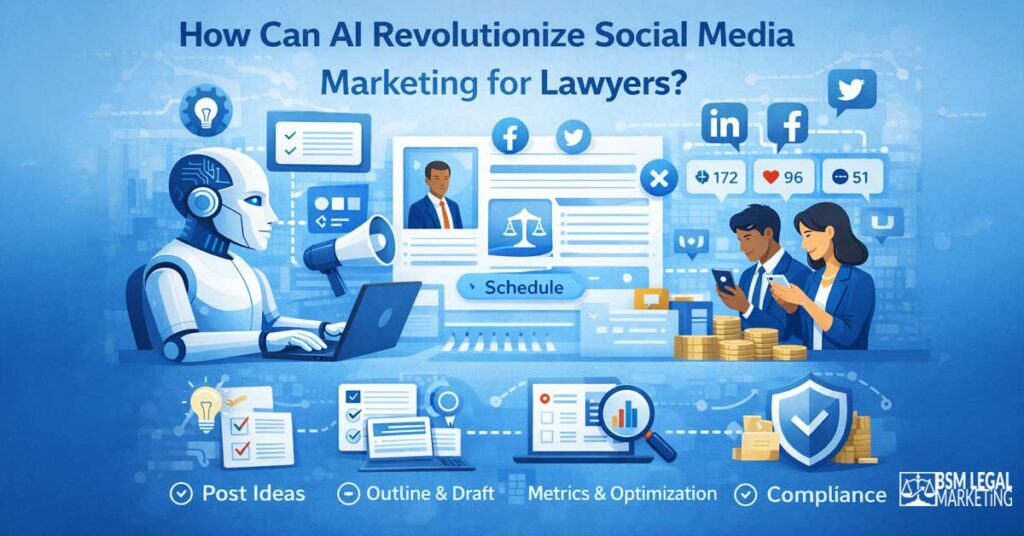
Social media is where most law firms fail spectacularly.
They post once a month. Share firm awards nobody cares about. Use stock photos of gavels. Then wonder why engagement is zero.
AI changes this because it removes the “I don’t know what to post” excuse forever.
Which Social Media Platforms Work Best with AI Content for Law Firms?
Not all platforms suit legal content equally.
LinkedIn: The professional platform where AI excels at thought leadership. Posts analysing legal changes. Commentary on employment trends. Career advice for in-house counsel. This is where senior lawyers should be posting weekly.
Twitter/X: Perfect for quick legal updates and breaking news commentary. AI can summarize new legislation into tweet threads. Explain Supreme Court decisions in plain English. Create timely, relevant content.
Facebook: Still effective for consumer-facing practices, family law, personal injury, conveyancing. AI generates client success stories (anonymized), educational posts, and community-focused content.
Instagram and TikTok: Growing for younger demographics seeking legal help. AI creates video scripts explaining legal concepts in 60 seconds. Carousel post copy about tenant rights. Behind-the-scenes content ideas.
Choose platforms based on your target clients, not what you personally enjoy using.
How Do I use AI to Create Engaging Social Media Content?
Engaging social content requires understanding platform psychology.
Compelling captions start with hooks: “Three employment rights your employer hopes you don’t know about…” AI generates dozens of hook variations.
Prompt structure: “Write 5 LinkedIn posts for an employment lawyer. Each should start with a strong hook, provide valuable information, and end with a question to encourage comments. Topics: [list topics]. 150 words maximum each.“
Hashtag generation: “Suggest 15 relevant hashtags for a LinkedIn post about workplace mental health discrimination. Mix popular (#EmploymentLaw) with specific (#MentalHealthAtWork) hashtags.”
Content calendars: “Create a 30-day social media calendar for a family law firm. Include content themes, posting frequency, and platform mix. Balance educational content with engagement posts.“
Maintaining professionalism while using AI requires editorial judgment. AI sometimes produces overly casual content. Review tone. Cut anything that sounds unprofessional or could be misinterpreted.
How Often Should Law Firms Post AI-Generated Social Media Content?
Consistency beats frequency.
Ideal posting frequency:
- LinkedIn: 3-5 times per week
- Twitter/X: Daily (or multiple times for breaking news)
- Facebook: 3-4 times per week
- Instagram: 4-5 times per week
- Google Business Profile: 1-3 times per week
AI makes consistent presence achievable. Generate a month’s content in 2 hours. Schedule it. Show up reliably.
Automation tools like Hootsuite and Buffer integrate with AI. Create content with ChatGPT. Schedule across platforms. Maintain presence without daily management.
How Do I Measure Social Media Success from AI-Generated Content?
Vanity metrics (likes, follows) mean nothing if they don’t generate enquiries.
Metrics that matter:
- Click-through rate to your website
- Profile visits from ideal clients
- Direct messages requesting consultations
- Referral traffic in Google Analytics
- Actual instructions from social channels
Tracking engagement and lead generation requires UTM parameters on links. This shows which posts drive traffic and which clients found you via social media.
AI analytics tools provide insights for improvement. They identify which topics resonate. Which post formats get shared. What time your audience engages most.
Test. Measure. Optimise. Repeat.
How can AI Transform Law Firm Email Marketing and Client Communication?

Email remains the highest-ROI marketing channel for law firms.
But most legal newsletters are terrible. Dense paragraphs about firm news. Legal updates written for lawyers, not clients. Send rates of once per quarter when you remember.
AI fixes all of this.
What Types of Legal Emails Can AI Help Create?
Client onboarding sequences: Welcome series for new clients explaining what happens next. AI generates 5-7 emails spaced over two weeks, reducing client anxiety and support queries.
Newsletter content: Monthly updates summarizing legal changes affecting your clients. AI drafts summaries in plain English, you add commentary and specific implications.
Follow-up sequences: Nurture campaigns for prospects who inquired but didn’t instruct. Educational content building trust until they’re ready to proceed.
Promotional emails: New service announcements. Practice area campaigns. Referral requests. AI maintains tone while including necessary calls-to-action.
How Do I Personalize AI-Generated Email Content for Different Client Segments?
Generic emails get deleted. Personalized emails get read.
AI enables segmentation at scale. Create different versions for different practice areas. Prospective clients receive different content than existing ones.
Segmentation prompts: “Write three versions of this email: one for corporate clients, one for individual consumers, one for referral partners. Adjust tone and focus accordingly.”
Use merge tags for personalization: {First_Name}, {Practice_Area}, {Last_Contact_Date}. AI can even generate conditional content blocks: “If client is interested in employment law, include paragraph about recent tribunal changes.”
What Email Formats Work Best with AI Content Generation?
Format affects readability and engagement.
| Email Type | Recommended Format | AI Prompt Focus | Key Element |
|---|---|---|---|
| Newsletter | Scannable sections with headings | Brief summaries + read more links | Clear CTAs |
| Welcome Email | Personal, one-topic focus | Warm tone, next steps | What to expect |
| Educational Series | Story-based, problem-solution | Specific pain points | Actionable advice |
| Promotional | Benefit-focused, short | Clear offer, urgency | Single CTA |
How Do I Maintain Compliance in AI-Generated Legal Emails?
Email marketing is regulated. You can’t send bulk emails to anyone.
GDPR and Privacy and Electronic Communications Regulations apply to all UK law firms. You need:
- Explicit consent to email marketing content
- Clear unsubscribe mechanism in every email
- Accurate sender information
- No misleading subject lines
AI doesn’t understand these requirements automatically. You must build compliance into your prompts: “Ensure this email includes an unsubscribe link and complies with UK email marketing regulations.”
For AI marketing tools for law firms, integration with compliant email platforms (Mailchimp, HubSpot, ActiveCampaign) is essential. These platforms handle the regulatory requirements while AI handles content creation.
What are the Best AI Tools for Legal Content Creation in 2026?
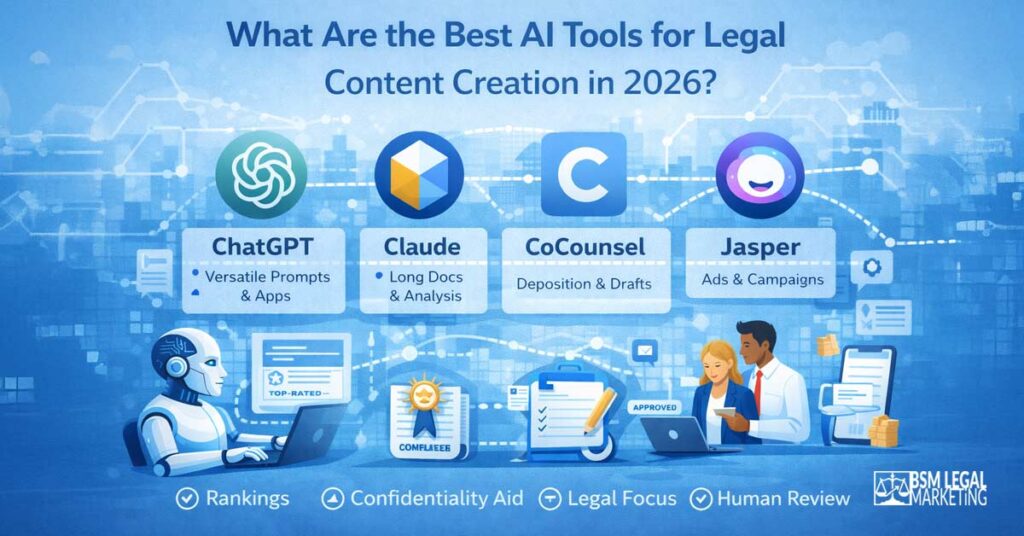
Tool selection matters. Not all AI platforms work equally for legal content.
Which AI Writing Platforms Work Best for Law Firms?
ChatGPT (GPT-5): The most versatile option for legal professionals. Excellent at conversational content, blog drafts, social posts. £20/month for Plus, or free with limitations.
Claude (Anthropic): Often produces more naturally flowing content. Better at maintaining consistent tone across longer documents. Particularly good for email sequences.
Jasper AI: Purpose-built for marketing content with templates for different formats. Higher cost ($59/month) but includes SEO tools and brand voice training.
Copy.ai: Affordable option ($29/month) with specific templates for lawyers. Good for social media and ad copy.
What About AI Tools for SEO and Keyword Research?
Content without SEO strategy is invisible.
Semrush: Comprehensive keyword research, competitor analysis, content optimization. AI-powered topic research shows what’s ranking.
SurferSEO: Real-time content optimization. Write or edit while seeing SEO scores improve. Suggests keywords and structure.
MarketMuse: AI content intelligence platform. Identifies content gaps, suggests topics, analyses topic coverage depth.
Which AI Email Marketing Tools Should Lawyers Use?
HubSpot: CRM plus email marketing with AI content assistance. Expensive (£40+/month) but powerful for client management.
Mailchimp: Affordable (free to £40/month) with AI subject line optimization and send time optimization.
ActiveCampaign: Automation-focused with AI predictions for optimal sending and content recommendations.
Are There AI Tools Specifically for Legal Professionals?
General AI tools work fine for marketing content. Legal-specific AI platforms like Harvey AI, LexisNexis+, and CoCounsel focus on legal research and document drafting, different use case entirely.
For content marketing, stick with mainstream AI writing tools. The language patterns in marketing content don’t require specialized legal training.
How Do I Write Effective AI Prompts for Legal Content?
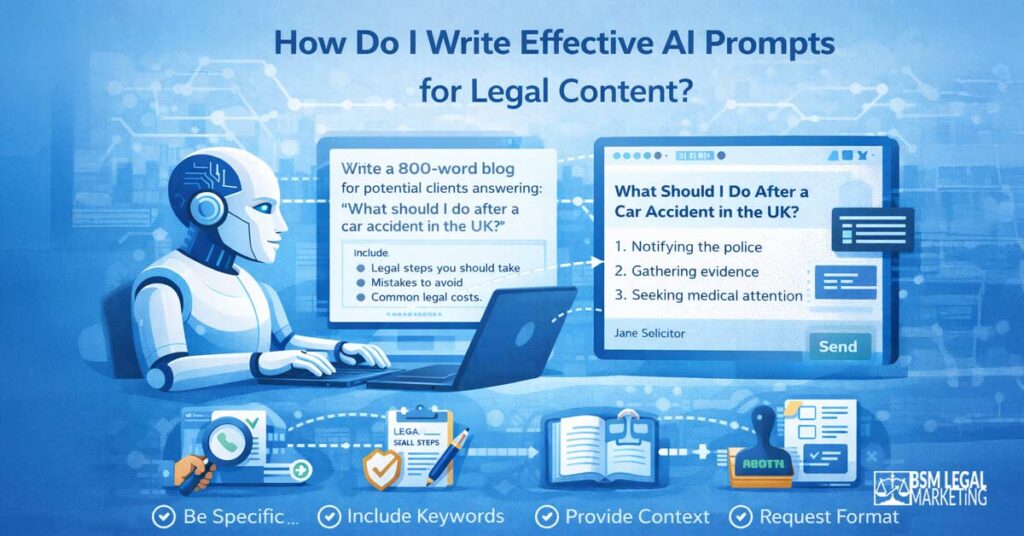
Prompt engineering determines success or failure with AI.
Bad prompts produce generic rubbish. Good prompts produce publication-ready drafts.
What Makes a Legal Content Prompt Effective?
Effective prompts follow a structure:
1. Role assignment: “You are an experienced legal content writer specializing in employment law for UK solicitors.”
2. Specific task: “Write a 1,200-word blog post titled…“
3. Audience definition: “For employees considering constructive dismissal claims, not lawyers.“
4. Key requirements: “Include: definition using Western Excavating test, 5 examples, time limits, next steps. Grade 8 reading level. Conversational tone.“
5. Format specifications: “Structure: Hook introduction, 4 main sections with H2 headings, FAQ section with 5 questions, call-to-action conclusion.“
6. Constraints: “Avoid: legal jargon, passive voice, case citations. Use UK spelling throughout.“
What’s the CLEAR Framework for Legal AI Prompts?
The CLEAR framework provides a memorable structure:
C – Context: Who’s the audience? What’s their problem?
L – Length: How long should output be?
E – Examples: Show what you want
A – Adjust: Specify tone, style, reading level
R – Refine: Ask AI to improve its own output
Example: “Context: Prospective clients searching for divorce lawyers. Length: 1,500 words. Examples: [paste example blog]. Adjust: Empathetic tone, Grade 7 reading level. Refine: After drafting, suggest 3 improvements to make it more engaging.”
How Do I Create Practice-Area-Specific Prompts?
Generic prompts produce generic content. Specificity matters.
Personal injury prompt: “Write for accident victims 48 hours after incident. Focus on immediate concerns: medical treatment, reporting accident, time limits. Avoid sounding ambulance-chasing.”
Commercial law prompt: “Write for business owners and finance directors. Technical accuracy is critical. Explain implications for cash flow, contracts, compliance. Professional, authoritative tone.”
Family law prompt: “Write for people in emotional situations. Compassionate tone without being patronizing. Focus on practical next steps and what to expect from the legal process.”
How Can I Test and Improve My AI Prompts?
Prompt improvement is iterative.
Generate content with your initial prompt. Note what’s missing or wrong. Refine the prompt. Generate again. Compare outputs.
Keep a prompt library. When you create a prompt that works brilliantly, save it. Adapt for similar content. Build templates for different content types.
Test variables one at a time. Change the tone instruction. See if output improves. Change audience definition. Check results. Systematic testing reveals what works.
How Do I Optimize AI Content for Voice Search and AI-Powered Search?
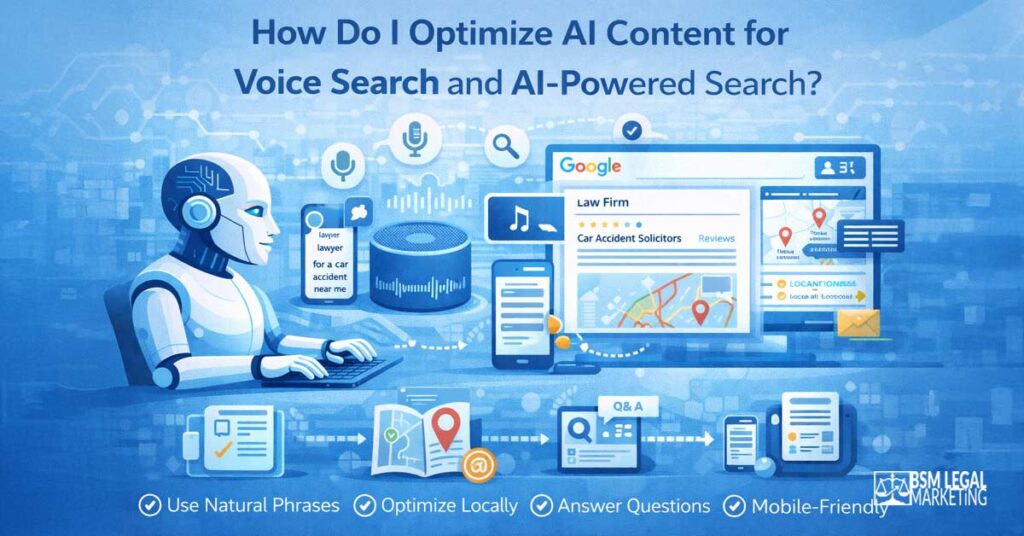
Search is changing. Voice assistants and AI search engines (ChatGPT search, Perplexity, Google AI Overviews) are replacing traditional search.
Content optimized only for traditional SEO will become invisible.
What is Voice Search Optimization for Lawyers?
Voice search is conversational. People don’t say “divorce lawyer Manchester.” They say “Who’s the best divorce lawyer near me who handles high-net-worth cases?“
Voice search optimization requires:
- Question-and-answer format content
- Conversational language matching natural speech
- Featured snippet optimization
- Schema markup for better AI understanding
- Fast-loading, mobile-optimized pages
AI can reformat existing content for voice search. Prompt: “Rewrite this section as Q&A format optimized for voice search. Use natural, conversational language people would speak.“
How Does Generative Engine Optimization (GEO) Differ from Traditional SEO?
GEO focuses on getting cited by AI systems when they answer questions.
Traditional SEO: Rank on page one of Google
GEO: Get cited when ChatGPT or Perplexity answers legal questions
GEO requirements:
- Authoritative, well-structured content
- Clear, direct answers to questions
- Proper source attribution and credibility signals
- Updated, current information
For marketing for law firms, this means creating content that AI can confidently cite as accurate legal information.
What Schema Markup Do Legal Websites Need for AI Search?
Schema markup helps AI understand your content structure and context.
Essential schema types for law firms:
- Organization schema (firm details, credentials)
- LegalService schema (practice areas offered)
- Attorney schema (lawyer profiles)
- FAQPage schema (for FAQ sections)
- Article schema (for blog posts)
- LocalBusiness schema (for local SEO)
AI can generate schema markup: “Create Schema.org markup for a law firm article about constructive dismissal. Include Article type with author, publication date, and FAQPage for the FAQ section.”
How Do I Structure Content for AI Overviews and Featured Snippets?
AI systems and Google prefer clearly structured content.
Featured snippet formats:
- Paragraph snippets: 40-60 words answering a specific question
- List snippets: Numbered or bulleted steps
- Table snippets: Comparison or data in table format
Prompt AI: “Rewrite this section to target a featured snippet for the query ‘how long does employment tribunal take’. Provide a 50-word paragraph answer followed by a step-by-step process.“
What are the Ethical and Compliance Issues with AI-Generated Legal Content?
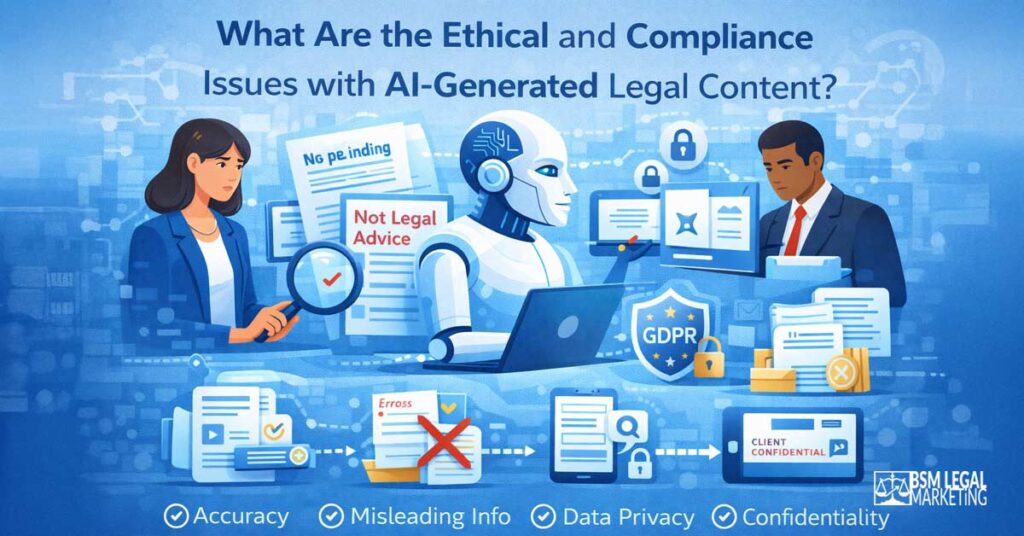
Ethics and compliance aren’t optional extras. They’re fundamental.
What Do ABA and Law Society Guidelines Say About Using AI?
The American Bar Association and Law Society haven’t banned AI content. But they’ve established clear principles:
- Lawyers remain responsible for all content accuracy
- AI outputs must be supervised and reviewed
- Client confidentiality applies when using AI tools
- Competence duty includes understanding AI limitations
The Law Society’s guidance on AI emphasizes that “firms must understand the technology they’re using and ensure appropriate oversight.“
How Do I Verify AI-Generated Legal Information?
Verification is mandatory, not optional.
AI Verification checklist:
- Check every legal principle against primary sources
- Verify cited cases exist and say what AI claims
- Confirm time limits and procedures are current
- Test that information applies to correct jurisdiction
- Cross-reference with recent legislative changes
- Review for logical consistency
- Check tone is appropriate for audience
What About Copyright Issues with AI-Generated Content?
UK copyright law is still evolving on AI content.
Current understanding: AI-generated content isn’t automatically copyrighted because there’s no human author. However, when you substantially edit and revise AI output, you create a new work that is copyrightable.
Practical approach: AI generates first drafts. Humans edit, revise, and enhance. The final work has sufficient human authorship for copyright protection.
How Do I Maintain Client Confidentiality When Using AI Tools?
NEVER input client-specific information into public AI tools.
Don’t use:
- Client names or identifying details
- Case-specific facts
- Confidential legal strategies
- Privileged information
Use AI for general content only. When you need AI assistance with client matters, use enterprise versions with data privacy agreements (ChatGPT Enterprise, Claude for Business).
Should I Disclose AI Use in Legal Marketing Materials?
There’s no legal requirement to disclose AI use in marketing content (unlike court documents).
Most firms don’t disclose. The test is content quality and accuracy, not creation method.
However, if you market yourself as “handwritten, personal client letters,” using AI contradicts that claim. Authenticity matters more than disclosure.
How Do I Measure ROI from AI Content Creation?

If you can’t measure it, you can’t improve it.
What Metrics Matter for Legal Content ROI?
Vanity metrics (page views, social likes) don’t pay the bills. Track business metrics:
| Metric | What It Measures | Target | Tool |
|---|---|---|---|
| Organic Traffic | Visitors from search engines | 20% MoM growth | Google Analytics |
| Contact Form Submissions | Enquiries from content | 5-10 per month | CRM/Analytics |
| Phone Calls | Direct enquiries | 10-20 per month | Call tracking |
| Email List Growth | Newsletter subscribers | 100+ per month | Email platform |
| Content-Sourced Instructions | Clients from content | 2-5 per month | CRM attribution |
| Cost Per Acquisition | Cost to acquire client | £100-500 | CRM/Analytics |
How Do I Calculate Time Savings from AI Content?
Time is money. Especially for lawyers.
Traditional time investment:
- Blog post: 4-6 hours (research, writing, editing)
- Social media (30 posts): 6-8 hours
- Email campaign: 3-4 hours
AI-assisted time:
- Blog post: 1-1.5 hours (prompting, editing, fact-checking)
- Social media (30 posts): 1.5-2 hours (batch generation, review, scheduling)
- Email campaign: 45 minutes (generation, personalization, review)
At £200/hour partner rate, one blog post saves £600-800 in opportunity cost. Over a year (48 posts), that’s £28,800-38,400 saved.
How Do I Track Which AI Content Generates Actual Clients?
Attribution is crucial.
Set up proper tracking:
- Use UTM parameters on all social links
- Implement call tracking numbers on content pages
- Create unique landing pages for email campaigns
- Ask new clients “How did you find us?” in intake forms
- Tag content sources in your CRM
Google Analytics 4 shows the customer journey. You’ll see which blog posts people read before enquiring. Which social posts drove website visits. Which emails led to consultations.
What’s a Realistic ROI Timeline for AI Content Marketing?
Content marketing is a long game.
Timeline expectations:
- Months 1-3: Minimal results. You’re building foundation.
- Months 4-6: Traffic starts increasing. First enquiries from content.
- Months 7-12: Compounding results. Multiple enquiries monthly.
- Year 2+: Consistent client flow. Content becomes top acquisition channel.
AI accelerates this timeline slightly because you can publish more content faster. But organic visibility still takes 4-6 months minimum.
What are Common Mistakes Law Firms Make with AI Content?
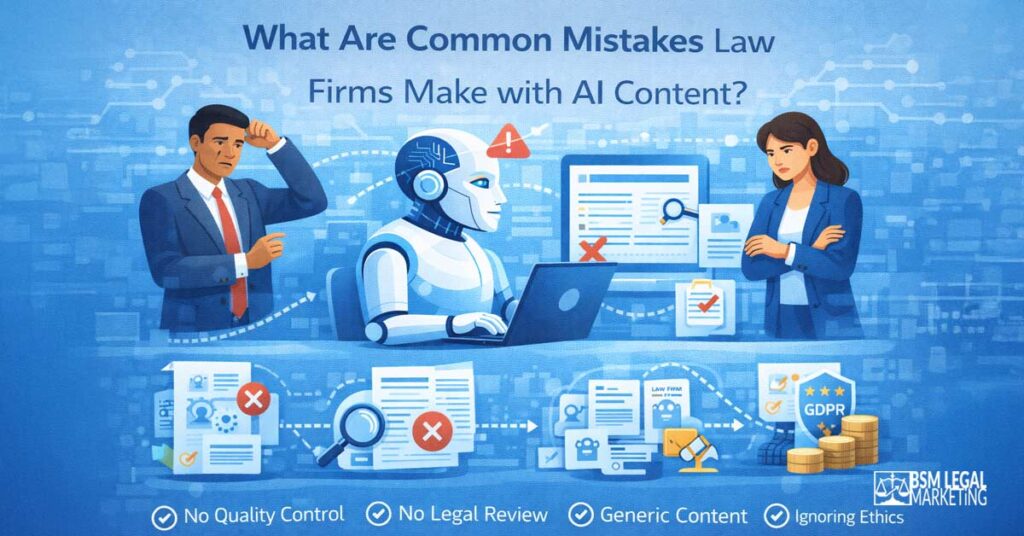
I see the same errors repeatedly.
Publishing AI Content Without Proper Review
Biggest mistake. Most dangerous mistake.
AI produces confident-sounding errors. It fabricates case citations. It applies wrong jurisdiction law. It gives outdated information.
Publishing without review risks:
- Misleading potential clients
- Damaging professional credibility
- Potential regulatory issues
- Undermining client trust
Always review. Always fact-check. Always verify.
Using Generic Prompts That Produce Generic Content
“Write a blog about divorce” produces worthless content.
Generic prompts create content that:
- Doesn’t answer specific client questions
- Lacks unique perspective or expertise
- Won’t rank on Google (too generic)
- Doesn’t differentiate your firm
Specificity wins. Detailed prompts produce valuable content.
Ignoring Your Law Firm’s Voice and Tone
AI’s default voice is formal, corporate, bland.
Without specific tone instructions, AI content sounds like every other law firm. It doesn’t reflect your personality, approach, or values.
Train AI on your voice. Feed it examples. Specify tone in every prompt. Edit output to sound like you.
Expecting AI to Handle Complex Legal Analysis
AI is brilliant at explanatory content. Terrible at nuanced legal analysis.
Don’t use AI for:
- Case strategy discussions
- Complex statutory interpretation
- Content requiring recent case law
- Jurisdiction-specific technical analysis
KAI’s limitations. Use it where it excels. Apply human expertise where it’s essential.
Not Tracking Results and Adjusting Strategy
Creating content without measuring results is pointless.
Track what works. Double down on successful topics. Abandon what doesn’t resonate.
AI helps you create more content. Analytics tells you which content matters. Use both.
How Do I Get Started with AI Content Creation for My Law Firm?

Starting is simpler than you think.
What’s a Practical 30-Day Content Implementation Plan?
Week 1: Foundation
- Choose one AI tool (start with ChatGPT Plus)
- Create account and familiarize yourself with interface
- Write 5 practice prompts for different content types
- Generate sample content and review quality
Week 2: Content Strategy
- List 20 client questions in your practice area
- Identify 3 blog topics to create
- Plan 1 month of social media content
- Outline 1 email campaign
Week 3: Production
- Generate and edit 2 blog posts
- Create 20 social media posts
- Draft 3 emails for welcome sequence
- Review and fact-check all content
Week 4: Publication and Measurement
- Publish blog posts to website
- Schedule social media content
- Set up email automation
- Implement tracking (Analytics, UTMs)
Which Content Type Should I Start With?
Start with blog posts.
Why? Blogs have the longest lifespan. They build SEO authority. They answer client questions. They demonstrate expertise.
Once you’re comfortable with blog content, expand to social media. Then email. Then more advanced content types.
How Much Should I Budget for AI Content Tools?
Budget depends on scale:
Starter budget (£50-100/month):
Professional budget (£150-300/month):
- Jasper AI: $59/month
- Semrush: from $165/month
- HubSpot Starter: $15/month
- Canva Pro: £100/year
Enterprise budget (£500+/month):
- ChatGPT Enterprise: Custom pricing
- Semrush Advanced: $455/month
- HubSpot Professional: $1,450/month
- SurferSEO: from $79/month
Start small. Scale as you see results.
Should I Train Staff or Outsource AI Content Creation?
In-house gives you control and flexibility. Outsourcing saves time but costs more.
Train staff if:
- You have someone with time and interest
- You want full control over content
- You produce content frequently
- Budget is limited
Outsource if:
- Nobody internal has capacity
- You need results immediately
- You prefer to focus on legal work
- Budget allows (£500-2,000/month for managed service)
Hybrid approach works well: outsource strategy and complex content, handle simple social posts and email internally with AI.
What’s the Future of AI Content Creation in Legal Marketing?

The future is already here. It’s not evenly distributed yet.
How will AI-Powered Search Change Legal Marketing?
Traditional search is dying. AI search is rising.
Instead of clicking through ten blue links, people ask ChatGPT, Perplexity, or Google AI. They get direct answers with citations.
This changes everything:
- Position one rankings matter less
- Being cited by AI matters more
- Content quality becomes critical (AI cites authoritative sources)
- Thin, keyword-stuffed content becomes worthless
Law firms that create genuinely helpful, well-structured content will dominate AI search results.
What New AI Tools Are Emerging for Lawyers?
AI development moves fast. New tools launch monthly.
Emerging capabilities:
- AI video generation for legal explainers
- Voice cloning for podcast content
- AI image generation for blog graphics
- Automated content repurposing (blog to social to email)
- Real-time content optimization
- Predictive analytics for content performance
How Can Law Firms Stay Ahead of AI Marketing Trends?
Staying ahead requires active learning.
Practical steps:
- Test new AI tools quarterly
- Follow legal tech news (Above the Law, Legal Futures)
- Join law firm marketing communities
- Attend legal marketing conferences
- Experiment with emerging platforms
- Track what competitors are doing
The firms that adopt AI early build advantages. The firms that wait fall behind.
You don’t need to be bleeding edge. But you can’t afford to ignore AI entirely.
Frequently Asked Questions

Is AI-generated content allowed under Law Society and SRA rules?
Yes, with proper oversight. The Law Society and SRA don’t prohibit AI content. They require lawyers to maintain responsibility for accuracy and ensure proper supervision of AI outputs. You must review, verify, and approve all AI-generated content before publication.
Can Google detect AI-generated content and penalize my website?
Google doesn’t penalize content for being AI-generated. Their guidance states they reward high-quality, helpful content regardless of creation method. The key is ensuring AI content is accurate, well-edited, and genuinely useful to readers. Poor-quality content gets penalized whether written by humans or AI.
How much time does AI save law firms on content creation?
AI typically reduces content creation time by 60-80%. A blog post taking 4-6 hours traditionally takes 1-1.5 hours with AI (generation, editing, fact-checking). Social media content for a month drops from 6-8 hours to 1.5-2 hours. Email campaigns reduce from 3-4 hours to 45 minutes.
What’s the biggest risk of using AI for legal content?
AI hallucinations, fabricated information presented confidently. AI might cite non-existent cases, provide outdated legal information, or apply wrong jurisdiction law. Always verify legal claims, case citations, time limits, and procedural requirements before publishing. Never skip fact-checking.
Should I tell clients that AI helped create content?
There’s no legal requirement to disclose AI use in marketing content. Most firms don’t. content accuracy and quality, not creation method. However, if your marketing emphasizes “personally handwritten” content, using AI contradicts that claim. Authenticity matters more than disclosure.
Can AI replace my law firm’s content writer?
Not entirely. AI excels at generating first drafts, creating social media posts, and producing volume. But it requires human oversight for legal accuracy, tone refinement, and strategic direction. Think of AI as enhancing human writers, not replacing them. You still need someone (lawyer or writer) to review and improve AI output.
How long before I see results from AI-generated content?
Expect 4-6 months for meaningful organic traffic growth. Content marketing is a long game. Months 1-3 build foundation with minimal results. Months 4-6 show traffic increases and first enquiries. Months 7-12 deliver compounding results with multiple monthly enquiries. Year 2+ creates consistent client flow.
What AI writing tool is best for solicitors in the UK?
ChatGPT Plus (£20/month) offers the best value for most UK law firms. It’s versatile, produces quality content, and handles various formats. Claude (Anthropic) is excellent for longer documents. Jasper AI (£40+/month) suits firms wanting built-in SEO tools and templates. Start with ChatGPT and expand based on needs.
How do I stop AI content sounding robotic and corporate?
Specify tone explicitly in prompts: “conversational, friendly, Grade 7 reading level, avoid legal jargon.” Feed AI examples of your best content to learn your voice. Always edit AI output to add personality. Cut formal phrases. Shorten sentences. Add your perspective and real examples. AI provides structure; you provide personality.
Can AI help with local SEO for my law firm?
Absolutely. AI generates location-specific content, optimizes Google Business Profile descriptions, creates local landing pages, and writes location-targeted social posts. Prompt: “Write a blog post about employment law for businesses in Manchester, mentioning local employment tribunals and Greater Manchester resources.” Local SEO improves when you publish location-specific content regularly.
What should I never use AI for in legal content?
Never use AI unsupervised for: specific client advice, court submissions, content requiring recent case law, complex statutory interpretation, confidential client matters, or anything where errors could cause harm. AI is for general educational content and marketing materials, not bespoke legal advice.
How do I measure ROI from AI content marketing?
Track business metrics, not vanity metrics. Measure: organic traffic from search, contact form submissions, phone calls (using call tracking), email list growth, content-sourced client instructions, and cost per acquisition. Use Google Analytics, CRM attribution, and UTM parameters. Calculate time saved versus content-driven revenue generated.
Can AI write practice-area-specific content accurately?
AI handles general practice-area content but struggles with technical nuance. It can explain constructive dismissal basics or probate processes effectively. But it might miss jurisdiction-specific details, recent case law, or procedural changes. Always have someone with practice-area expertise review content before publication.
What prompts work best for legal blog content?
Effective prompts include: role assignment (“You are an experienced legal writer”), specific task (“Write a 1,500-word blog post titled…”), audience definition (“For employees considering tribunal claims”), key requirements (definition, examples, time limits, next steps), reading level (Grade 7-8), and tone (conversational). The more specific your prompt, the better the output.
How often should law firms publish AI-generated content?
Consistency matters more than frequency. Aim for: 2-4 blog posts monthly, 3-5 social media posts weekly per platform, and 1-2 email newsletters monthly. AI makes this sustainable without burning out. Start with what you can review properly. Scale as you refine your process. Regular, quality content beats sporadic high volume.
Evidence & Metrics
Content speed uplift (practical range)
30–50% time saved
A realistic range for first-draft work and repurposing, when human review stays in place and prompts are standardised.
Marketing productivity potential
5–15% uplift
Independent research estimates generative AI can create meaningful productivity gains across marketing activities, depending on adoption quality and governance.
Search quality guidance
Helpful content wins
AI-generated content is acceptable when it is genuinely helpful and not produced at scale without adding value, accuracy, or usefulness.
UK marketing risk (legal sector)
Compliance still applies
Marketing rules apply whether content is human-written or AI-assisted. Claims must stay accurate, fair, and properly controlled.
Ethics guardrails (US lens)
Competence and confidentiality
Ethics opinions highlight the need for supervision, confidentiality protections, and competent use when relying on generative AI tools.
Safety and training gap
Process reduces risk
A simple policy, prompt library, and two-step review reduces hallucinations, inconsistency, and accidental over-claims.
Implementation & Targets
| What to implement | How to measure | Target / note |
|---|---|---|
| AI-assisted blogs, FAQs and service pages | Output per month · organic leads · conversion rate | 2x publishing cadence, 30–50% less drafting time, quality held by review |
| Repurposing system (one to many) | Assets per source piece · assisted conversions | 1 article becomes 6–12 assets, then refine based on lead quality |
| PPC ad variants and landing page testing | CTR · CVR · cost per lead · lead quality | 10–25% lower CPL while signed matters stay level or improve |
| Editorial QA (accuracy and compliance) | Review completion rate · errors caught | Two-step review: legal accuracy, then compliance and claims clarity |
| AI policy and approved tools list | Policy in place · staff training completion | One-page policy, approved tools only, and a sign-off log per asset |
Key References
References
[1] Clio. “AI Marketing for Law Firms.” https://www.clio.com/uk/blog/ai-marketing-law-firms/
[2] SpotDraft. “Glossary of AI Terms for Legal.” https://www.spotdraft.com/blog/glossary-of-ai-terms-legal
[3] IJIRT. “Natural Language Processing in Legal Domain.” https://ijirt.org/publishedpaper/IJIRT178986_PAPER.pdf
[4] Lexicon Legal Content. “AI-Generated Marketing Content for Lawyers: FAQs.” https://www.lexiconlegalcontent.com/ai-generated-marketing-content-for-lawyers-faqs1/
[5] Gatehouse Chambers. “ChatGPT – Generative AI and the Law.” https://gatehouselaw.co.uk/are-you-there-chatgpt-its-me-charlotte-chatgpt-generative-ai-and-the-law/
[6] Google Cloud. “What are AI hallucinations?” https://cloud.google.com/discover/what-are-ai-hallucinations
[7] John SLabs. “Legal NLP – Natural Language Processing for Legal Documents.” https://www.johnsnowlabs.com/legal-nlp/
[8] Conroy Creative Counsel. “Ethics and Compliance Guide: Using AI in Legal Marketing.” https://conroycreativecounsel.com/ethics-and-compliance-guide-using-ai-in-legal-marketing/
[9] The Barrister Group. “Oops! AI Made a Legal Mistake: Now What? AI Hallucinations, Professional Responsibility, and the Future of Legal Practice.” https://thebarristergroup.co.uk/blog/ai-made-a-legal-mistake#:~:text=The%20Law%20Society’s%20Generative%20AI:%20The%20Essentials%20codifies%20a%20threefold,Technical%20Causes%20of%20Hallucination
[10] The Solicitors Regulation Authority (SRA)”Marketing your services to members of the public – Warning notice.” https://www.sra.org.uk/solicitors/guidance/marketing-public/
[11] Baringa. “TRUST: transparency earns trust, and right now there isn’t enough of either. https://www.baringa.com/en/insights/balancing-human-tech-ai/trust/#:~:text=Transparency%20seems%20to%20matter.,and%20what%20may%20be%20trustworthy.
[12] EvenSpark. “Business Benefits of Blogging.” https://whitehat-seo.co.uk/blog/benefits-of-blogging-for-business#:~:text=For%20professional%20services%20firms%20specifically,for%20firms%20investing%20in%20it.
Previous Article
How Artificial Intelligence is Transforming Legal Marketing for Law Firms in the Age of AI