

Why SRA marketing compliance protects your reputation, and your profits
The Solicitors Regulation Authority doesn’t just set marketing rules to keep lawyers busy with paperwork.
These rules exist because one dodgy advert can destroy decades of hard-earned trust. And trust, as any successful solicitor knows, directly translates to client instructions and fee income.
I’m going to walk you through exactly what the SRA expects from your marketing. No legal jargon. No confusing interpretations. Just the practical guidance you need to market your services compliantly while actually growing your practice.
Who are the SRA and what is their role in regulating solicitors?
The Solicitors Regulation Authority (SRA) [1] is the independent regulatory body for solicitors and law firms in England and Wales. Think of them as the watchdog that protects the public while maintaining professional standards across the legal sector.
The SRA’s primary responsibilities include:
- Setting and enforcing professional conduct standards
- Regulating how solicitors can advertise and market their services
- Investigating complaints about solicitor conduct
- Taking disciplinary action when rules are breached
- Protecting client money through compensation schemes
Unlike the Law Society, which represents solicitors’ interests, the SRA focuses solely on regulation and public protection. They have significant powers including the ability to fine firms, restrict practices, and even strike solicitors off the roll in serious cases.
Why the SRA regulates marketing so strictly
Legal services are what regulators call “credence goods,” clients often can’t judge quality until after the service is delivered, and sometimes not even then. This information imbalance makes consumers vulnerable to misleading claims.
The SRA recognises that poor marketing doesn’t just harm individual clients. It damages public trust in the entire legal profession. That’s why their legal marketing rules focus heavily on accuracy, transparency, and protecting vulnerable consumers from aggressive sales tactics.
The SRA’s enforcement approach
The regulator takes a proportionate but firm stance on marketing breaches. They consider factors like:
- The seriousness of the misleading information
- Whether vulnerable clients were targeted
- The firm’s compliance history
- Steps taken to remedy any problems
Recent enforcement actions show the SRA won’t hesitate to act when firms breach marketing rules, particularly around unsolicited approaches to accident victims or misleading “no win, no fee” advertising.
Understanding the SRA’s core marketing principles

The SRA built their marketing rules on five fundamental principles. Think of these as your marketing North Star, every advertisement, website page, and social media post should align with them.
Principle 2: Demands you act in ways that uphold public trust and confidence. This isn’t about being boring. It’s about being believable.
Principle 4: Requires honesty in all communications. No exaggerated claims about success rates. No misleading testimonials.
Principle 5: Focuses on integrity. Your marketing should reflect the same professional standards you bring to client work.
Principle 7: Puts client interests first. This means your marketing promises must align perfectly with what you actually deliver.
The SRA’s research reveals something fascinating: solicitors care more about professional reputation than regulatory penalties [2]. The fear of reputational damage drives compliance behaviour more than any fine ever could.
The accuracy and transparency requirements every solicitor must know
Rule 8.8 of the SRA Code of Conduct couldn’t be clearer: all publicity must be “accurate and not misleading” [3].
But what does “misleading” actually mean in practice?
The SRA provides specific examples that trip up many law firms:
- Exaggerated claims about case success prospects
- Inaccurate statements about likely damage awards
- Unverifiable client testimonials
- False claims about awards or credentials
- Failing to mention free ombudsman services
Cost transparency sits at the heart of compliance. Rule 8.7 requires you to provide clients with the “best possible information” about pricing. This applies both at engagement and as matters progress.
Many solicitors worry this means publishing their full fee structure online. It doesn’t. But it does mean being upfront about how you charge, what additional costs might arise, and when clients might face liability for the other side’s costs.
The SRA specifically highlights “no win, no fee” marketing as high-risk. If you use this phrase, you must clearly explain what happens if:
- A client discontinues their claim mid-way through
- Your firm fails to maintain After The Event insurance properly
- Other scenarios where the client could become liable for costs
The ban on unsolicited approaches: what you can and cannot do
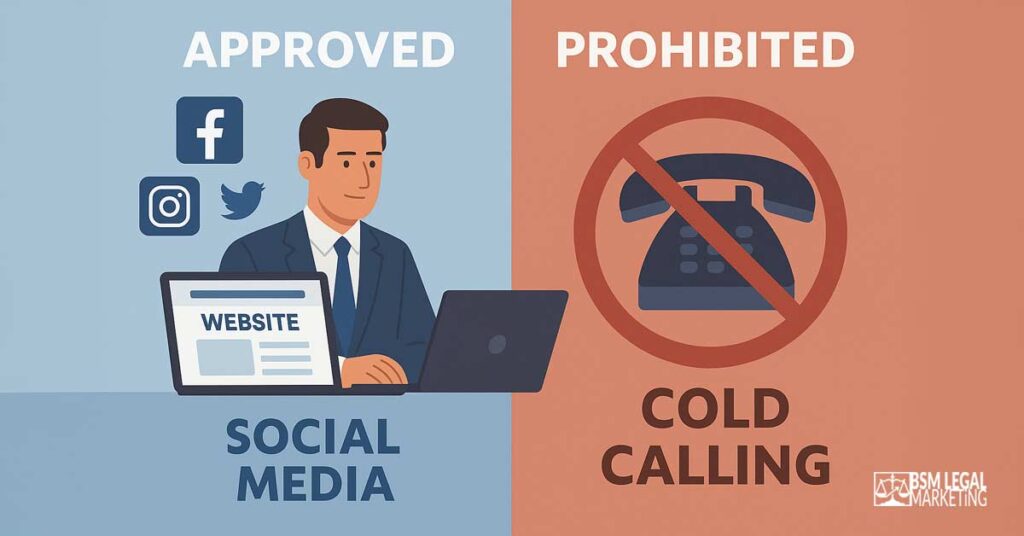
Rule 8.9 establishes a clear prohibition: “You do not make unsolicited approaches to members of the public, with the exception of current or former clients, in order to advertise legal services” [4].
The SRA defines prohibited approaches as:
- Cold calling potential clients
- Door-to-door canvassing
- Targeted letters to accident victims identified through media reports
- Direct LinkedIn messages to non-clients offering legal services
But plenty of marketing channels remain completely permissible:
| Marketing Method | SRA Status | Key Considerations |
|---|---|---|
| Google Ads (PPC) | ✅ Permitted | General advertising available to public |
| Content marketing (blogs) | ✅ Permitted | Provides value that people seek out |
| Email to former clients | ✅ Permitted | Explicitly allowed under Rule 8.9 |
| Non-targeted leaflet drops | ✅ Permitted | Not approaching specific individuals |
| Cold calling prospects | ❌ Prohibited | Quintessential unsolicited approach |
| Targeted accident victim letters | ❌ Prohibited | Using vulnerability-based targeting |
| LinkedIn messages to strangers | ❌ High risk | Likely viewed as cold calling |
The SRA warns specifically about remarketing campaigns. These require careful consideration to avoid crossing the line between helpful reminders and intrusive pursuit.
Third-party marketing partners: your compliance responsibilities
Here’s where many solicitors make a costly mistake. They assume that because a claims management company or lead generator isn’t SRA-regulated, different rules apply.
They’re wrong.
Rule 5.1(e) makes you fully accountable for how any third party acquires clients on your behalf. The SRA states clearly: “It is not acceptable to say that the third party was not regulated by the SRA and so not subject to the prohibition on cold calling” [5].
Your due diligence must include:
Documentation requirements:
- Written evidence of the partner’s SRA compliance training
- Detailed methodology for lead generation
- Source documentation for any contact databases
- Copies of all marketing materials used on your behalf
Ongoing monitoring obligations:
- Regular spot checks on new clients asking how they were contacted
- Quarterly reviews of marketing materials
- Written confirmation that no unsolicited approaches occurred
Red flags that should concern you:
- Partners who can’t explain their lead sources clearly
- Unusually cheap leads (often indicates non-compliant acquisition methods)
- Reluctance to share marketing materials or processes
- Claims about “opt-in survey data” without clear consent documentation
Digital marketing compliance: navigating GDPR and PECR alongside SRA rules
SRA compliance is necessary but not sufficient for lawful digital marketing. You must also navigate UK GDPR [6] and the Privacy and Electronic Communications Regulations (PECR) [7].
The philosophical alignment is clear: an approach that violates SRA rules on unsolicited contact will almost certainly breach PECR’s consent requirements for electronic marketing.
Key data protection concepts for legal marketers:
Lawful basis for processing: You need either explicit consent or legitimate interests to process personal data for marketing purposes.
PECR’s electronic marketing rules: For new prospects, you generally need specific opt-in consent before sending marketing emails or SMS messages.
The “soft opt-in” exception: You can market similar services to existing clients, provided you collected their details during a sale and offered clear opt-out options.
This dual-compliance framework means effective digital marketing requires expertise in both legal professional conduct and data protection law.
Building compliant marketing systems within your firm
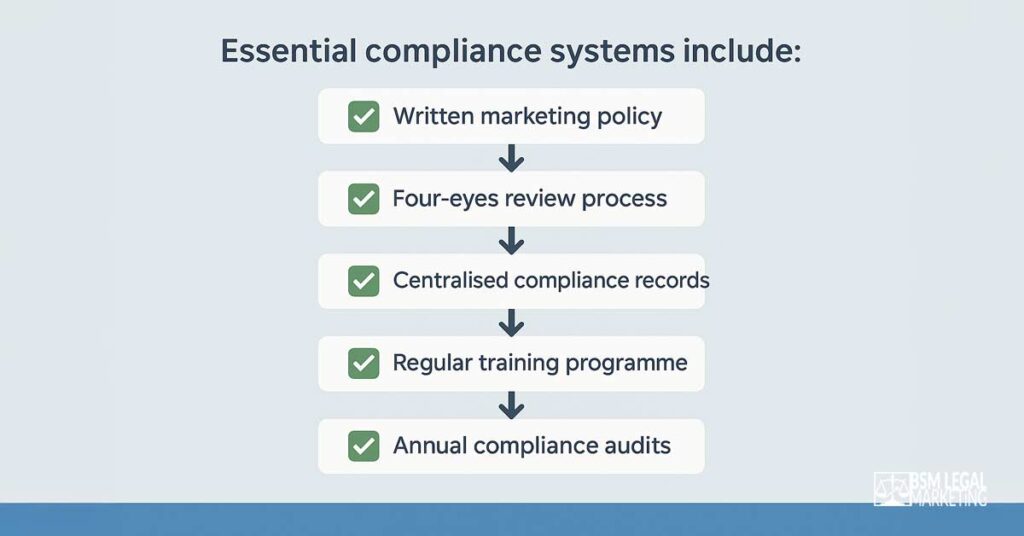
Compliance cannot be an afterthought or one person’s responsibility. Rule 2.1 of the Code of Conduct for Firms requires “effective governance structures, arrangements, systems and controls” for all regulatory compliance [8].
Essential compliance systems include:
Written marketing policy: Document your firm’s position on publicity, unsolicited approaches, and third-party relationships. Include clear approval processes for all marketing materials.
Four-eyes review process: Never publish external-facing content without two-person sign-off. One reviewer should have specific SRA marketing knowledge.
Centralised compliance records: Maintain accessible records of major campaigns, key materials, and third-party agreements as required by Rule 2.2.
Regular training programme: All marketing staff and business development teams need practical, role-specific training on compliant marketing principles.
Annual compliance audits: Your COLP or designated compliance lead should formally review websites, marketing materials, and agency agreements at least annually.
What happens when firms get marketing compliance wrong
The SRA doesn’t just issue guidance, they take enforcement action when solicitors breach marketing rules.
Recent warning notices highlight common violations:
- Claims management companies making unsolicited approaches on behalf of law firms
- Misleading “no win, no fee” advertising that doesn’t explain client cost risks
- Firms failing to monitor how third parties acquire clients
The enforcement consequences extend beyond regulatory sanctions. The SRA’s research shows solicitors fear reputational damage more than penalties. An SRA investigation creates a “no smoke without fire” perception that can damage client confidence regardless of the final outcome.
Financial implications include:
- Direct regulatory fines and costs
- Lost client instructions due to reputational concerns
- Increased professional indemnity insurance premiums
- Time costs of dealing with investigations
Making compliance your competitive advantage
Smart solicitors don’t view SRA marketing rules as restrictions, they see them as quality standards that separate professional firms from cowboys.
Compliant marketing builds trust faster. When potential clients see transparent pricing, honest success rate discussions, and clear service explanations, they’re more likely to choose your firm over competitors making unrealistic promises.
The regulatory framework protects your reputation. Following SRA rules means never having to worry about enforcement action damaging your professional standing.
Compliance drives better business decisions. The discipline required for compliant marketing forces you to think clearly about your value proposition, target clients, and service delivery promises.
The most successful law firms don’t just follow SRA marketing rules, they exceed them. They use compliance as the foundation for building marketing that actually converts prospects into paying clients.
Frequently asked questions about SRA marketing compliance
Can solicitors advertise their services without breaching SRA rules?
Absolutely. The SRA doesn’t ban advertising, they regulate how you advertise. Focus on accuracy, transparency, and avoiding unsolicited approaches.
What constitutes an unsolicited approach under SRA rules?
Any individual targeting of non-clients through phone, email, post, or in-person contact. General advertising available to the public (like Google Ads or billboards) is fine.
Can law firms use lead generation companies?
Yes, but you remain fully responsible for how they acquire clients. You must verify they don’t use cold calling or other prohibited methods.
How should firms handle price transparency requirements?
Be upfront about how you charge, what additional costs might arise, and scenarios where clients could face liability. You don’t need to publish exact fees, but you must give clear cost information.
Do SRA rules affect social media marketing?
Yes. All social media content must be accurate and not misleading. Avoid direct messaging non-clients to offer services, as this could constitute an unsolicited approach.
What are the penalties for breaching SRA marketing rules?
Penalties range from written warnings to fines and practice restrictions. The SRA considers the seriousness of the breach, any harm caused, and the firm’s compliance history.
References
[1] The Solicitors Regulation Authority (SRA)
[2] SRA Research: Solicitor attitudes to regulation and compliance
[3] SRA Code of Conduct for Solicitors
[4] SRA Code of Conduct for Solicitors, Rule 8.9
[5] SRA Warning Notice: Marketing your services to members of the public
[6] UK General Data Protection Regulation
[7] the Privacy and Electronic Communications Regulations (PECR).
[8] SRA Code of Conduct for Firms