
You’re Wasting Marketing Budget Right Now (And You Don’t Even Know It)
AI-Overview Optimised
Local SEO KPIs & Reporting for Law Firms
Keyboard-friendly tabs. Mobile-ready. Compliance-aware.
Measure local SEO by enquiries, not impressions: GA4 generate_lead, GBP calls/directions/site clicks, GSC “service + city” filters, monthly per-location reporting with conversion rate, rating, and review cadence.
KPIs that actually matter
- GA4 key event: generate_lead (forms, booked consults).
- GBP actions: calls, directions, website clicks, messages.
- GSC: impressions, clicks, CTR, average position for “service + city”.
- Reviews: average rating and replies (prominence signal).
Monthly report (per location)
- Leads, conversion rate, signed-case rate (if tracked).
- GBP actions trend and review cadence.
- Top queries (GSC) and landing pages.
- Actions: what we’ll test next month.
Tip: export GBP performance for location comparisons; save GA4 and GSC Explorations for repeatable snapshots.
74% of law firms believe they’ve thrown money away on marketing that delivered nothing.[1]
Most solicitors can’t prove whether their campaigns worked. They’re flying blind, spending thousands each month with zero idea what’s coming back. If you’re investing in local SEO for lawyers without tracking the right metrics, you’re gambling with your firm’s future. Without clear KPIs to monitor, even the best SEO campaign will fail to deliver measurable results.
Why Local SEO KPIs Matter for Your Law Firm
You don’t need more website traffic. You need more paying clients.
Law firms now spend an average of 3.1% of turnover on marketing.[3] For a firm turning over £10 million, that’s £310,000 a year on digital marketing and other channels.
65% of lawyers admit they don’t know which metrics to track.[4] They’re approving budgets and making decisions based on gut feeling rather than data from an SEO tool or tracking tool.
Understanding what is local SEO is the start. Measuring SEO success and tracking SEO results separates firms that grow from those that stagnate. Without proper SEO tracking, you’re essentially investing in local SEO blindly. Your marketing strategies must be built on concrete data, not assumptions.
The ROI Crisis in Legal Marketing
96% of people seeking legal advice start with an online search.[4]
Most firms can’t answer: Are potential clients finding you in search engine results? Are they calling?
They know their spending. They might know website traffic. But they can’t connect marketing spend to new client instructions. This is the fundamental challenge facing the legal industry today: measuring SEO effectiveness without proper tracking systems.
What Makes Local SEO Different for Law Firms
When someone searches “family solicitor Manchester,” they need help now. That search intent differs from someone researching “how divorce works in the UK.”
Your law firm SEO strategy and KPIs need to reflect that urgency. Understanding local keywords and how they differ from broader search terms is fundamental to your legal SEO strategy.
The Google Local Pack drives 42% of all clicks for local searches.[5] Not appearing there means you’re invisible to nearly half your potential clients. This is why tracking your local search performance is critical for any attorney SEO or SEO for lawyers initiative. Your visibility in local search results directly determines how many qualified prospects find you.
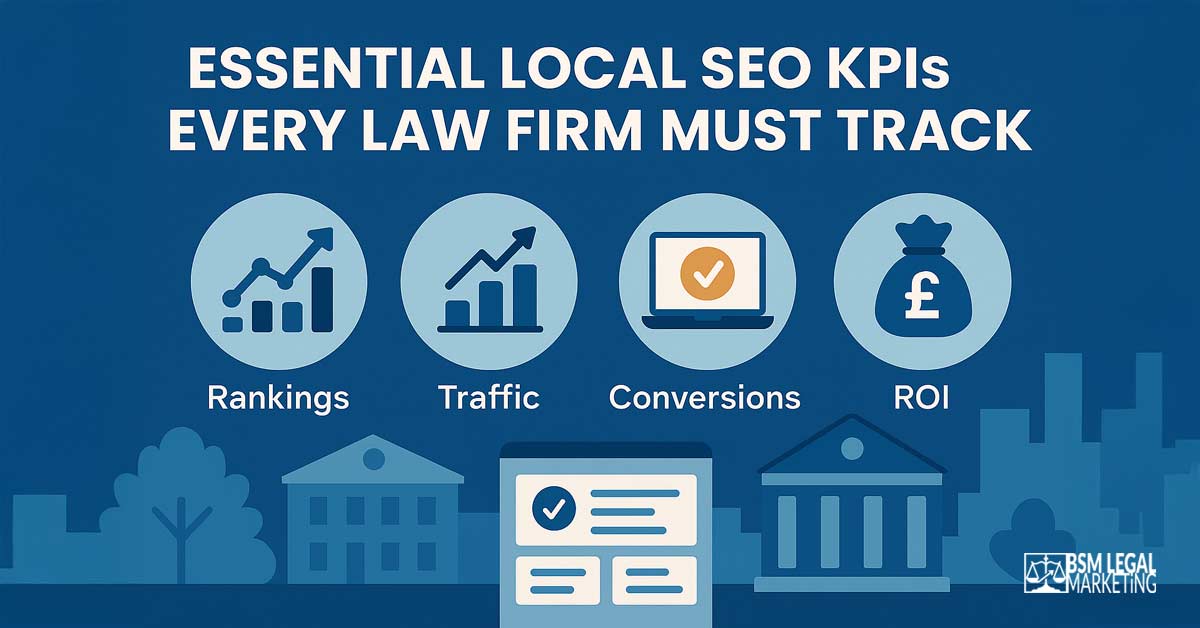
The Essential Local SEO KPIs Every Law Firm Must Track
Vanity metrics feel good but pay no bills. Your SEO agency might report 10,000 website visits. How many became clients?
These essential KPIs form the foundation of any successful local SEO for lawyers campaign. Without tracking SEO performance across these categories, you can’t measure the success of your efforts. These are the important SEO metrics that actually impact your bottom line and help improve your law firm’s market position. Understanding which KPIs to monitor is the difference between guessing and knowing what drives results.
| KPI Category | Primary Metrics | Why It Matters | Tracking Frequency |
|---|---|---|---|
| Visibility | Local Pack presence, average position | Shows if prospects can find you | Weekly |
| Engagement | GBP views, website clicks, calls | Measures interest level | Weekly |
| Conversion | Qualified leads, cost per lead | Proves ROI | Daily |
| Reputation | Review count, rating, response rate | Builds trust and rankings | Daily |
Visibility Metrics: Are You Even Being Seen?
Before anyone can call you, they need to find you in search engine results. These visibility metrics reveal whether your local SEO efforts are actually getting your law firm website in front of potential clients.
Local Pack Presence Rate
Track how often you appear in the Local Pack for target keywords. Check weekly for terms like “solicitor [your area]” and “[practice area] lawyer near me.”
Below 30% presence means you’re losing clients daily. Above 70% means you’re dominating. This is the first metric to check when measuring SEO visibility and one of the most critical KPIs for your law firm’s local performance.
Average Local Ranking Position
Position 1-3 in the Local Pack captures most clicks. Positions 4-10 get scraps. Below page one? You don’t exist.
BrightLocal or Local Falcon track rankings across multiple locations. Check monthly to spot trends. Tracking SEO results at this granular level helps you understand exactly where you stand against competitors.
Map Pack Click-Through Rate
Healthy CTR for legal services ranges from 3-7%.[6] Lower means your profile needs work. Better photos, more reviews, or stronger service descriptions can double your CTR overnight. This metric directly shows how your law firm’s website listing converts visibility into actual traffic.
Google Business Profile Analytics
Check these monthly:
Total Views (Search vs Direct)
Search views mean people found you by searching. Direct views mean they already knew your name.
You want search views growing month-on-month.
Customer Actions
Track separately:
- Website clicks
- Direction requests
- Phone calls
Phone calls are critical. For most law firms, 80% of new instructions start with a call.[7]
Photo Views and Quantity
Profiles with photos get 42% more direction requests and 35% more clicks.[8]
Upload at least one new photo weekly.
| Google Business Profile Metric | What It Tells You | Target Benchmark | Check Frequency |
|---|---|---|---|
| Search Views | New discovery potential | Month-on-month growth | Weekly |
| Direct Views | Brand awareness | Lower than search views | Weekly |
| Website Clicks | Interest level | 10-15% of total views | Weekly |
| Phone Calls | Genuine leads | 5-10% of total views | Daily |
| Direction Requests | Local intent | 3-5% of total views | Weekly |
| Photo Views | Profile engagement | Growing weekly | Monthly |
Website Engagement Metrics
Organic Sessions from Target Locations
Filter Google Analytics to show only visitors from your service area. This helps you focus on local search results that actually matter to your practice.
Set up location-based segments in GA4 for within 10 miles, 20 miles, and broader region.
Mobile vs Desktop Traffic Split
57% of local searches happen on mobile.[9] If your mobile traffic is below 50%, something’s wrong.
Check mobile bounce rate separately. Above 60%? Your site frustrates mobile users.
Bounce Rate and Time on Page
For legal services, bounce rate should be below 50%. Time on page should exceed 2 minutes for service pages.
Compare metrics for traffic from local landing pages versus general pages.
Pages per Session
2-3 pages is healthy. It means visitors explore your services. One page and out means they didn’t find what they needed. This engagement metric reveals whether your law firm’s website successfully guides visitors toward conversion or loses them immediately.
Lead Generation & Conversion Metrics
These metrics connect marketing spend directly to revenue. For any SEO for lawyers campaign, conversion tracking is where you prove actual business value.
| Lead Metric | What It Measures | Calculation | Target Benchmark |
|---|---|---|---|
| Qualified Leads | Total opportunities | Count of valid inquiries | 20+ per month |
| Cost Per Lead | Efficiency | Total spend ÷ leads | £60-£300 (varies) |
| Lead-to-Client Rate | Conversion quality | Clients ÷ leads × 100 | 15-30% |
| Phone Call Volume | Immediate intent | Tracked calls | Growing monthly |
| Form Submissions | Digital engagement | Goal completions | 30-50% of leads |
Qualified Local Leads
A qualified lead means:
- From your service area
- Needs services you provide
- Has a legitimate legal issue
- Can afford your fees
Track qualified leads separately from general inquiries.
Firms generating fewer than 20 qualified local leads monthly are underperforming. 50+ puts you in the top 20%.
Form Submissions and Contact Methods
Track each channel separately. Phone calls typically convert at 2-3 times the rate of form submissions.[7]
Lots of form fills but few phone calls means:
- Your phone number isn’t prominent enough
- People don’t trust you enough to call
- Your website works but your brand needs work
Set up goals in Google Analytics for:
- Contact form submissions
- Phone number clicks (mobile)
- Live chat initiations
- Direction requests from Google Business Profile
Cost Per Lead
Total monthly marketing spend divided by qualified leads generated.
UK law firm averages by practice area:
- Conveyancing: £40-80
- Family Law: £60-150
- Personal Injury: £150-300+
- Commercial Law: £200-500+[10]
Double these benchmarks means your targeting is off or your local link building efforts aren’t working. Understanding these local SEO targets helps you set realistic expectations and identify when your SEO efforts need adjustment.
Lead-to-Client Conversion Rate
What percentage of leads become paying clients?
Target: 15-30%.[11]
Below 10%? The problem isn’t your marketing. It’s your sales process, pricing, or service offering.
Track by lead source. Do Google Business Profile leads convert better than website forms? This data shows where to invest and where to cut. Tracking these conversion patterns is one of the most important SEO metrics for understanding the true ROI of your SEO campaign.
Call Tracking: The Missing Link
If you’re not tracking phone calls, you’re tracking nothing.
Most law firm instructions start with a phone call. Without call attribution, you can’t calculate ROI. This is arguably the most critical aspect of tracking SEO for any attorney SEO strategy.
Call tracking software like CallRail or ResponseTap gives each marketing channel a unique phone number. When it rings, you know exactly which campaign drove it.
Dynamic Number Insertion
Shows different phone numbers to different visitors based on how they found you.
AI Call Scoring and Transcription
Records calls, transcribes them, and uses AI to score quality.
You see which calls were genuine inquiries versus spam. You review how reception handles initial contact.
Firms using AI call scoring report 50% better lead qualification and 30% faster client onboarding.[12]
Reputation & Review Metrics

88% of consumers trust online reviews as much as personal recommendations.[13]
| Review Metric | Target | Why It Matters | Check Frequency |
|---|---|---|---|
| New Reviews | 2-4 per month | Fresh reviews boost rankings | Weekly |
| Average Rating | 4.3-4.8 stars | Below 4.0 repels clients | Daily |
| Response Rate | 100% | Shows you care, helps rankings | Daily |
| Response Time | Under 48 hours | Demonstrates attentiveness | Daily |
Review Volume and Growth Rate
Google’s algorithm loves fresh reviews. A firm with 50 reviews from three years ago ranks below a firm with 30 reviews from the last six months.
You need a systematic local reviews strategy generating 2-4 new reviews monthly.
Average Star Rating
Minimum viable rating: 4.0 stars. Below that actively repels potential clients.
Sweet spot: 4.3-4.8. A perfect 5.0 can hurt you. People suspect fake reviews.
Review Response Rate and Speed
Responding to reviews is a ranking signal.[14] Firms that respond to 100% of reviews rank higher. This is one of the critical ranking factors for law firms that’s often overlooked.
Policy: respond to every review within 48 hours.
For negative reviews, respond professionally and offer to resolve offline. Never argue publicly.
Sentiment Analysis
Tools like ReviewTrackers or Birdeye analyse language in reviews to identify common themes.
Are people praising your communication? Complaining about fees? Mentioning how easy you were to find?
Tools for Tracking Local SEO KPIs
| Tool Category | Solutions | Key Features | Cost |
|---|---|---|---|
| Web Analytics | Google Analytics 4 | Traffic, conversions, behaviour | Free |
| Search Performance | Google Search Console | Rankings, clicks, queries | Free |
| Local Rank Tracking | BrightLocal, Local Falcon | Local Pack position, heat maps | £40-150/month |
| Citation Management | Whitespark, BrightLocal | Directory listings, consistency | £40-100/month |
| Call Tracking | CallRail, Ruler Analytics | Call attribution, recording | £30-200/month |
| Review Management | Birdeye, ReviewTrackers | Multi-platform monitoring | £100-300/month |
| Reporting Dashboard | Google Looker Studio, AgencyAnalytics | Custom reports, portals | Free-£100/month |
Google Analytics 4
Set up:
- Location-based segments for service areas
- Event tracking for phone clicks and form submissions
- Custom reports showing organic traffic by landing page
Create a monthly dashboard showing:
- Total organic sessions from local searches
- Top performing local landing pages
- Conversion rate by traffic source
- Geographic breakdown of visitors
Google Search Console
Filter for queries containing your location (e.g., “Birmingham,” “near me,” “local”). Track separately from general keywords.
Pay attention to:
- Impressions (how often you appear)
- Click-through rate (percentage who click)
- Average position (where you rank)
Growing impressions with static clicks means people see you but don’t click. Your titles and descriptions need work.
Local SEO Platforms
BrightLocal offers:
- Local Pack rank tracking
- Citation building and monitoring
- Review management across platforms
- Competitor comparison reports
Local Falcon provides:
- Heat maps showing where you rank geographically
- Granular tracking across entire cities
- Visual reports for non-technical stakeholders
Whitespark specializes in:
- Citation discovery and building
- Review monitoring
- Local rank tracking by postcode
Call Tracking Solutions
CallRail (from £30/month):
- Dynamic number insertion
- Call recording and transcription
- Integration with Google Analytics and CRMs
- AI-powered call scoring
Ruler Analytics (from £199/month):
- Advanced multi-touch attribution
- Revenue tracking by marketing source
- Full customer journey visibility
Moneypenny (custom pricing):
- Call tracking plus live answering service
- Designed for UK law firms
- Integration with legal practice management software[12]
Building Your Reporting Framework
Your monthly report should answer three questions in 10 minutes:
- What’s working?
- What’s not working?
- What are we doing about it?
This framework is essential for measuring the success of your local SEO for lawyers investment and communicating results to stakeholders. Your reporting should demonstrate the success of your law firm’s digital presence clearly and concisely.
Monthly Performance Reports
Executive Summary
- Total qualified leads this month vs last month
- Cost per lead
- Lead-to-client conversion rate
- Month-on-month change in Google Business Profile calls
One paragraph summarizing performance.
Visibility Metrics
- Local Pack rankings for top 10 keywords (table)
- Average ranking position trend (3-6 month graph)
- Google Business Profile views and actions
Engagement Metrics
- Website sessions from local searches
- Top performing local landing pages
- Bounce rate and average session duration
- Mobile vs desktop split
Conversion Metrics
- Total leads by source (table)
- Cost per lead by channel
- Lead quality score
- Conversion rate trends
Reputation Metrics
- New reviews this month
- Current average rating
- Review response rate
- Top mentioned keywords in reviews
Action Items
Three specific actions for next month with deadlines.
Quarterly Strategic Reviews
Every three months:
- Are we targeting the right keywords?
- Do local landing pages need refreshing?
- Has the competitive landscape changed?
- Should we expand to new practice areas or locations?
Use this time to:
- Review citations for accuracy
- Audit competitors’ strategies
- Analyse which content drives conversions
- Plan next quarter’s priorities
Setting Realistic Benchmarks
Year one timeline:
- Months 1-3: Set up tracking, fix technical issues, address any technical SEO problems
- Months 4-6: Build citations, generate first reviews
- Months 7-9: See initial ranking improvements
- Months 10-12: See meaningful lead growth
Realistic year-one goal: 50-100% increase in organic local leads. Year two: another 30-50% growth. These benchmarks help you evaluate your law firm’s SEO performance against realistic expectations.
| Reporting Timeframe | Key Activities | Primary Metrics | Decision Type |
|---|---|---|---|
| Weekly | Quick health check | GBP views, calls, new reviews | Tactical adjustments |
| Monthly | Performance analysis | All KPIs, trends, ROI | Campaign optimization |
| Quarterly | Strategic review | Competitive position, market changes | Strategic pivots |
| Annually | Full business impact | Revenue attribution, CLV, market share | Budget allocation |
Advanced Analytics
Multi-Touch Attribution
Most law firms credit the last touchpoint. Someone clicks a Google ad, calls, becomes a client. Google Ads gets credit.
But what if they first found you through organic search two weeks ago? Then saw a Facebook post? Then clicked the ad?
Multi-touch attribution tracks the entire journey and assigns credit proportionally. This reveals the true value of your local SEO for lawyers efforts and helps you measure the success of each touchpoint in your law firm SEO strategy.
Tools like Ruler Analytics and HubSpot offer this. Essential for firms spending £5,000+ monthly.
Offline Conversion Tracking
Someone might see your Local Pack listing, visit your office without clicking anything, and instruct you immediately.
Ask every new client: “How did you first hear about us?” Record this in your practice management system.
Integrating Practice Management Data
Pull monthly reports showing:
- New client count by referral source
- Average case value by source
- Client lifetime value by source
When you know Google Business Profile leads generate an average £8,000 in fees while Facebook leads average £3,000, your budget allocation becomes obvious.
Competitive Intelligence
Track competitors monthly:
- Their Local Pack rankings for your top keywords
- Their review count and rating
- New content they’re publishing
- Citation sources they have that you don’t
Understanding where competitors appear in search engine results helps you identify opportunities and gaps in your own strategy. This competitive analysis is a key component of tracking your local performance within the legal industry. Analysing their local SEO efforts reveals what’s working in your market and where you can gain an advantage.
Common Reporting Mistakes
Mistake 1: Tracking Vanity Metrics
Traffic, impressions, and page views mean nothing without conversion data. Always tie metrics back to business outcomes.
Mistake 2: Irregular Reporting
Set a fixed schedule. Review Google Business Profile insights every Monday. Run full reports on the first of each month. Quarterly reviews the first week of January, April, July, October.
Mistake 3: Ignoring Negative Trends
Traffic down 20%? Investigate immediately. Is it seasonal? Did Google update its algorithm? Did a competitor launch? Has your Google Business Profile been suspended?
Mistake 4: Not Sharing Data
Share reports with everyone. When your team knows most instructions come from local landing pages, they’ll be more motivated to contribute content. Transparency about your SEO efforts creates buy-in across the entire firm and helps everyone understand how to improve your law firm’s online performance.
Mistake 5: Death by Dashboard
Some firms create reports with 47 metrics, 12 graphs, 8 pages.
Nobody reads them.
Show the 5-7 metrics that drive decisions. Everything else is noise.
Compliance and Ethics

The Solicitors Regulation Authority (SRA) has specific rules about legal marketing.[15]
SRA Advertising Rules
Your marketing must not be misleading. This extends to internal reports.
You cannot:
- Make unsolicited approaches to members of the public
- Make misleading claims about success rates
- Misrepresent credentials or awards
When reporting performance, be honest. If a campaign failed, say so.
Your internal reports might be disclosed in disputes or regulatory investigations.
Data Transparency with Clients
If reporting to clients (for PI cases where they cover marketing costs), they need full transparency.
Explain what each metric means in plain English. Show exactly where their money went. Prove the connection between spend and results.
Ethical Considerations for Review Generation
Your local reviews strategy must comply with Google’s policies and SRA rules.
You can:
- Ask satisfied clients for reviews
- Provide direct links to review profiles
- Thank clients who leave reviews
You cannot:
- Offer incentives for reviews
- Write fake reviews
- Ask clients to remove negative reviews
Track your review solicitation in your CRM.
Real-World Case Studies
Case Study 1: Family Law Firm in Manchester
Starting position (January 2024):
- Local Pack ranking: Position 8-12
- Monthly qualified leads: 12
- Cost per lead: £245
- Google Business Profile: 23 reviews, 3.9 stars
12 months later (January 2025):
- Local Pack ranking: Position 1-3 consistently
- Monthly qualified leads: 47
- Cost per lead: £98
- Google Business Profile: 67 reviews, 4.6 stars
They started tracking granular data. They discovered local landing pages for specific Manchester neighbourhoods drove 3x more conversions.
They doubled down on hyperlocal content. They built local links from community organizations. They implemented a systematic review request process.
They tracked everything and optimized based on data. By consistently measuring SEO performance and tracking SEO results, they were able to measure the success of each initiative and adjust their strategy accordingly.
Case Study 2: Personal Injury Firm in London
They spent £8,000 monthly on Google Ads with no call tracking.
We implemented:
- CallRail with dynamic number insertion
- AI call scoring to identify genuine PI inquiries
- Integration with case management system
- Weekly reporting of calls-to-cases conversion
Within 90 days:
- 40% of calls were non-PI inquiries
- “Car accident” keywords cost between £5 to £20 per click but converted at 25%
- “No win no fee” keywords cost between £13 to £35 per click but converted at only 8%
They reallocated budget from “no win no fee” to “car accident” terms. Same total spend. Lead quality improved 60%. Cost per case dropped from £720 to £440.
Case Study 3: Small Conveyancing Firm in Bristol
Two-person firm. Limited budget.
They focused on free tools:
- Google Business Profile optimized perfectly
- Weekly posts about Bristol property market
- Citations built to 50+ directories
- Monthly review requests
Tracked everything in a spreadsheet.
Six months in:
- Google Business Profile calls up from 4/month to 18/month
- Local Pack ranking moved from position 7 to position 2
- Cost per lead: essentially £0 (just time investment)
Small firms can compete with disciplined tracking and optimization. You don’t need an expensive SEO agency to see results, just consistent effort and the right tracking tool to monitor your progress.
Your 30-Day SEO Tracking Action Plan
This comprehensive SEO tracking implementation plan will help you establish the foundation for measuring SEO success across all your local marketing efforts.
Week 1: Audit Your Current Tracking
Day 1-2: Assess What You Have
Log into:
- Google Analytics
- Google Search Console
- Google Business Profile
- Other marketing platforms
Take screenshots. This is your baseline for tracking your local performance.
Day 3-4: Identify the Gaps
Which essential KPIs can you currently measure? Which are missing?
Make a list. Prioritize by impact and ease. This gap analysis reveals exactly what you need to implement to start properly tracking SEO across your entire digital footprint.
Day 5-7: Clean Your Data
Check Google Analytics tracking. Test contact forms. Verify Google Business Profile information is accurate.
Fix obvious issues before building new reports. This includes addressing basic technical SEO problems that might be blocking your visibility in local search results.
Week 2: Implement Essential Tracking
Day 8-10: Set Up Call Tracking
Top priority. Choose CallRail and implement it on your website.
Track calls from Google Business Profile separately from your website.
Day 11-12: Configure Google Analytics
Set up:
- Goals for form submissions
- Event tracking for phone number clicks
- Location-based audience segments
- Custom reports for local organic traffic
These configurations ensure you’re capturing all the data you need to track your law firm website’s performance accurately.
Day 13-14: Create Review Monitoring System
Set up Google Alerts for your law firm name + “review“.
Connect Google Business Profile to your email for review alerts.
Decide who responds. Set a 48-hour response policy.
Week 3: Build Your Reporting Dashboard
Day 15-17: Choose Your Reporting Tool
Google Data Studio (Looker Studio) is free and integrates with all Google products.
Alternatively, AgencyAnalytics (£50/month) or Databox (£40/month) offer better-looking reports.
Day 18-20: Build Your First Dashboard
Single-page dashboard showing:
- Total qualified leads this month
- Lead source breakdown (pie chart)
- Google Business Profile actions
- Top 5 ranking keywords
- Current review count and average rating
Day 21: Share It
Send your first report to partners or management. Ask for feedback.
Iterate based on input.
Week 4: Establish Your Routine
Day 22-24: Document Your Processes
Write down exactly how you pull each metric. Where do you find it? How do you calculate it? What date ranges?
This ensures consistency and makes delegation easy.
Day 25-27: Set Your Reporting Calendar
Schedule:
- Weekly 15-minute Google Business Profile check (every Monday)
- Monthly full report creation (first Friday of each month)
- Quarterly strategic review (first week of quarter)
Put these in your calendar with reminders.
Day 28-30: Establish Your Baseline
You now have proper tracking. This month’s numbers are your baseline.
Next month, you’ll say “we’re up 15% in qualified leads” or “our Local Pack rankings improved for 7 of 10 keywords.“
| Week | Focus Area | Key Deliverables | Time Investment |
|---|---|---|---|
| Week 1 | Audit | Screenshots, gap analysis, cleaned data | 5-7 hours |
| Week 2 | Tracking Setup | Call tracking live, GA4 configured, review alerts | 8-10 hours |
| Week 3 | Dashboard Build | Working dashboard, first report shared | 6-8 hours |
| Week 4 | Process & Routine | Documented processes, calendar set, baseline | 4-6 hours |
Frequently Asked Questions

What are the most important KPIs to track for local SEO in law firms?
The most important KPIs are qualified leads, cost per lead, and lead-to-client conversion rate. You also need Google Business Profile calls, Local Pack rankings for your top keywords, and your review count and rating. These essential KPIs directly impact your ability to acquire new clients and measure financial return on your investment in local SEO for lawyers. Without tracking these core metrics, you cannot effectively measure the success of your marketing investment. Working with a knowledgeable SEO agency or using the right SEO tool can help you monitor these critical metrics consistently.
How often should law firms review local SEO KPIs?
Check Google Business Profile insights weekly, run full monthly performance reports, and conduct quarterly strategic reviews. Weekly checks spot problems quickly. Monthly reports track trends and measure campaign performance. Quarterly reviews assess strategy and make larger pivots based on accumulated data.
Which metrics best show the ROI of local SEO for legal practices?
The clearest ROI metrics are cost per qualified lead, lead-to-client conversion rate, and return on ad spend. Connect these to your average case value using your practice management system. For example, if your average family law case is worth £4,000 and your cost per lead is £100 with a 20% conversion rate, your cost per client is £500 and your ROI is 800%.
How do Google Local Service Ads impact local SEO results for law firms?
Google Local Service Ads appear at the very top of search results, above even the Local Pack.[16] They operate on a pay-per-lead model and display a “Google Screened” badge that builds trust. LSAs are currently rolling out across the UK.[17] Track LSA leads separately from organic local SEO to measure their specific contribution.
What is the cost per lead benchmark for law firms using local SEO?
Cost per lead varies by practice area. Conveyancing typically costs £40-80 per lead, family law £60-150, personal injury £150-300+, and commercial law £200-500+.[10] These benchmarks include both paid and organic costs. If your cost per lead is more than double these figures, your local SEO strategy needs optimization.
How can law firms accurately track phone calls and leads from local SEO?
Implement call tracking software like CallRail, Ruler Analytics, or Moneypenny. These tools assign unique phone numbers to different marketing sources. When someone calls, you know exactly which campaign drove it. Advanced solutions offer call recording, transcription, and AI-powered lead scoring.[12] Without call tracking, you’re missing 70-80% of your attribution data.
What should be included in a local SEO report for a law firm?
A comprehensive report should include an executive summary with key wins, Google Business Profile metrics (views, calls, direction requests), Local Pack ranking positions for target keywords, website engagement data from your service area, qualified lead count by source, cost per lead, review metrics, and specific action items for the next period. The entire report should be readable in 10 minutes and focus on business outcomes.
How do law firms optimize their Google Business Profile for local SEO?
Complete it 100%, choose the most specific business categories, post weekly updates, upload new photos monthly, respond to all reviews within 48 hours, use relevant keywords in your description naturally, and ensure your NAP (name, address, phone) is perfectly consistent across all online listings.[6] Profiles that are active and complete rank significantly higher. This optimization is one of the most important ranking factors for law firms and should be a cornerstone of your digital marketing efforts.
What role does online review management play in local SEO KPIs for law firms?
Online reviews are a critical ranking factor. 88% of consumers trust online reviews as much as personal recommendations.[13] Track review volume, growth rate, average star rating, and response rate as core KPIs. Aim for 2-4 new reviews monthly, maintain above 4.3 stars, and respond to 100% of reviews. Reviews impact both your Local Pack rankings and conversion rates.
How long does it take to see results after optimizing for local SEO KPIs?
Initial improvements in Google Business Profile views and website traffic typically appear within 2-4 weeks. Local Pack ranking improvements usually take 4-8 weeks. Meaningful lead generation growth develops over 3-6 months as Google validates your optimization signals and your review count grows.[18] Local SEO is a medium-term investment. Firms that commit to consistent optimization see compounding returns.
Are there common mistakes that hurt local SEO rankings for law firms?
The biggest mistakes are neglecting your Google Business Profile, having a slow or non-mobile-friendly website, inconsistent NAP information across online directories, not responding to reviews, ignoring call tracking (making ROI measurement impossible), and focusing on vanity metrics like traffic instead of qualified leads and conversions. Many firms also violate SRA advertising rules.[15]
How can law firms measure the success of their local SEO optimization efforts?
Measure the success by tracking qualified lead growth month-on-month, improvement in Local Pack rankings for target keywords, increasing Google Business Profile actions (especially calls), rising organic traffic from your service area, and growth in client instructions attributed to local search. Create a baseline measurement, then track these metrics consistently. Success means measurable business growth. Effective SEO tracking and measuring SEO performance are the only ways to prove ROI from your law firm SEO strategy.
Can multiple office locations help improve local SEO search performance?
Yes. Each office needs its own Google Business Profile and dedicated landing page with unique, location-specific content. Don’t duplicate content across locations. Each page should mention local landmarks, provide specific directions, and ideally feature team members at that office. Multiple locations help you appear in Local Pack results across different geographic areas.[19]
How do law firms integrate local SEO reporting with overall marketing analytics?
Connect your local SEO metrics to your practice management system to track which marketing sources generate the highest-value clients. Use multi-touch attribution tools like Ruler Analytics to understand the full customer journey. Create unified dashboards showing how local SEO performs alongside other channels. The goal is to see total cost per client acquisition across all channels.
What tools help with local SEO tracking and reporting for law firms?
Essential tools include Google Analytics 4 and Google Search Console (both free), BrightLocal or Local Falcon (£40-150/month) for Local Pack rank tracking, call tracking software like CallRail (from £30/month), review management platforms like Birdeye (£100-300/month), and reporting tools like Google Looker Studio (free) or AgencyAnalytics (£50/month). Start with free tools and add paid solutions as your budget allows.
Why is tracking cost per lead important for law firm SEO?
Cost per lead is the fundamental efficiency metric that tells you whether your marketing investment is sustainable. It’s calculated by dividing your total monthly marketing spend by the number of qualified leads generated. Without this number, you can’t make informed decisions about budget allocation. If you know family law leads cost you £80 each and convert at 25%, you can calculate your cost per client (£320) and determine if that’s acceptable given your average case value.
How to set up Google Analytics for local SEO reporting for lawyers?
In Google Analytics 4, create location-based audience segments for your service area (typically within 10-20 miles of your office). Set up conversion events for contact form submissions and phone number clicks. Create custom reports filtering for organic traffic from these locations. Add secondary dimensions for landing page to see which local pages perform best. Configure your data stream to exclude internal traffic from your office IP address.
What success looks like in local SEO for law firms?
Success means consistent growth in business outcomes: 20+ qualified leads monthly from local search, steady month-on-month lead growth of 10-20%, cost per lead below practice area benchmarks, Local Pack rankings in positions 1-3 for your primary keywords, 4.5+ star rating with steady review growth, and most importantly, a clear positive ROI where your local SEO generates significantly more revenue than it costs.
How local SEO KPIs differ from general SEO for legal services?
Local SEO KPIs focus on geographic-specific performance and immediate conversion actions. You track Local Pack rankings (not just organic rankings), Google Business Profile metrics (which don’t exist for general SEO), proximity-based searches like “near me,” and local citation consistency. General SEO tracks broader keyword rankings, domain authority, and top-of-funnel content performance. Local SEO is about capturing high-intent searches from people in your service area right now. Understanding this distinction is critical for developing an effective attorney SEO or SEO for lawyers approach that works in the legal industry. Tracking SEO results must account for these fundamental differences.
What mistakes to avoid in local SEO reporting for law firms?
Avoid reporting on vanity metrics without business context (traffic without conversions), checking data sporadically instead of on a fixed schedule, ignoring negative trends, creating overly complex reports that nobody reads, failing to connect marketing data to actual client instructions in your practice management system, not tracking phone calls (the primary conversion method for legal services), and making claims in reports that could violate SRA advertising rules if disclosed publicly.
How to interpret local SEO KPIs to improve law firm marketing?
Start with conversion metrics and work backwards. If leads are low, check whether traffic is low (visibility problem) or conversion rate is low (website problem). If cost per lead is high, investigate whether you’re ranking for the wrong keywords or your targeting is too broad. If Google Business Profile calls are high but website traffic is low, double down on GBP optimization. If reviews have stalled, implement a systematic request process. Let the data reveal the bottleneck.
Stop Guessing. Start Measuring. Start Growing.
The firms dominating local search in your market aren’t smarter than you. They’re more systematic about measurement and optimization.
Your competitors are either ignoring these metrics or tracking them inconsistently.
74% of law firms believe they’ve wasted marketing budget.[1] With proper KPI tracking, you’ll know exactly where every pound goes and what it returns.
Start Monday. Your future clients are searching right now.
Ready to Transform Your Law Firm’s Local SEO Performance?
At BSM Legal Marketing, we specialize in data-driven local SEO for lawyers that delivers measurable results. We don’t just improve your rankings, we prove the ROI of every campaign with transparent, comprehensive reporting.
What we deliver:
- Complete local SEO KPI tracking and monthly reporting
- Google Business Profile optimization and management
- Systematic local reviews strategy that builds your reputation
- Call tracking and attribution that connects marketing to instructions
- Local landing pages that convert visitors into clients
- SRA-compliant marketing that protects your professional standing
Get your free Local SEO Performance Audit. We’ll analyse your current local search visibility, identify gaps in your tracking, and show you exactly where you’re losing potential clients to competitors.
Book a consultation today or call 01689 602 248 to schedule your audit.
Evidence & Metrics
GBP Performance (what you can measure)
Views · Searches · Calls · Directions · Site clicks · Messages
Export per location for comparisons.
Local ranking drivers
Relevance · Distance · Prominence
Reviews/ratings can help local ranking under Prominence.
Lead tracking (web)
GA4 generate_lead
Use recommended events; mark as a key event; add value/currency if useful.
Search visibility
GSC: Clicks · Impressions · CTR · Avg. position
Filter by page/query; compare devices and countries.
Consumer context
83% use Google for local reviews
Review behaviour matters for trust and clicks.
Review integrity (UK)
CMA crackdown
Google can warn or disable reviews on offending profiles.
Implementation & Targets (edit to fit your firm)
| What to implement | How to measure | Target / note |
|---|---|---|
GA4 generate_lead (+ phone clicks) | Leads/month · Conversion rate | Firm goal (e.g., +15% QoQ) |
| GBP actions per location | Calls · Directions · Site clicks | MoM growth; answer rate ≥85% |
| GSC “service + city” visibility | Impressions · CTR · Position | CTR ↑ and position ↑ for top terms |
| Reviews & replies | Average rating · New reviews/mo | ≥4.6 rating; 100% replies ≤7 days |
| Signed-case rate (optional) | Enquiries → Instructions | Report by office and channel |
Numbers are working targets. Calibrate to your intake capacity and practice mix.
References
- Legal Futures – Law firm marketing does not convey their expertise well – https://www.legalfutures.co.uk/latest-news/law-firm-marketing-does-not-convey-their-expertise-well-say-bosses
- Legal Futures – Legal market’s strong growth in 2024 – https://www.legalfutures.co.uk/latest-news/legal-markets-strong-growth-in-2024-set-to-continue-this-year
- Today’s Wills and Probate – UK law firms spending on marketing – https://todayswillsandprobate.co.uk/find-out-how-much-uk-law-firms-spending-on-marketing-activity/
- GrowLaw – Key Legal Marketing Statistics – https://growlaw.co/blog/legal-marketing-statistics
- BSM Legal Marketing – How to Optimise for Near Me Searches – https://bsmlegalmarketing.com/marketing-for-law-firms/local-seo-for-lawyers/how-to-optimise-for-near-me/
- ClearBox SEO – Google Business Profile Guide for Law Firms – https://www.clearboxseo.com/the-ultimate-google-business-profile-guide-for-law-firms/
- EnX2 Marketing – Call Tracking for Lawyers – https://enx2marketing.com/call-tracking-for-lawyers/
- Rankings.io – Google My Business for Lawyers – https://rankings.io/blog/google-my-business-for-lawyers/
- Clio – Local SEO for Lawyers – https://www.clio.com/blog/local-seo-lawyers/
- Big Dog ICT – Google Ads Cost Strategy ROI for Law Firms – https://bigdogict.com/ppc-lsa-blog/google-ads-cost-strategy-roi-law-rms/
- EnX2 Marketing – Law Firm Local SEO – https://enx2marketing.com/law-firm-local-seo/
- Legal Futures – Moneypenny Call Tracking Service – https://www.legalfutures.co.uk/associate-news/moneypenny-launches-new-call-tracking-service-to-help-legal-firms-unlock-marketing-return-on-investment
- Webris – Local SEO for Attorneys – https://webris.org/local-seo-for-attorneys/
- LawRank – Local SEO for Lawyers – https://lawrank.com/local-seo-for-lawyers/
- SRA – Marketing to Members of the Public – https://www.sra.org.uk/solicitors/guidance/marketing-public/
- Attorney Marketing Network – Google Local Service Ads – https://www.attorneymarketingnetwork.com/google-local-service-ads-for-lawyers/
- Virens – Google Local Services Ads UK – https://virens.co.uk/services/google-local-services-ads/
- Make Me Local – Local SEO for Law Firms Guide – https://makemelocal.com/blog/local-seo-for-law-firms-a-guide-to-getting-more-clients
- Orbit Local – Local SEO for Lawyers – https://www.orbitlocal.com/resources/local-seo-for-lawyers/