

How Law Firms Can Gain a Competitive Edge Through Local Market Intelligence
AI-Overview Optimised
Local Competitor Analysis for Law Firms
Keyboard-friendly tabs. Mobile-ready. Compliance-aware.
Benchmark rivals by Map Pack and organic: compare GBP categories, proximity, reviews/ratings, justifications, and actions; segment GSC service + city; use Ads Auction Insights. Prioritise fixes that raise leads.
One-page workflow
- List top five local rivals for each office.
- Capture: primary/secondary GBP categories, review count/rating, visible justifications, and proximity.
- Export your GBP Performance (calls, directions, website clicks) as baseline.
- Set actions: category alignment, review plan, page updates, and internal links.
Relevance, distance, and prominence drive local ranking; reviews and ratings can help prominence.
While you’re focused on serving clients, your competitors are studying your every move, and winning the clients you should be getting.
Local competitor analysis for law firms shows you who’s outranking you in your postcode, why they rank, and how to move past them. Think of it as law firm competitive intelligence: structured, repeatable, and tied to leads.
Here’s the reality:
- 96% of individuals seeking legal advice begin with an online search. [1]
- 74% of people use search engines to search for legal advice. [2]
- 65% of lawyers admit they don’t know which metrics to track. [3]
If your competitors understand this better than you do, they’ll take first position, the map pack, and the reviews that drive enquiry volume.
What I analyse:
- SERP reality check: Who sits in positions 1–3 and in the Local Pack for your priority terms.
- Attorney competitor research: The keywords they win, the pages doing the work, and the backlinks powering them.
- Local credibility signals: Review velocity, star rating, and response quality.
- Operational basics: Citations, GBP optimisation, and local landing pages.
How to turn this into wins:
- Close keyword gaps where rivals rank and you don’t.
- Outperform their local landing pages with clearer service scope, location proof, and conversion UX.
- Systemise review generation to catch up fast, and respond better than they do.
- Replicate and improve links from the sites that already trust your competitors.
- Track the right KPIs (traffic, calls/forms, Local Pack coverage, review growth).
Bottom line: competitor analysis isn’t about copying. It’s about evidence-led decisions that move keyword rankings, leads, and revenue. If you want the full system, start with our primer on Local SEO for Lawyers guide, then layer in this competitor playbook to boost your law firm’s market position.
Understanding Local SEO Competition and Market Intelligence for Law Firms

What is Local SEO for Lawyers and Competitive Intelligence?
Local competitor analysis for law firms is the process of identifying which legal practices dominate local search results in your area, and uncovering why. It’s the foundation of any effective local SEO for law firms strategy that incorporates comprehensive keyword research and competitive intelligence.
It involves auditing your direct and indirect competitors to understand their visibility, keyword reach, backlinks, client reviews, and local signals. This includes analysing their website architecture, content marketing strategies, and user experience optimisation. The aim is simple: pinpoint what makes them more visible and build a strong local SEO strategy to outperform them.
Modern search engine algorithms consider multiple ranking factors, making it essential for law firms to understand how competitors structure their markup language, implement meta element optimisation, and create effective landing page experiences that convert visitors into clients.
PracticeProof’s competitive analysis framework sets out a clear methodology for law firms, establish a benchmark of local rankings, audit rival websites, and map backlink networks to expose gaps in authority [5]. Understanding Google Search behaviour patterns and how potential clients navigate the World Wide Web when seeking legal services is crucial for developing effective strategies.
Itineris defines this process as part of a complete law firm local SEO strategy, helping solicitors identify search intent, local ranking signals, and content that drives client enquiries [6]. This approach considers how mobile device usage affects search patterns and ensures local seo services are optimised for all user behaviours.
Unlike standard SEO audits, local competitor analysis goes beyond technical metrics. It focuses on geographic competition, where each rival firm appears in Google’s Local Pack, how they manage their Google Business Profile, and how consistent their citations are across directories. This analysis can help law firms understand their local relevance positioning compared to competitors.
By mapping these factors, law firms can make informed decisions, where to focus resources, which keywords to target, and what actions deliver measurable improvements to boost your law firm’s visibility. Understanding these patterns helps search engines better understand your firm’s geographic relevance and authority.
Why Local Competition Analysis Matters
Most solicitors underestimate how much local business they lose to firms with stronger digital visibility in competitive legal markets.
According to Itineris, 74% of legal clients start their search online, usually typing queries like “divorce solicitor near me” or “conveyancing lawyer in [city]” [6]. If your competitors appear in local search results first, they capture the majority of enquiries before clients reach your website. Successful law firms recognise that local search performance directly correlates with client acquisition rates.
DSayce’s analysis confirms this: firms that dominate page-one visibility in local search results generate up to 60% more inbound enquiries than those ranking below the fold [7].
Research from the Legal Marketing Association shows that law firms investing in structured competitor tracking experience higher marketing ROI, lower acquisition costs, and stronger client retention [8]. These services for law firms that focus on law firms deliver measurable competitive advantages.
Without analysis, you’re guessing. With it, you can:
- Identify the keywords bringing competitors traffic through organic search results.
- Track which pages attract local leads and examine their click-through rate performance.
- Benchmark your reviews and reputation against rivals across multiple platforms.
- Detect gaps in their strategy, and fill them before they do.
- Understand their target audience approach and messaging strategies.
Data-driven competitive insight focuses your local SEO efforts on actions proven to work in your area, helping you gain more visibility in local search results. Blog content analysis and social media presence evaluation provide additional competitive intelligence opportunities.
Types of Legal Competitors to Monitor
Not every law firm ranking near you is the same type of competitor. Some dominate locally; others use national brand recognition to win local searches. PracticeProof’s competitor categorisation framework identifies four main types [5]:
| Competitor Type | Description | Competitive Focus |
|---|---|---|
| Direct local competitors | Firms in your town offering the same legal services | Compete directly for your target local clients and search terms. |
| Niche specialists | Firms focusing on one practice area, e.g. family, immigration, or probate | Often dominate long-tail, high-intent keywords that convert faster. |
| Regional or multi-branch firms | Large firms expanding into multiple towns or cities | Compete for both branded and non-branded local searches with bigger ad spend and content reach. |
| Alternative legal service providers (ALSPs) | Online-only legal platforms and hybrid models | Disrupt traditional markets and attract digital-first clients. |
Understanding which type of competitor you’re facing changes your approach.
- For direct firms, focus on better citations, reviews, and content depth.
- Against niche specialists, build broader topical authority.
- Competing with regional firms, double down on hyperlocal targeting.
- Facing ALSPs (Alternative Legal Service Provider), emphasise personal service, expertise, and trust signals.
Tracking these categories lets you stay proactive, not reactive, in your market. You’ll know who’s gaining visibility, which strategies are working, and where to apply pressure next.
The 15-Step Local Competitor Analysis Framework
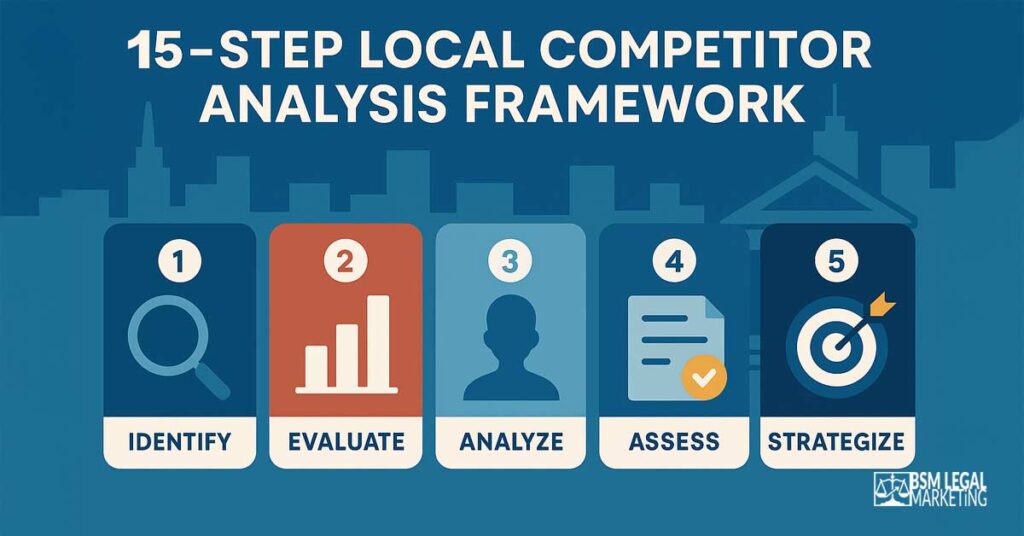
A detailed local competitor analysis for law firms turns raw data into strategic advantage. This 15-step framework is divided into three clear phases:
- Competitor Identification: Know exactly who you’re competing against.
- Digital Presence Analysis: Understand what makes them visible.
- Strategic Intelligence: Use insights to outperform them.
Phase 1: Competitor Identification (Steps 1–5)

Step 1: Map Your Local Legal Market
Start by mapping every law firm in your target area. Use Google Maps to locate solicitors, note their practice areas, and track their review counts and star ratings.
Obiter Marketing recommends including high-ranking directories such as ReviewSolicitors, Law Society Find a Solicitor, and Yell, as they often compete for the same local visibility.
BrightLocal confirms that 82% of local searches trigger a map result, making this mapping process non-negotiable for visibility tracking [12].
Step 2: Analyse Google Local Pack Results
Check which firms consistently appear in the local pack for your target keywords. These are your top digital rivals who have optimised their presence to appear in local search results effectively.
BrightLocal data shows that firms ranking first in the pack have double the average review volume of those in lower positions [12]. Cross-reference these results with local search rankings data using PracticeProof’s benchmarking method [5]. Understanding these patterns is essential for law firms looking to improve their Local Pack positioning.
Step 3: Identify Direct Competitors
List local firms offering identical legal services. Focus on those with consistent Local Pack or page-one visibility.
Step 4: Identify Indirect Competitors
Include regional firms, niche specialists, and legal tech providers. DSayce’s analysis highlights that niche firms capture high-intent keyword traffic overlooked by general practices [6].
Step 5: Categorise and Prioritise Competitors
Organise findings into priority tiers. This helps focus on competitors that genuinely impact visibility.
Competitor Identification Table
| Priority | Type | Ranking Position | Analysis Focus | Action Required |
|---|---|---|---|---|
| Tier 1 | Direct local competitors | Google Local Pack | Reviews, citations, GBP optimisation | Benchmark performance |
| Tier 2 | Page-one firms | Organic search results | Domain authority, backlinks | Analyse SEO gaps |
| Tier 3 | Niche specialists | Family, probate, or conveyancing firms | Long-tail keywords, content topics | Create topic clusters |
| Tier 4 | Indirect competitors | Legal tech or regional firms | Paid ads, visibility overlap | Monitor & respond |
Phase 2: Digital Presence Analysis (Steps 6–10)

Step 6: Website Competitor Analysis
LawRank’s research shows that top-ranking law firm sites share four core technical traits:
- Fast load speed (under 3 seconds)
- HTTPS security
- Structured schema markup
- Full mobile optimisation [10]
Use Screaming Frog or SEMrush Site Audit to crawl competitor sites. Compare page titles, structure, and internal linking. Identify technical weaknesses you can improve to boost your law firm’s technical performance. Look for local SEO opportunities in their site architecture that you can exploit.
Analyse meta element implementation, XML schema markup, and page speed using Google PageSpeed Tools. Understanding how competitors structure their search engine results page (SERP) elements provides valuable insights for improving local search performance.
Step 7: Local SEO Performance Analysis and Keyword Research
Evaluate keyword reach and local visibility through comprehensive research and data analysis. MarketMyMarket’s keyword gap analysis identifies which search terms drive actual client leads, while BrightLocal’s ranking tracker reveals where competitors hold dominant visibility [12].
Understanding what is local SEO helps you evaluate these strategies more effectively. Firms may need to adjust their approach based on competitor strengths in local search rankings. Modern algorithm updates favour firms that demonstrate genuine relevance and authority in their local markets.
Track these core metrics:
- Keyword overlap ratio
- Visibility share (Top 10 rankings)
- Domain authority
- GBP engagement metrics
- Long tail keyword performance
Step 8: Evaluate Content Strategy
Analyse your competitors’ law firm’s content quality and consistency. SEMrush reports that law firms publishing monthly, long-form blogs see 55% more organic traffic than firms posting less frequently [13].
Check:
- Keyword intent (awareness vs. conversion) and local intent targeting
- Internal linking and readability
- Freshness of content updates
Step 9: Analyse Advertising and PPC Activity
Review paid search strategies using SEO competitor analysis techniques. Use SEMrush Advertising Toolkit or Google Ads Transparency Reports to identify firms running local SEO campaign efforts. Obiter Marketing suggests tracking impression share and messaging focus to reveal which competitors are aggressively bidding on local terms.
Understanding competitor call to action (marketing) strategies and how they position their services helps identify opportunities for differentiation. Analyse their business directory presence and how they collect client feedback through various platforms.
Step 10: Assess Backlink Profile and Citations
Compare link-building and directory accuracy through comprehensive backlink analysis. SEMrush’s backlink data shows strong correlation between authoritative domains and first-page rankings. BrightLocal adds that top-ranking firms maintain 80%+ citation accuracy [12].
Local backlinks from region-specific websites often carry more weight than generic national links for local SEO rankings. Focus on identifying opportunities to build local authority through community partnerships and regional business relationships.
Digital Presence Scorecard
| Factor | Metric | Target | Competitor A | Competitor B | Your Firm |
|---|---|---|---|---|---|
| Website Speed | Load time | <3 seconds [10] | |||
| Mobile UX | Google Mobile-Friendly Test | Pass | |||
| Reviews | Star rating | 4.5+ average [12] | |||
| Backlinks | Domain Authority | 40+ [13] | |||
| Citations | Accuracy rate | 80%+ [12] |
Use this table as a living document, update it quarterly to track improvement.
Phase 3: Strategic Intelligence (Steps 11–15)

Step 11: Build a SWOT Matrix
Use all gathered data to build a clear SWOT for each competitor. PracticeProof’s model advises weighting ranking factors (speed, backlinks, content) against reputation and client acquisition performance [5].
SWOT Matrix Template
| Area | Strengths | Weaknesses | Opportunities | Threats |
|---|---|---|---|---|
| SEO | High keyword rankings in “family law” | Weak backlink profile | Optimise “probate” content gaps | Competitor expanding into local area |
| Reviews | High review rating | Low review count | Automate review generation | Rapid rival review growth |
| Local Presence | Optimised GBP | Limited citations | Expand listings | Regional firm entering market |
Step 12: Identify Content Gaps
Overlay competitor keyword maps onto your own. DSayce notes that firms targeting “micro-intent” terms such as “urgent probate advice [city]” win high-quality leads fast [6].
Step 13: Benchmark Engagement Metrics
Track review response rates, GBP (Google Business Profile) activity, and engagement speed. Reply to all reviews as quickly as possible.
Step 14: Predict Competitor Moves
Use SEMrush trend data and BrightLocal citation updates to identify when competitors expand or add services. Acting early lets you defend rankings [12].
Step 15: Create Your Action Plan
Turn your findings into strategy. Prioritise:
- GBP optimisation
- Content publishing cadence
- High-authority backlinks
- KPI tracking, rankings, leads, reviews, conversions
This ensures every insight translates to measurable progress toward getting your law firm’s practice to the top of local search results.
Essential Local SEO Tools and Software for Law Firm Competitor Analysis
Running a local competitor analysis for law firms without the right tools is like trying to cross-examine a witness without evidence. You’ll miss details that matter.
The right software turns guesswork into data and helps you see exactly why rival firms outrank you, and how to change that.
Below, we’ll look at free and paid tools, legal-specific solutions, and how to choose the best combination for your firm.
Free Competitor Analysis Tools
Free tools can be a useful starting point for law firms with limited budgets, but they have real limitations in depth and reporting accuracy.
The most reliable free options include:
- Google Search: Reveals which competitors consistently rank in your region.
- Google Business Profile Insights: Shows how clients find your firm (direct vs. discovery searches).
- Google Maps & Google Reviews: Provide visibility into your local pack rivals and their reputation scores.
- Google Analytics, Search Console & Bing Webmaster Tools: Measure site performance, search queries, and impressions for local traffic.
Zapier’s comparative guide to free marketing tools highlights that while these options give an overview of local visibility, they lack advanced SEO and backlink intelligence [18].
LawRank’s analysis agrees, free data sources miss the depth needed to diagnose technical SEO issues or keyword gaps [10].
Use free tools for initial orientation, but rely on premium platforms for serious strategy.
Premium SEO Platforms
Paid SEO platforms provide the competitive intelligence your firm actually needs, from keyword tracking and backlink audits to content gap reports and visibility scores.
1. SEMrush
A market leader in digital marketing analytics, SEMrush provides a dedicated Legal Industry Toolkit with:
- Competitor keyword discovery by location
- Backlink audit and toxicity analysis
- Position tracking for “near me” and practice area queries
- Organic traffic share reports for law-related keywords
Its Legal Competitor Research feature allows solicitors to see exactly which firms hold top search positions across specific towns or regions.
2. Ahrefs
Ahrefs offers powerful backlink and content analytics tailored for law firm SEO campaigns:
- Domain comparison for rival firms
- Content Gap tool (shows keywords competitors rank for but you don’t)
- Site Explorer for detailed authority scoring
The platform’s Attorney Competitor Research capabilities help firms assess domain authority, top pages, and referring domains at scale.
3. BrightLocal
BrightLocal focuses specifically on local SEO performance, giving insights unavailable in generic platforms:
- Local Pack rank tracking across multiple postcodes
- Citation audit and consistency checker
- GBP (Google Business Profile) review monitoring and reporting
Its data confirms that firms with strong local optimisation outperform larger national brands in proximity-based searches [16].
Use SEMrush and Ahrefs for keyword and backlink research, and BrightLocal for geographic and review-based visibility tracking.
Legal-Specific Tools
Generic SEO platforms can’t fully capture the nuances of legal marketing. That’s where LexisNexis stands apart.
The LexisNexis Competitive Intelligence Platform aggregates law firm marketing data with verified legal directories, case outcomes, and practice growth analytics. This information helps firms understand market positioning beyond basic SEO metrics.
It enables you to:
- Benchmark your firm’s visibility by practice area
- Identify rising competitors by region and client acquisition rate
- Track mentions in legal publications and directories including Avvo and FindLaw
For law firms handling multiple practice areas or competitive urban markets, LexisNexis provides industry-specific depth that general SEO platforms can’t. Understanding how competitors leverage these legal-specific platforms is essential for law firms seeking comprehensive market intelligence.
Tool Selection Matrix
Choosing the right combination depends on your goals, team skill level, and budget. The following matrix summarises how each platform supports key competitor analysis functions.
Tool Selection Matrix
| Tool | Best For | Ideal Firm Size | Limitations | ROI Rating |
|---|---|---|---|---|
| Google Suite (Analytics, Search Console, Maps) | Basic visibility tracking | Sole practitioners and small firms | Limited competitor benchmarking | ★★☆☆☆ |
| SEMrush | Full competitor & keyword intelligence | Medium–large firms | High data complexity for beginners | ★★★★★ |
| Ahrefs | Backlink & content gap analysis | Firms focused on organic growth | Lacks local ranking features | ★★★★☆ |
| BrightLocal | Local SEO & review analysis | Firms targeting nearby clients | Minimal backlink data | ★★★★☆ |
| LexisNexis CI Platform | Legal market insights & benchmarking | Multi-office or specialist firms | Premium pricing | ★★★★★ |
| Zapier Integration Stack | Workflow automation across tools | Tech-savvy marketing teams | Requires setup time | ★★★☆☆ |
*ROI ratings estimated from aggregated data in MarketMyMarket and Zapier comparative tool studies [18].
This table helps decision-makers evaluate both performance and practicality.
How to Build Your Stack
For most UK law firms, the ideal setup combines:
- SEMrush or Ahrefs for SEO competitor analysis
- BrightLocal for local visibility
- LexisNexis for legal-specific intelligence
- Google tools for free baseline tracking
Automation platforms like Zapier can integrate these tools, for example, sending weekly ranking reports or automating citation audits.
By using a hybrid stack, you gain complete coverage: technical SEO, local reputation, and industry benchmarking, all essential to winning local visibility. Expert for local SEO analysis often recommend this integrated approach for biggest firms looking to maintain market dominance.
Competitive Analysis by Practice Area: SEO Strategies for Different Legal Markets

Different areas of law face different competitive pressures in competitive legal markets. The way a personal injury firm fights for visibility isn’t the same as how a family or corporate practice builds authority.
Understanding these variations is critical for tailoring your law firm’s SEO and marketing strategy. Each practice area requires specific approaches to dominate local search results within their respective niches.
Personal Injury Law
The personal injury market is one of the most competitive in UK and US legal search. High search volumes, strong commercial intent, and costly keywords make visibility hard to sustain.
To compete effectively, smaller firms need to focus on:
- Hyperlocal optimisation: Prioritise searches like “personal injury solicitor [town]” rather than national terms.
- Landing page specificity: Build dedicated pages for accident types (road traffic, workplace, medical negligence).
- Review management: Clients often choose based on trust signals, not rankings. Aim for consistent 4.8★+ scores on Google and ReviewSolicitors.
- Content authority: Publish client case summaries (compliant with SRA rules) to showcase experience.
Top-performing firms in this area use video testimonials and structured data markup to boost credibility and conversion. They rely heavily on backlinks from regional news sites that report on local legal cases, a strategy that consistently improves search rankings in this niche.
Family Law
Family law clients prioritise empathy, trust, and privacy, all of which must be reflected in your content and brand voice.
SEO in this field is less about volume and more about conversion through connection. The key tactics include:
- Local directory visibility: Ensure listings on ReviewSolicitors, Law Society, and local business directories are complete and consistent.
- Long-tail keywords: Target specific needs such as “child custody solicitor [city]” or “divorce mediation services [town]“.
- E-E-A-T content signals: Demonstrate expertise through solicitor profiles, accreditations, and legal Q&A content.
- Content tone: Keep pages approachable, compassionate, and written for clients under stress, not for algorithms.
Top-ranking family law firms combine this with active community engagement, sponsoring parenting workshops, school events, or local support charities. These efforts not only generate backlinks but also reinforce brand trust in search results and offline reputation.
Corporate and Commercial Law
Corporate law presents a different challenge: lower search volume but higher-value clients. It’s a relationship-driven niche where reputation and thought leadership drive visibility more than sheer keyword density.
What separates leaders in this space:
- Content depth: Whitepapers, case studies, and long-form insights that attract backlinks and mentions from financial media.
- Author authority: Visible solicitor profiles with credentials, chambers rankings, and recognised awards.
- LinkedIn engagement: Consistent sharing of thought leadership pieces generates both traffic and direct enquiries.
- SEO structure: Well-optimised practice pages targeting industries (e.g. “commercial contracts for tech companies” or “M&A legal support for SMEs“).
Unlike B2C practice areas, corporate clients research multiple firms before engagement. Ranking well helps, but brand perception and peer trust close the deal.
The firms winning this space invest in technical SEO combined with PR-driven backlinking, often publishing in outlets like The Lawyer and Legal Business.
Key Takeaways by Practice Area
| Practice Area | Main Challenge | Core Strategy | Success Factor |
|---|---|---|---|
| Personal Injury | Oversaturated keywords, high CPC | Hyperlocal SEO, reviews, video testimonials | Build authority through content and trust signals |
| Family Law | Emotional buying, low trust threshold | Long-tail keywords, empathetic content | Combine online SEO with offline community visibility |
| Corporate Law | Low search volume, high client value | Author authority, industry content | Strengthen thought leadership & PR backlinks |
Each practice area demands a distinct approach, grounded in its audience, competition, and client decision process.
By tailoring your law firm competitive intelligence to practice-specific conditions, you avoid wasting effort on generic SEO tactics and focus only on what drives qualified leads.
Monitoring and Automation Systems for Improving Local SEO Performance

Once your local competitor analysis for law firms is in place, the next step is automation. Manual tracking is slow and inconsistent, and by the time you’ve updated a spreadsheet, your competitors have already changed their tactics.
Automated monitoring tools and dashboards keep your firm informed in real time. They alert you to shifts in rankings, reviews, backlinks, and even new pages your competitors publish.
Automated Alerts Setup
Automation begins with smart alerts. These notify you the moment something important changes, a new backlink appears, a competitor publishes content, or your rankings fluctuate.
Google Alerts is the simplest free option. You can configure alerts for your firm name, competitor names, or specific phrases like “divorce solicitor [city]” to track media mentions and new content.
To set up:
- Go to Google Alerts.
- Enter your target keyword or competitor domain.
- Select “Show results as they happen.”
- Filter by region and frequency.
However, for law firms managing multiple practice areas or offices, more advanced systems are essential.
Specialist platforms like SEMrush Sensor, Ahrefs Alerts, and BrightLocal Review Monitoring outperform basic alerts by providing data accuracy and historical trend tracking.
It is very important to use multi-channel monitoring, combining SEO, social mentions, citations, and reviews into one system.
In short, law firms should automate the essentials:
- Rank tracking alerts: Detect SERP position changes instantly.
- Review alerts: Monitor new reviews or drops in rating.
- Backlink alerts: See when competitors earn new links.
- Content alerts: Spot new pages or blog posts published by rival firms.
Automation ensures no important shift slips through unnoticed.
Competitive Intelligence Dashboards
While alerts show what’s changing, dashboards show what matters most.
Dashboards bring together KPIs from multiple sources, SEO rankings, lead data, review growth, and call metrics, into one visual command centre.
Dashboard Design Tips:
- Centralise key metrics: Combine Google Analytics, GBP Insights, and SEMrush ranking data.
- Use colour coding: Red for decline, green for growth, quick to interpret at a glance.
- Focus on KPIs that convert: Calls, enquiries, visibility score, and review sentiment.
- Automate refresh intervals: Weekly for rankings, daily for reviews and mentions.
Example Core Metrics to Include:
| Metric | Data Source | Update Frequency |
|---|---|---|
| Rankings | Local Pack & Organic Position | SEMrush / BrightLocal |
| Backlinks | New vs. Lost Referring Domains | Ahrefs |
| Reviews | Volume, Rating, Sentiment | GBP / ReviewSolicitors |
| Citations | Consistency Score | BrightLocal |
| Conversions | Calls, Forms, Chat Leads | Google Analytics |
These dashboards create a living, breathing view of your firm’s competitive health.
Regular Monitoring Schedule
Automation doesn’t replace consistency, it enhances it. Even with alerts and dashboards, law firms must maintain a structured monitoring schedule.
The Monitoring Frequency Research Report 2025 recommends:
- Daily: Review new alerts, mentions, and reviews.
- Weekly: Track keyword movement, backlink gains/losses, and Local Pack visibility.
- Monthly: Evaluate content performance, traffic sources, and conversions.
- Quarterly: Reassess competitors’ content, link building, and geographic expansion strategies.
This rhythm ensures you stay ahead rather than reacting after visibility drops.
A predictable monitoring cycle gives you clarity, and when combined with automated alerts, you’re effectively running real-time competitor surveillance without adding admin time.
Automation Summary Table
| Function | Purpose | Tools | Review Frequency |
|---|---|---|---|
| Alerts | Instant notifications on competitor activity | Google Alerts, Ahrefs Alerts, BrightLocal | Daily |
| Dashboards | Centralised KPI tracking | Google Looker Studio, Power BI | Weekly |
| Reports | Summarised insights for management | SEMrush / BrightLocal exports | Monthly |
| Audits | Full comparative review | Internal or agency analysis | Quarterly |
When automation and structure work together, your law firm’s practice never falls behind, even in fast-moving local markets.
Ethical Considerations

Competitor analysis can be powerful, but in the legal sector, it must always be conducted within strict ethical and professional boundaries. Unlike general business marketing, law firms operate under the oversight of the Solicitors Regulation Authority (SRA) and, for barristers, the Bar Standards Board (BSB).
Every step, from data collection to outreach, must respect confidentiality, client privacy, and advertising rules. The goal is to gather market intelligence, not to mislead, manipulate, or breach ethical obligations.
Transparency and Fair Research Practices
The Bar Association’s Competitor Research Guidelines make it clear: any form of competitive intelligence must rely only on publicly available data and lawful collection methods [19].
This means law firms can:
- Analyse publicly visible websites, blogs, and reviews.
- Use SEO and analytics tools (e.g., SEMrush, Ahrefs) to compare performance metrics.
- Monitor citations, backlinks, and local directory listings.
But firms must not:
- Misrepresent themselves to obtain information.
- Engage in data scraping or infiltration of competitors’ private systems.
- Repurpose client feedback or competitor testimonials without consent.
Transparency isn’t just an ethical obligation, it’s a reputational safeguard. If a competitor or regulator challenges your data collection methods, you should be able to prove everything was obtained through open, verifiable sources.
Protecting Confidential and Client-Sensitive Data
Ethics in competitive intelligence extend beyond how you collect data, it’s also about how you store and use it.
Practical safeguards include:
- Maintaining separate drives or folders for market research.
- Avoiding the use of competitor data in client marketing without attribution.
- Ensuring that analytics access is limited to authorised marketing personnel.
Under GDPR and the UK Data Protection Act, even public business data must be processed lawfully. For example, exporting contact details from LinkedIn or directories into a database for unsolicited marketing could breach privacy regulations and the SRA Code of Conduct.
Professional ethics demand that data collected for strategic insight never crosses into direct solicitation.
Responsible Marketing and Representation
Competitor analysis should guide marketing, not become a weapon against competitors.
In practice:
- Avoid comparative advertising unless the data is accurate, verifiable, and presented neutrally.
- Never imply regulatory endorsement (“approved by the SRA”), this violates SRA marketing rules.
- Keep your tone professional. Your competitors are peers, not adversaries.
Ethical marketing focuses on differentiation through excellence, not on undermining others. Staying compliant not only protects your firm legally but reinforces client trust, proving that your competitive strategy aligns with professional integrity.
Summary
Ethical competitor analysis rests on three principles:
- Transparency: Use only lawful, public data sources.
- Confidentiality: Protect client and firm data rigorously.
- Professionalism: Market through value, not comparison.
Law firms that follow these standards build credibility, avoid regulatory risk, and maintain long-term brand trust, which is the ultimate competitive advantage.
Converting Intelligence into Action

Competitor analysis means nothing without execution. The firms that win aren’t just collecting data, they’re acting on it.
The goal of this stage is simple: take insights from your research and convert them into strategic, measurable improvements that enhance visibility, drive leads, and secure long-term advantage.
From Insight to Strategy
Turning research into results starts with structured planning.
A good process includes three key steps:
- Audit → Identify Gaps: Compare where competitors outperform you (keywords, backlinks, reviews).
- Prioritise → Select Actions: Choose high-impact changes aligned with measurable ROI.
- Integrate → Plan Implementation: Add each improvement into your marketing roadmap.
Example: if your main competitor dominates “family solicitor [city]” because of a stronger local landing page, make that a Q1 action item, redesign, rewrite, and optimise your equivalent page.
By embedding competitive intelligence into quarterly planning cycles, your team stays proactive instead of reactive.
Identifying and Building Competitive Advantage
Data alone doesn’t create advantage, interpretation does.
Look for advantage in three areas:
- Geography: Gaps in towns or boroughs where competitors underperform.
- Service Specialisation: Niche areas with consistent search demand but little content coverage.
- Trust Signals: Review consistency, testimonials, and accreditations, areas where even large firms often fall short.
Once identified, double down. Develop pages, campaigns, and partnerships that reinforce that strength.
Example: If your law firm’s practice holds the strongest reviews in probate law, make that central to your ad copy, landing pages, and social proof. Clients act on credibility first, not just rank position.
Competitive advantage isn’t built by doing more of what everyone else does. It’s built by doing what they’re ignoring, and proving it through measurable outcomes.
Enhancing Legal Marketing Strategy and ROI
The final step is integration, turning insights into sustained marketing improvement.
Here’s how to operationalise that:
- SEO: Optimise around proven ranking gaps, not generic keywords.
- Content: Publish thought leadership addressing client pain points your competitors ignore.
- Local SEO: Improve citations and reviews where competitors lag.
- PPC: Redirect ad spend toward underbid but high-converting search terms.
- Reporting: Use monthly competitor benchmarking to measure visibility and lead growth.
This continuous improvement cycle transforms static research into dynamic growth.
Competitor-to-Action Blueprint Table
| Competitor Insight | Strategic Opportunity | Tactical Action | Success Metric |
|---|---|---|---|
| Competitor dominates “family solicitor [city]” | Improve local SEO for target town | Build new landing page, optimise meta tags, add schema | Page-one ranking within 90 days |
| Rival firm gains backlinks from local media | Increase PR visibility | Pitch case studies to local press and chambers networks | 3 new backlinks per quarter |
| Competitor’s reviews exceed 100+ | Boost review velocity | Automate email follow-up for clients post-case | 25 new Google reviews per month |
| National firm enters local market | Strengthen regional identity | Update “About” and GBP profile with location proof | Increase map pack visibility |
| High CPC in personal injury ads | Shift to organic strategy | Invest in content and YouTube video testimonials | 15% cost reduction per lead |
This table turns theory into measurable execution, bridging research, strategy, and performance.
Summary
Competitor intelligence becomes valuable only when it shapes your law firm’s daily actions.
- Plan based on evidence, not assumptions.
- Act where your competitors are weakest.
- Measure everything against defined KPIs.
When law firms use intelligence to guide strategy, not just monitor it, they stop reacting to the market and start defining it.
Measuring Competitive Analysis ROI

Competitive intelligence only proves its worth when you can measure results. For law firms, ROI isn’t just about traffic or rankings, it’s about how those improvements translate into instructions, enquiries, and retained clients.
To quantify success, you need measurable KPIs, clear attribution models, and consistent tracking across all campaigns.
Defining ROI in Legal Marketing
Return on Investment (ROI) in legal marketing measures the profit or value generated compared to what’s spent on analysis, tools, and campaign execution.
A basic formula for calculating ROI:
ROI (%) = (Net Profit from Marketing – Total Marketing Cost) ÷ Total Marketing Cost × 100
But in practice, law firms should go beyond revenue alone, including metrics such as enquiry volume, cost per lead (CPL), and case acquisition efficiency.
KPI Tracking for Competitive Intelligence
Every insight from competitor analysis should link directly to a Key Performance Indicator (KPI).
- Visibility KPIs: how well you’re seen
- Local Pack share of voice
- Organic ranking improvements
- Citation accuracy rate
- Engagement KPIs: how effectively users respond
- Click-through rate (CTR) from search results
- Average session duration
- Review response time
- Conversion KPIs: how marketing translates into leads
- Enquiries (forms, calls, chats)
- Conversion rate (%)
- Cost per lead (CPL)
Monitoring these KPIs shows whether your competitive edge is widening or narrowing over time.
Attribution and Performance Modelling
Understanding where results come from is essential to prove ROI. Law firms often use multiple marketing channels, SEO, PPC, content, referrals, making attribution complex.
This model tracks each step of a client’s journey, from the first Google search to the initial enquiry, assigning proportional credit to every interaction (organic search, review click, or remarketing ad).
Benefits of multi-touch attribution:
- Highlights which channels actually influence conversions.
- Prevents over-investing in underperforming campaigns.
- Links SEO and review management directly to revenue outcomes.
Local SEO KPIs and Reporting Framework
Understanding whether your competitive analysis efforts generate results requires systematic measurement through comprehensive local SEO services tracking.
ROI Tracking Framework Table
| Category | Metric | Tool/Method | Frequency | Success Target |
|---|---|---|---|---|
| Visibility | Local Pack share | BrightLocal / SEMrush | Weekly | +15% increase quarter-on-quarter |
| Engagement | CTR & session time | Google Analytics | Monthly | CTR above 5%, time on site +30% |
| Conversion | Leads from search | CallRail / CRM | Monthly | 10–20% increase in qualified leads |
| Cost Efficiency | CPL (Cost Per Lead) | CRM / Finance data | Quarterly | Maintain CPL under £100 |
| Revenue | Client acquisition ROI | CRM + Accounting | Quarterly | ROI ≥ 300% over 6 months |
Tracking these metrics ensures every marketing pound is accountable. When law firms combine competitive analysis with structured measurement, they not only improve rankings, they prove commercial value.
Summary
Competitive intelligence becomes profitable only when measured consistently. By linking your analysis to clear KPIs, using attribution models, and tracking ROI through transparent dashboards, your firm can justify every investment and continually refine its strategy for maximum impact.
Advanced Competitive Strategies

Once your competitor analysis process is established, the next step is refinement. Advanced strategies allow your firm not only to monitor competitors but to anticipate their moves, neutralise their advantages, and strengthen your network intelligence.
These techniques use predictive analytics, counter-intelligence frameworks, and collaborative market data, tools that turn ordinary insights into sustainable strategic advantage.
Predictive Analytics and Foresight Marketing
Predictive analytics helps law firms look ahead, not just back. It uses machine learning and trend data to forecast how competitors, clients, and markets are likely to behave.
How it works:
- AI tools analyse keyword and content trends across regions and practice areas.
- Historical ranking data predicts which competitors are gaining or losing ground.
- Client behaviour metrics (like enquiry times or case types) help forecast emerging demand.
Example: A personal injury firm using predictive models may identify rising searches for “industrial accident solicitors” before competitors notice, allowing early content publication and faster page-one ranking.
Implementation tip: Integrate Google Trends, SEMrush Market Explorer, and your CRM analytics to identify early shifts in case volume and intent.
Predictive analytics turns your marketing from reactive to anticipatory, the difference between catching up and leading.
Competitive Counter-Intelligence
Counter-intelligence doesn’t mean spying, it means defending your position by monitoring how others respond to your strategies and preparing accordingly.
- Brand monitoring: Track mentions of your firm name, key partners, and slogans to detect unauthorised use or imitation.
- Link protection: Regularly review backlinks for toxic or spam links potentially damaging your SEO.
- Content differentiation: Ensure your articles, case studies, and thought leadership remain original and verifiable.
By protecting intellectual and reputational assets, your law firm prevents competitors from replicating content or targeting your branded keywords.
Counter-intelligence also includes observing competitor changes, new service pages, office openings, or ad campaigns, and identifying potential threats. If a competitor begins targeting your local keywords, adjust your landing pages and PPC bids immediately.
It’s about agility through awareness, staying alert and adapting before your rivals gain an edge.
Collaborative and Networked Intelligence
The most advanced law firms share knowledge strategically. Collaborative intelligence means pooling anonymised market data across partner firms, associations, or industry bodies to benchmark performance and forecast wider legal trends.
Examples of collaborative intelligence in action:
- Joining regional legal marketing consortiums to share anonymised SEO and conversion benchmarks.
- Partnering with non-competing firms (e.g., employment vs. conveyancing practices) to exchange local link building opportunities and referral data.
- Participating in industry-wide analytics initiatives such as aggregated GBP performance studies or sector-specific AI models.
This data-sharing approach allows firms to gain insights not possible in isolation, identifying market shifts, algorithm impacts, and referral patterns before competitors.
Collaborative intelligence creates a shared advantage, not a zero-sum game. When firms understand the broader ecosystem, they can forecast more accurately and innovate faster.
Summary
Advanced competitive strategy is about foresight, protection, and collaboration:
- Predictive analytics: Anticipate demand before competitors do.
- Counter-intelligence: Safeguard your law firm’s reputation and SEO integrity.
- Collaborative intelligence: Build smarter networks for shared market insight.
By combining all three, your firm stops reacting to change and starts engineering it, achieving sustainable growth built on insight, not imitation.
Examples of What Law Firms Can Do
Competitor analysis is only valuable when it produces real-world results. Below are three hypothetical law firm case studies, each demonstrating how data-driven competitive intelligence can help deliver measurable growth in visibility, clients, and revenue.
Small Law Firm: Local Market Domination
A two-partner family law firm faced declining enquiries despite strong reviews. Their challenge: three larger firms were dominating the Local Pack for “family solicitor near me.”
Using a structured local competitor analysis, the firm identified:
- Weak landing page optimisation compared to rivals.
- Inconsistent directory listings (citations).
- Limited Google Business Profile activity.
They implemented a 90-day corrective plan based on the findings:
- Rewrote local landing pages with schema markup and location-rich headings.
- Claimed and standardised 50+ local citations.
- Launched a client local reviews strategy follow-up system using BrightLocal.
By following this process it is possible for your law firm to see results within three months, and improve its Local Pack results for major keywords and achieved increase in the number qualified leads.
Key Takeaway: Consistent citation management and hyperlocal optimisation outperform large-budget rivals when executed strategically.
Mid-Size Firm: Regional Expansion and Market Share Growth
A mid-sized full-service law firm wanted to expand from its current location to other nearby locations. The region was already saturated with established competitors.
Their marketing team conducted a competitive gap audit, comparing local rankings, content coverage, and backlink authority across towns.
Findings:
- Competitors had strong local presence but weak keyword coverage for niche services like employment law for SMEs.
- Low backlink diversity across regional domains.
- Sparse content addressing business owners directly.
Actions implemented:
- Created geo-targeted landing pages for each town.
- Published SME-focused employment law content targeting underserved search terms.
- Built 30+ new regional backlinks from business associations and local directories.
The possible result: within six months, the firm can increase its local market share and gain new client instructions from the new targeted areas.
Key Takeaway: Competitive analysis doesn’t just defend, it enables expansion. By identifying where rivals are weak, regional firms can scale strategically.
NOTE: For this particular example, yes the firm of solicitors’ web pages can rank organically, but they will not appear in Google Maps (Google Business Profile) unless they have a physical branch in the desired location.
Solo Practitioner: Niche Specialisation and Revenue Growth
A solo practitioner specialising in medical negligence law faced limited visibility and stiff competition from national brands.
Through targeted competitor research, they discovered:
- National firms ranked broadly but lacked content focused on local hospital negligence cases.
- Review sentiment analysis showed local clients valued personal service over scale.
- Competitor PPC campaigns were high-cost but low-conversion.
They acted fast:
- Rebranded the practice around “Local Medical Negligence Expertise.”
- Published detailed blog posts on hospital-specific claims, optimised for how to optimise for near me searches.
- Produced testimonial-based videos to strengthen trust.
Within eight months, the firm can triple enquiries and achieve a revenue increase, with percentage of new clients originating from organic search.
Key Takeaway: Focus and relevance beat scale. Niche content paired with authentic trust signals can outperform national competition, even with minimal ad spend.
Summary
These examples show that competitive intelligence can work, for any firm size. Whether improving citations, identifying geographic gaps, or carving out a niche, structured analysis turns visibility into real business growth.
The formula is simple: Analyse → Act → Measure → Refine. When applied consistently, it converts competitive pressure into opportunity.
Tools and Templates

Data alone isn’t enough, execution requires structure. Templates and toolkits make competitor analysis repeatable, accurate, and time-efficient. For solicitors and marketing managers, having ready-to-use resources eliminates guesswork and standardises how insights are gathered, tracked, and acted upon.
Downloadable Resources for Law Firms
Essential templates every legal marketing team should maintain:
| Template | Purpose | Update Frequency | Key Metrics |
|---|---|---|---|
| Competitor Audit Spreadsheet | Logs ranking data, backlinks, and GBP performance | Monthly | Keyword gaps, backlink totals, review count |
| Local SEO KPI Dashboard | Tracks visibility across postcodes and practice areas | Weekly | Local Pack share, impressions, leads |
| Content Gap Analysis Sheet | Identifies missing or underperforming topics | Quarterly | Keyword intent, topic volume, SERP position |
| Citation Tracker | Monitors directory accuracy and link consistency | Monthly | Citation accuracy rate, NAP uniformity |
| Action Plan Template | Translates findings into measurable marketing steps | Quarterly | Actions completed vs. goals achieved |
Each template should include clear input fields, date stamps, and automated formulas to track changes over time.
When configured properly, automation tools can populate these templates automatically, pulling ranking, review, and citation data directly from APIs like SEMrush, BrightLocal, or Google Search Console.
Implementation and Success Tracking
Having templates is one thing. Using them consistently is what drives results.
To maximise efficiency:
- Assign ownership: Designate one person to maintain each template.
- Automate data imports: Use Zapier or API integrations to keep metrics up to date.
- Schedule regular reviews: Ensure leadership sees monthly KPI summaries.
- Refine quarterly: Adapt templates as your competitive priorities evolve.
When properly configured, these systems create a “single source of truth” for your law firm’s online presence marketing performance, ensuring no data is lost, misinterpreted, or outdated.
Templates aren’t paperwork. They’re the backbone of consistent execution, transforming complex competitive intelligence into clear, actionable strategy. Understanding your law firm’s website performance compared to competitors through structured tracking enables more informed strategic decisions.
Building Long-Term Competitive Advantage: Next Steps
Competitor analysis isn’t a one-off project, it’s a continuous process that evolves with your market. The firms that win long-term are those that act on intelligence systematically, review progress regularly, and refine their strategy over time.
The 90-Day Action Framework
Law firms should start small but move fast. Structure your implementation into three simple phases.
90-Day Competitive Growth Plan
| Phase | Focus | Key Actions | Expected Outcome |
|---|---|---|---|
| Days 1–30 | Baseline Audit | Conduct competitor and citation audits, identify keyword gaps, and benchmark rankings | Clarity on competitive position |
| Days 31–60 | Implementation | Optimise GBP profiles, publish updated local pages, build review and backlink campaigns | Improved visibility and engagement |
| Days 61–90 | Measurement & Refinement | Review KPIs, evaluate ROI, and refine strategy for next quarter | Sustainable growth and process maturity |
This phased approach ensures structured momentum, turning insights into measurable wins without overwhelming your team.
Sustaining Competitive Advantage
To sustain your edge:
- Review your dashboards monthly.
- Refresh competitor analysis quarterly.
- Expand into new practice areas annually based on opportunity gaps.
Consistency compounds, the longer you maintain a structured process, the stronger your competitive moat becomes.
Preparing for the Future
Competitive intelligence will continue to evolve. Emerging trends in AI-powered market forecasting and predictive analytics will shape how law firms plan, market, and grow.
Firms that start building intelligent systems today, integrating automation, dashboards, and data-driven decision-making, will own tomorrow’s local markets.
Summary
Building long-term competitive advantage comes down to three principles:
- Structure the process — plan in 90-day cycles.
- Measure relentlessly — track KPIs, not guesses.
- Evolve intelligently — adopt tools and AI to stay ahead.
The firms that act on these principles won’t just compete, they’ll lead.
Frequently Asked Questions About Local SEO Competitor Analysis
Understanding competitor analysis requires addressing common questions that law firms have about implementation and strategy.
How often should we conduct competitor analysis?
Successful competitor analysis requires regular monitoring. Monthly reviews for ranking changes, quarterly deep dives for strategy shifts, and annual comprehensive assessments ensure your local SEO strategy remains competitive.
What’s the difference between direct and indirect competitors?
Direct competitors offer identical legal services in your geographic area. Indirect competitors might include national firms, legal technology platforms, or adjacent service providers who compete for the same target audience.
How do we measure the success of our competitive analysis efforts?
Track key metrics including local search rankings improvements, increased visibility in local search (Internet) results, enhanced click-through rate performance, and most importantly, growth in qualified client enquiries and instructions.
Ready to Outrank Your Competitors?
Your competitors are already analysing you, the question is, are you analysing them? At BSM Legal Marketing, we specialise in helping law firms, solicitors, and attorneys dominate local search, attract higher-value clients, and build lasting visibility.
Whether you’re a solo practitioner or a multi-office firm, our data-driven Local SEO and competitive intelligence strategies reveal exactly where you can win, and how to do it faster.
Stop guessing. Start outperforming.
Call us now on +441689 602248 or book your free consultation today.
Let’s turn your competitor insights into measurable growth. BSM Legal Marketing, Where smart strategy meets real results for law firms.
Evidence & Metrics
Local ranking model
Relevance · Distance · Prominence
Google confirms reviews/ratings can help local ranking under Prominence.
GBP Performance metrics
Calls · Directions · Website clicks
Use these to gauge competitor strength and your own progress, per location.
Query/URL segmentation
GSC regex filters
Filter “service + city” queries and pages for precise gap analysis.
Auction Insights
Impression share · Overlap · Position above rate
Confirms who you fight most on paid; often mirrors local organic rivalry.
Justifications
“Provides…”, “Reviews mention…”, “Close to…”
Snippets in the pack that signal why a business appears; influence click choice.
Consumer thresholds
71% avoid < 3★
Negative review patterns reduce consideration; track rating and cadence.
Implementation & Targets
| What to compare | How to measure | Target / note |
|---|---|---|
| GBP categories & services | Primary/secondary match vs top rivals | Align; review quarterly |
| Reviews & rating | Count, 30-day cadence, average ★ | ≥4.6★; weekly replies |
| Justifications | Types triggered across rivals | Trigger 2+ types on core terms |
| GBP actions | Calls · Directions · Site clicks | MoM growth per office |
| GSC “service + city” | Impressions · CTR · Position | CTR ↑ and position ↑ |
| Auction Insights | Impression share overlap | Plan content vs. bid moves |
Key References
References
- https://lawrank.com/law-firm-seo-competitor-analysis/
- https://www.bestlawyers.com/article/leveraging-competitor-analysis-legal-seo/6144
- https://todaysconveyancer.co.uk/12-step-guide-law-firm-competitor-analysis/
- https://legalmarketing.org/Portals/0/LAW-2023-003Lawcom-LMA-Survey-Report20231.pdf
- https://www.practiceproof.com/competitive-analysis-for-law-firms-outperforming-rivals-in-crowded-markets/
- https://www.dsayce.com/digital-strategy/mastering-competitive-analysis-a-strategic-edge-for-uk-law-firms/
- https://www.itineris.co.uk/blog/local-seo-for-law-firms/
- https://www.legalmarketing.org/Portals/0/LAW-2023-003Lawcom-LMA-Survey-Report20231.pdf
- https://www.obitermarketing.co.uk/legal-marketing-competitor-analysis-guide/
- https://lawrank.com/law-firm-seo-competitor-analysis/
- https://www.marketmymarket.com/competitor-analysis-for-law-firms/
- https://www.brightlocal.com/research/local-search-industry-survey/
- https://www.semrush.com/blog/blogging-stats/
- https://www.semrush.com/industry-trends/legal-marketing-reports/
- https://ahrefs.com/blog/competitor-analysis-for-lawyers/
- https://www.brightlocal.com/research/local-search-industry-survey/
- https://legal.thomsonreuters.com/en/insights/articles/legal-competitive-intelligence-tools
- https://zapier.com/blog/competitor-analysis-tools/
- https://www.barstandardsboard.org.uk/static/2f51d889-9f4b-4a69-b5d1425d048cdaa1/summaryofresponsestothebsbspolicyconsultationontransparencystandardsupdated.pdf