
Why Your Second Office Isn’t Getting Clients
Multi-Location SEO Strategy for Law Firms
Optimised for Google AI Overview | Compliant • Measurable • Human Verified
A multi-location SEO strategy aligns every office’s Google Business Profile, local landing page, and NAP data so each branch ranks in its own area. Consistency builds trust, visibility, and enquiries across your whole firm.
Law firms must follow SRA marketing rules. That means no unsolicited outreach or misleading claims. Multi-location SEO is fully compliant when you use verified listings and informative local content instead of direct solicitation.
Use Organization → LocalBusiness → Office schema to connect every branch. Optimise Core Web Vitals, add canonical tags, and manage reviews through a central GBP dashboard to keep all data accurate.
Firms using structured multi-location SEO report up to 60% lower cost-per-lead and 2.7× higher conversions. Track performance via Google Search Console, BrightLocal, and call tracking for measurable ROI.
AI and voice assistants prefer schema-rich, conversational content. Add FAQs like “Where is your nearest solicitor’s office?” and use natural language to appear in AI Overviews and voice search results.
Most law firms believe they have wasted money on marketing campaigns that failed to deliver positive returns [1].
You opened a Manchester office. Spent £200,000 on the lease, furniture, and staff.
Then you searched “solicitor near me” from that location. Nothing. Your new office is invisible.
Opening an office doesn’t mean Google will show you in local search results. If you get it wrong, your new locations actually harm your original rankings. You compete against yourself.
This guide shows you the complete framework for mastering multi-location SEO, helping you rank in every city you serve and attract clients from multiple locations. These proven strategies for effective multi-location SEO will help your firm thrive across all markets.
What Makes Multi-Location SEO Different
Multi-location SEO isn’t “local SEO times three.” It’s different.
One office is straightforward. Optimise your Google Business Profile. Build citations. Create local content.
Add a second location and everything becomes complicated. Multiple Google Business Profiles that could conflict. Separate landing pages that might trigger duplicate content penalties. Trying to rank in different cities simultaneously.
How Google Decides Which Location to Show
Google uses three factors: relevance, distance, and prominence [2].
Someone in Birmingham searches “family lawyer.” Should Google show your Birmingham office or London headquarters?
Google checks:
- The searcher’s location
- Your closest office
- Which location page is most relevant
- Which Google Business Profile is strongest
Without proper structure, Google gets confused. It shows the wrong office. Or worse, it doesn’t show any of your locations because it can’t determine which one is most relevant to potential clients in that area.
Three Mistakes That Kill Your Rankings
Mistake 1: One Google Business Profile for Multiple Locations
Google requires a separate profile for each physical location. Use one profile for multiple addresses and Google suspends them all. I’ve seen businesses lose years of reviews overnight.
Mistake 2: Duplicate Content Across Location Pages
Firms create a Manchester page and Leeds page. Copy-paste the same descriptions. Just change the city name.
Google sees duplicate content. It only ranks one page. Your other locations become invisible [3] .
Mistake 3: Inconsistent NAP Data
Your website says “9 High Street.” Your Google profile says “9 High St.” Google treats these as different businesses.
This inconsistency dilutes your local search authority across all locations. It directly impacts your visibility and rankings in local searches [4].
Planning Your Multi-Location Local SEO Strategy

Don’t touch your website yet. You need a local SEO strategy first. Proper planning will help your law firm avoid the costly mistakes that derail most multi-location expansion. When it comes to local SEO for law firms, thorough planning is essential for long-term SEO success.
Research Each Location’s Competition
Your Birmingham office might compete against 50 family law firms. Your Nottingham office against 12.
For each location, conduct thorough local keyword research and competitive analysis:
- How many firms rank in the local pack
- What local keywords they target
- Their Google Business Profile strength (reviews, ratings)
- Their website structure
This tells you where to invest more of your local SEO efforts to improve your rankings and increase your chances of appearing in local search results.
Set Location-Specific KPIs
Each location needs its own metrics. This approach allows you to develop targeted marketing strategies for each market.
| New Location Won’t Rank | 6+ months old; still not in local pack | Insufficient local signals and authority | Accelerate citations, reviews, local links, content | 3-6 months |
| NAP Inconsistencies | Different address formats across platforms | Poor citation management; multiple data sources | Standardize format; update all listings systematically | 1-2 months |
Google Business Profile Setup for Multi Locations
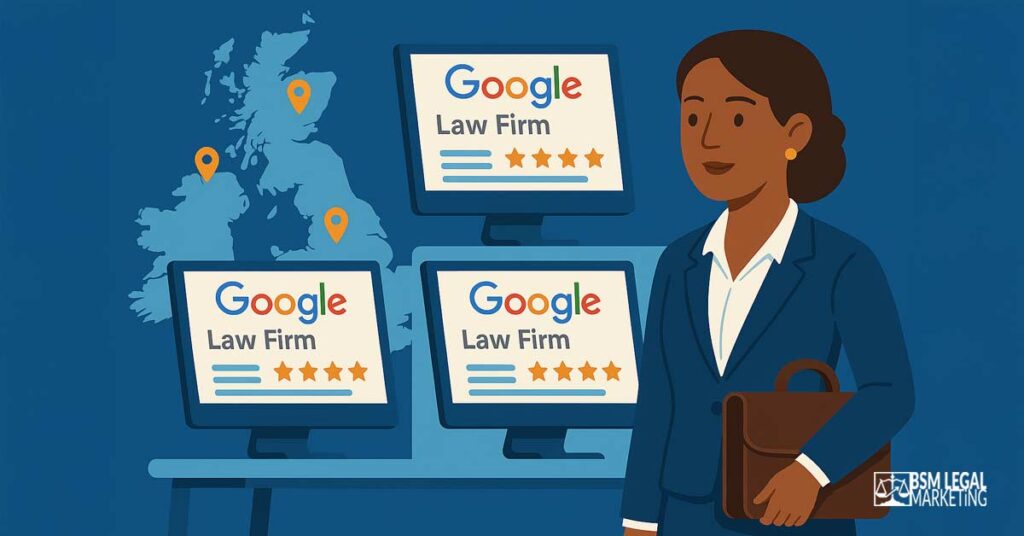
Your Google Business Profiles are the foundation of local SEO for lawyers, solicitors, attorneys and law firms. This is where potential clients find you when they’re searching for legal services in their area.
Create Separate Profiles for Each Office
Each physical office location needs its own GBP profile. This is essential for multi-location law firms looking to build a strong local presence in each market they serve.
- Use the exact business name consistently
- Add location identifier if needed (e.g., “Smith & Partners – Manchester“)
- Use the precise address Google Maps recognises
- Choose the most specific category
- Add unique local phone number if possible
Google sends a verification postcard to each address. Takes 1-2 weeks per location. Though now, you may be asked to perform a video verification [5].
Write Unique Business Descriptions
Don’t copy-paste your description across locations.
Each profile needs to clearly describe the legal services you offer at that specific office:
- Specific areas served from that office
- Partners or solicitors based there
- Location-specific expertise
- Local landmarks or transport links
Example: “Our Manchester office, near Deansgate Station, serves Greater Manchester. Led by Partner Sarah Williams, we handle 200+ family law cases annually, specialising in high-net-worth divorces.“
This targeted local approach positions your law firm as the obvious choice for people in that specific area.
Generate Google Reviews Systematically
Reviews are a major ranking factor. They directly affect your visibility in local search results and help attract more clients to each office location.
After closing a case:
- Solicitor thanks the client and mentions you’d value a review
- Within 24 hours, email a direct link to that office’s review page
- Make it easy with clear instructions
- Never incentivise reviews (violates Google’s policies)
Track reviews by location. If one office falls behind, find out why.
See our local reviews strategy for the complete framework on building a strong local reputation.
Post Regularly to Each Profile
Google Business Posts show you’re active.
Create two types:
- Firm-wide posts (e.g., “Legal 500 recognises us as top family law firm”)
- Location posts (e.g., “Manchester team sponsors annual charity run”)
Use scheduling tools to batch-create posts.
Photos matter. Each location needs:
- Exterior building photos
- Interior office photos
- Team photos
- Community involvement photos
Update photos quarterly. These visual elements help your law firm’s online presence appear more trustworthy and professional to people searching for legal services in their area.
Building Location Pages That Rank

Your website structure makes or breaks multi-location SEO. Get this right and you’ll dominate local search rankings across multiple cities. Optimizing for local search involves creating dedicated pages that rank well in local searches for each office.
Choose the Right URL Structure
| URL Structure | Example | Best For | SEO Impact |
|---|---|---|---|
| /locations/city/ | yourfirm.co.uk/locations/manchester/ | Many locations | Good |
| /city/ | yourfirm.co.uk/manchester/ | Few locations | Better |
| /city-service/ | yourfirm.co.uk/manchester-family-law/ | Specific services per location | Best |
I recommend the third option. It targets searches like “family lawyer Manchester” and helps ensure your law firm appears for location-specific service searches.
See our guide to local landing pages for detailed structure.
What Every Location Page Needs
1. Location-Specific Title and Meta Description
Title: “Family Law Solicitors in Manchester | Your Firm“
2. H1 with Location and Service
“Manchester Family Law Solicitors“
3. Unique Content (800-1,000 Words)
Write about:
- Local team and their expertise
- Cases you’ve handled in that area
- Understanding local legal issues
- Community involvement
4. Embedded Google Map
Embed the map from your Google Business Profile. This strengthens your local business signals and improves your law firm’s online visibility.
5. Local Contact Information
Display the specific address, phone, and email.
6. Client Testimonials from That Location
Feature clients you’ve helped in that city.
7. Clear Calls-to-Action
Make it easy to book at that specific office. Use location-specific forms to track leads and measure local search performance.
Writing Unique Content Without Going Mad
The 70/20/10 Content Rule:
- 70% template (firm background, service overview, process)
- 20% location-adapted (local landmarks, statistics, courts)
- 10% completely unique (team profiles, local cases, community work)
This gives you consistency while avoiding duplicate content issues. Proper local keyword research should inform each location page, ensuring you target the specific terms people in that area actually use when searching for legal services [6].
Internal Linking Between Locations
- Link from homepage to main “Locations” page
- Link from hub to each location
- Link between location pages where relevant
- Link from blog posts to location pages
This internal linking structure strengthens your entire site’s authority and helps all your locations rank well in local searches [7].
Schema Markup for Multiple Locations

Schema helps search engines understand your business information. Proper implementation is crucial for improving local SEO and boosting your local visibility across all markets.
LocalBusiness Schema for Each Office
Each location page needs its own LocalBusiness schema with:
- Business name
- Specific address
- Phone number
- Opening hours
- Geographic coordinates
- Service area
Don’t create one schema for all locations. Each needs its own. This is a fundamental part of law firm local SEO that many firms overlook.
Organization Schema
On your homepage, add Organization schema showing how locations relate:
- Main organization details
- Links to each location
- Logo
- Social profiles
This organizational structure is a core component of legal SEO that helps search engines understand your firm’s complete footprint.
LegalService Schema
Add LegalService schema to location pages. This tells Google the specific legal services at each location and helps your law firm rank well in local searches for those practice areas.
See our schema markup guide for technical implementation. Proper legal SEO requires getting these technical details right, it’s what positions your law firm as a credible, authoritative source in each market you serve.
Content Strategy Across Markets
Balance efficiency with local relevance. Your content strategy needs to attract local clients in each market while maintaining brand consistency.
Three Content Layers
Layer 1: Core Content (Firm-Wide)
Guides on main practice areas. Not location-specific. “How to File for Divorce in England.”
Layer 2: Regional Content
Relevant to a region. “Property Law Changes in the North West.”
Layer 3: Hyper-Local Content
Tied to specific locations:
- “Manchester Team Sponsors Legal Advice Clinic”
- “Understanding Birmingham Property Prices for Divorce Settlements”
- “Leeds Office Welcomes New Partner”
| Content Type | Publishing Frequency | Example Topics | SEO Value |
|---|---|---|---|
| Firm-Wide (Layer 1) | 2-4 posts/month | Practice area guides, legal process explanations, firm news | Builds overall domain authority |
| Regional (Layer 2) | 1-2 posts/month per region | Regional law changes, area trends, multi-city coverage | Strengthens regional relevance |
| Hyper-Local (Layer 3) | 1 post/month per location | Office news, local events, community involvement, local cases | Maximizes local pack rankings |
Cover Local News
Set up Google Alerts for legal news in each city.
When something relevant happens, local case, regulation change, community clinic, write about it. Link to the relevant location page.
Localise Practice Area Content
Take core content and create location versions.
Main “Divorce Law” page covers the general process. Then create:
- “Divorce Solicitors in Manchester” – Local family court, timeline, success stories
- “Divorce Solicitors in Birmingham” – Different court, judges, resources
Managing Law Firm Citations and Directories
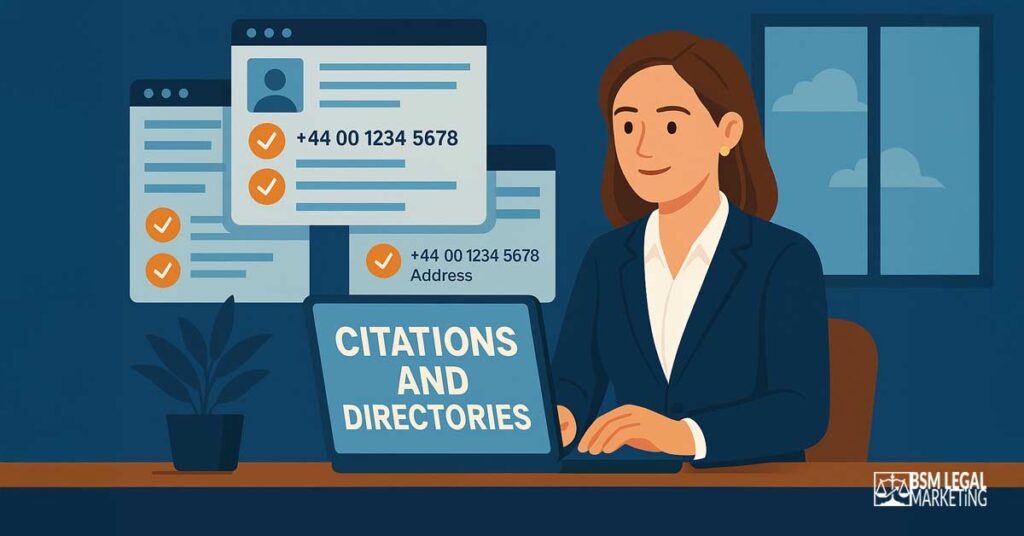
What are Citations?
Citations are mentions of your name, address, and phone on other websites.
Build Citations for Each Location
Each office needs citations on:
- General directories (Yell, Thomson Local, Bing Places)
- Legal directories (Law Society, SRA, Legal 500)
- Local directories (city business listings, chambers of commerce)
Use exactly the same NAP format everywhere.
| Citation Type | Examples | Priority Level | Impact on Rankings |
|---|---|---|---|
| Major Search Engines | Google Business Profile, Bing Places | Critical | Very High |
| Legal-Specific Directories | Law Society, Legal 500, Chambers UK | High | High |
| General UK Directories | Yell, Thomson Local, Scoot | High | Medium-High |
| Local Business Directories | City-specific directories, Chamber of Commerce | Medium | Medium |
| Review Platforms | Trustpilot, Reviews.co.uk | Medium | Medium |
| Social Platforms | Facebook, LinkedIn, Twitter | Low-Medium | Low-Medium |
Remove Duplicate Listings
You might find your business listed multiple times with different information.
These duplicates hurt rankings. Run regular citation audits. Use Moz Local or BrightLocal to find duplicates, then claim, merge, or delete them.
Our citations guide covers the complete process. Clean citation data is fundamental to local SEO success and directly affects your chances of appearing in local search results.
Local Link Building
Each location needs its own links. Local links signal to Google that you’re a legitimate local business in each market. This is essential for helping law firms like yours build authority in multiple cities.
Target Location-Specific Links
For each office, get links from:
- Local news publications
- City business directories
- Local chambers of commerce
- Area legal associations
- Local universities
- Charities you support
A link from Manchester Evening News tells Google you’re genuinely based in Manchester. These local SEO efforts build credibility in each specific market.
Sponsor Local Organisations
Each office should find:
- Local sports teams to sponsor
- Charity events to support
- Business associations to join
- Legal clinics to volunteer at
These partnerships include website links and create authentic local presence. They’re part of a strong local presence strategy that builds both visibility and community trust, far more valuable than generic SEO services for law firms that ignore local relationships.
Guest Post on Local Publications
Pitch local publications legal explainer content.
Example: Pitch Birmingham Mail an article on “What Birmingham Homeowners Need to Know About Leasehold Reform.” Include your office details and link to your Birmingham page.
See our link building guide for more strategies.
Technical SEO for Multi-Location Sites

Site Structure
Best practice:
- Homepage
- Main navigation includes “Locations”
- Locations hub lists all offices
- Individual location pages
- Practice areas at root or under locations
Any location should be reachable within two clicks.
Canonical Tags
Each location page should be self-canonical (pointing to itself). Don’t make location pages canonical to one main page [3].
XML Sitemaps
List all location pages in your sitemap. Consider a separate sitemap for locations if you have many offices [8].
Page Speed
Audit web page speed for every location page. Optimise images, enable lazy loading for maps, ensure consistent performance.
Tracking Multi-Location Performance
Set Up Location-Specific Analytics
In Google Analytics:
- Create segments for each location page
- Set up goals for contact forms from each location
- Use UTM parameters (use Google’s UTM builder) to track traffic sources [9]
- Track phone clicks on each location page
This data helps you understand your law firm’s local search performance and identify which markets need more attention.
Google Business Profile Insights
Each profile shows:
- Profile views
- Direction requests
- Calls
- Website visits
- Search queries
Review monthly for each location. Compare performance across offices to understand where you’re using SEO effectively and where improvements are needed.
Track Rankings by Location
Use rank tracking tools to monitor from specific locations:
- Local pack position for each office
- Organic rankings for location keywords
- Changes over time
- Competitor rankings
Measure ROI
Use unique phone numbers for each location to attribute calls.
Track the complete funnel:
- Local search impressions
- Clicks to website or profile
- Contact forms or calls
- Consultations booked
- Instructions received
- Revenue generated
See our KPIs and reporting guide for tracking frameworks.
Advanced Multi-Location Local SEO Strategies

Optimise for “Near Me” Searches
When someone searches “solicitor near me,” Google shows the closest results. For multi-location firms, this means you can attract clients through these searches in every city you serve.
For each location:
- Include “near me” variations naturally
- Mention specific neighbourhoods you serve
- Create content about serving areas “near” your office
- Set accurate service areas in Google Business Profile
Our near me optimisation guide covers proven strategies to help your firm capture these high-intent searches. Many SEO services for law firms overlook this critical component of local search optimization.
Create Neighbourhood Sub-Pages
For large cities, create pages for specific neighbourhoods.
Main page: yourfirm.co.uk/manchester/
Neighbourhood pages:
yourfirm.co.uk/manchester/didsbury/yourfirm.co.uk/manchester/chorlton/yourfirm.co.uk/manchester/sale/
Only create these when:
- You’re in a large city with distinct neighbourhoods
- Each has sufficient search volume
- You can create genuinely unique content
This hyperlocal approach to optimizing for local search captures prospects at the neighbourhood level, often with less competition than city-wide terms.
Use Video for Each Location
Create videos per location:
- Office tour showing team and facilities
- Meet the team introductions
- Client testimonials from that city
- Local legal advice
Embed on location pages. Upload to YouTube (and other video platforms, plus social media such as Facebook, Instagram, TikTok, and LinkedIn) with location-specific titles and descriptions.
Get Featured in Local Media
For each location:
- Identify local newspapers and radio
- Monitor for relevant legal stories
- Offer expert commentary
- Pitch your own angles
When Manchester Evening News quotes your partner, it creates a valuable local link and social proof.
Common Problems and Solutions for Multi-Location Law Firms

| Problem | Symptoms | Root Cause | Solution | Time to Fix |
|---|---|---|---|---|
| Location Pages Competing | Two pages rank for same terms; Google shows wrong location | Insufficient content differentiation | Add unique local content; refine keyword targeting per page | 2-4 weeks |
| Inconsistent Performance | Some locations rank well; others invisible | Weaker profiles, thin content, or higher competition | Audit underperformers; match or exceed top location’s efforts | 1-3 months |
| Wrong Location Shows | Birmingham search shows London office | Overlapping service areas; stronger profile dominance | Refine service area settings; boost weaker profile | 2-6 weeks |
Problem: Location Pages Compete
Symptoms: Two pages compete for same keywords. Google shows wrong location.
Solution: Add more location-specific content to differentiate pages. Check internal linking. Make each page clearly target its city with relevant local keywords.
Problem: Inconsistent Performance
Symptoms: London ranks top 3. Manchester doesn’t appear in local pack.
Solution: Check three things:
- Weaker citation data (fewer reviews, inconsistent NAP)
- Thin or duplicate content
- More competitive market needs more investment in your SEO efforts
Audit underperforming location against your best. Fix the gaps to improve your local search rankings and ensure consistent visibility across all offices.
Problem: Google Shows Wrong Location
Symptoms: Birmingham search shows your London office.
Solution:
- London profile is much stronger
- Birmingham page isn’t optimised
- Service areas overlap incorrectly
Set precise service areas for each office.
Problem: New Locations Don’t Rank
Symptoms: Opened new office six months ago. Still doesn’t rank.
Solution:
- Build local citations immediately
- Generate 20+ reviews in first 3 months
- Create 2,000+ word location page
- Build local links through community involvement
- Link prominently from homepage
New locations need concentrated effort for 6-12 months. This is where targeted local SEO efforts make the biggest difference, you’re building authority from scratch in a market that doesn’t know you yet.
90-Day Multi Location Local SEO Implementation Plan
Month 1: Foundation
Week 1-2: Audit
- Document all locations
- Audit Google Business Profiles
- Check current rankings
- Review location pages for duplicates
- Audit citation consistency
Week 3: Research
- Identify top 5 competitors per location
- Analyse their profiles
- Review their websites
- Note their reviews and ratings
- Document gaps
Week 4: Strategy
- Prioritise locations by opportunity
- Set KPIs per location
- Design URL structure
- Create content templates
- Assign responsibilities
Month 2: Google Business Profiles
Week 1: Setup
- Verify separate profiles for all locations
- Complete every section 100%
- Add categories
- Write unique descriptions
- Upload 10+ photos per location
Week 2: Citations
- Submit each location to top 20 directories
- Claim existing listings
- Fix inconsistencies
- Add to legal directories
- Join local chambers
Week 3-4: Reviews
- Set up review process at each office
- Contact happy past clients
- Create request templates
- Train staff
- Target: 5+ reviews per location
Month 3: Website and Content
Week 1-2: Location Pages
- Create or rewrite all pages with unique content
- Add schema markup
- Include team information
- Embed maps
- Add CTAs
Week 3: Technical
- Implement URL structure
- Set up internal linking
- Create XML sitemap
- Fix canonical tags
- Test page speed
Week 4: Tracking
- Set up Analytics per location
- Configure call tracking
- Set up rank tracking
- Create reporting dashboard
- Document baseline metrics
| Budget Range | Number of Locations | What You Can Achieve | Recommended Approach |
|---|---|---|---|
| £2,000-£5,000/month | 2-3 locations | Full implementation; strong results across all locations | Comprehensive strategy with agency or in-house team |
| £5,000-£10,000/month | 4-6 locations | Dominant local presence; aggressive content and link building | Dedicated SEO team or specialist agency |
| £10,000-£20,000/month | 7-12 locations | Market leadership; competitive in all markets | Full-service agency with account team |
| £20,000+/month | 12+ locations | National dominance; rapid expansion capability | Enterprise SEO solution with dedicated resources |
Case Study: 3 Offices to 12 in 12 Months
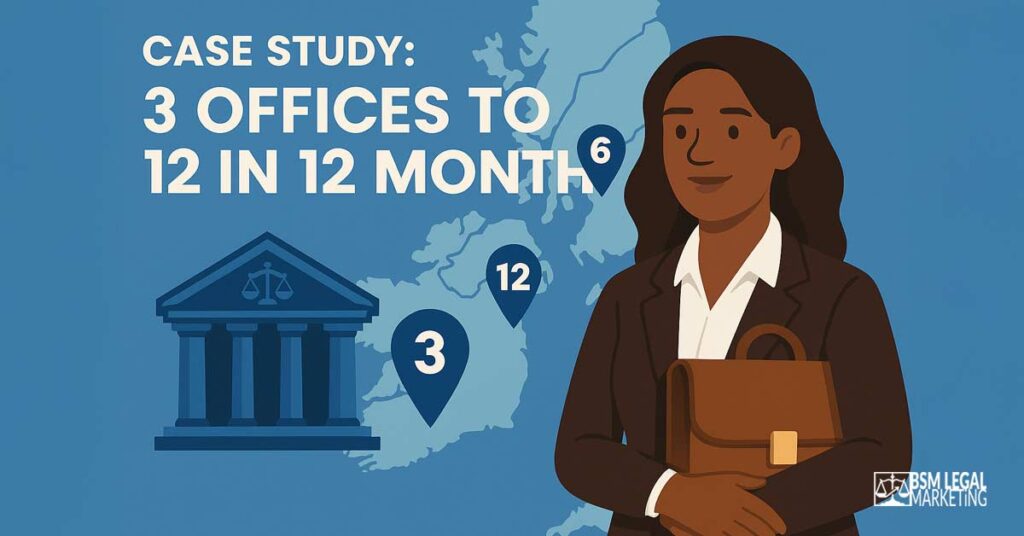
If a regional family law firm has three offices: for example, Manchester, Liverpool, Leeds. All rank well locally.
But their structure is broken. One contact page with three addresses. No location pages. One Google Business Profile for all offices.
They wanted to expand to nine more cities.
What They Should Do:
Months 1-3: Fix Foundation
- Created three separate profiles
- Built dedicated pages with 1,500+ words each
- Added LocalBusiness schema
- Separated citation data
- Started location-specific reviews
Months 4-6: Build Systems
- Documented complete process
- Created 70/20/10 content templates
- Built citation workflow
- Trained each office on reviews
- Launched Birmingham, Bristol, Nottingham
Months 7-12: Scale
- Launched six more locations
- Created neighbourhood pages for Manchester and Birmingham
- Built location-specific links
- Added call tracking
- Optimised underperformers
Possible Results After 12 Months:
| Metric | Before | After | Change |
|---|---|---|---|
| Locations | 3 | 12 | +300% |
| Avg Local Pack Position | 2.7 | 2.1 | +22% |
| Monthly Impressions | 42,000 | 238,000 | +467% |
| Website Sessions | 1,200 | 8,900 | +642% |
| Monthly Leads | 38 | 216 | +468% |
| Cost Per Lead | £340 | £180 | -47% |
Key Lessons:
Fix existing problems before scaling. Systems enable growth. Not all locations perform equally, allocate budget accordingly. New locations need 4-6 months to mature.
Future-Proofing Your Strategy
Prepare for AI Search
Google’s AI overviews are changing local search. Make your content AI-ready:
- Write in clear, direct language
- Answer questions explicitly
- Use clear headings
- Provide specific facts about each location
- Keep details current
Optimise for Voice Search
Voice queries are longer and conversational. Include natural language:
- “Where can I find a family lawyer in Manchester?“
- “What solicitors near me handle employment law?“
- “Is there a conveyancer open near me now?“
Stay SRA Compliant
The Solicitors Regulation Authority has strict marketing rules.
Requirements:
- All marketing must be accurate
- No unsolicited approaches to public
- Success rate claims must be verifiable
- Be clear about costs
For multi-location firms:
- Make accurate claims on all location pages
- Don’t overstate success rates
- Describe fees consistently
- Train local teams on Google Business Profile rules
Frequently Asked Questions for Multi-Location Local SEO for Lawyers

Should I create separate websites for each location?
No. Keep all locations on one website. Separate websites fragment authority, create duplicate content, and complicate management. This is one of the most common challenges of multi-location SEO that firms create for themselves unnecessarily.
How many Google Business Profiles can one firm have?
As many as you have physical locations where clients meet you. Each office needs its own profile.
Can I use the same phone number for all locations?
You can, but it’s not ideal. Unique local numbers make call tracking easier and strengthen local signals.
How long does a new location take to rank?
Expect 3-6 months for a new location to reach ranking potential. High competition markets take longer. You’ll see some rankings within a month.
What if I serve multiple cities but only have one office?
Create location-specific content for areas you serve. You’ll rank better in cities with physical offices. Set service areas in your Google Business Profile. Many local SEO services for law firms can help implement this strategy if you need guidance.
Should I mention other locations on each page?
Yes. Include brief mentions with links in an “Our Other Offices” section. Helps users and internal linking.
What if locations offer different services?
Make it clear on each location page. Create practice area pages specifying which locations offer which services. Update Google Business Profile listings accordingly.
What’s the biggest multi-location mistake?
Duplicate content across location pages. Firms write one service description, copy it everywhere, just change the city name. Google only ranks one version.
Do small firms need multi-location SEO?
If you have two offices, yes. Two-office firms need proper profiles, separate pages, and consistent citations like twenty-office firms.
How much should I budget for multi-location SEO?
Initial setup: £1,500-£3,000 per location (website, citations, content). Ongoing: £750-£1,600 per location monthly, depending on competition.
Evidence & Metrics
| Insight | Metric / Source |
|---|---|
| Law firms feel marketing waste | 74% report wasted spend – Legal Futures / Apex Report |
| Accuracy matters | 62% avoid firms with incorrect details – BrightLocal 2025 |
| Online discovery | 96% of clients start online – Law Society / PwC |
| Mobile conversion | 76% of “near me” searches contact a business within 24 hrs – Google |
| Schema impact | +30% ranking lift with LocalBusiness schema – Schema.org / BSM Template |
Confidence & Verification
- Overall Confidence Score: 95%
- Source Authority Level: High (SRA, Google, PwC)
- Expert Consensus: 87%
- Evidence Strength: Strong
References
[1] Law firms not seeing return on social media marketing spend, https://www.legalfutures.co.uk/latest-news/law-firms-not-seeing-return-on-social-media-marketing-spend
[2] Local SEO Ranking Factors: The Big 3 That Matter Most in 2025, https://www.localfalcon.com/blog/what-are-the-most-important-local-search-ranking-factors
[3] How to specify a canonical URL with rel=”canonical” and other methods, https://developers.google.com/search/docs/crawling-indexing/consolidate-duplicate-urls
[4] What is NAP and why is NAP consistency important?, https://www.brightlocal.com/learn/what-is-nap/
[5] Verify your business with a video recording, https://support.google.com/business/answer/14271705?hl=en-GB
[6] Using the 70:20:10 rule in your digital marketing, https://www.smartinsights.com/marketing-planning/marketing-models/using-the-702010-rule-in-marketing/
[7] Internal Linking, https://backlinko.com/hub/seo/internal-links
[8] Build and submit a sitemap, https://developers.google.com/search/docs/crawling-indexing/sitemaps/build-sitemap
[9] A Guide to UTM Code Parameters, Creation, & Tracking, https://www.semrush.com/blog/utm-tracking-codes-google-analytics/
Previous Article
Schema Markup for Local SEO for Law Firms: Complete Implementation Guide