
The Tick-Off List That Gets Law Firms Ranking in Local Search
Local SEO Checklist for Law Firms
Compliant. Measurable. Human verified.
Core checklist. Finish every GBP field, keep NAP identical everywhere, build foundational citations, publish robust location pages, and track GBP Performance weekly. Roll into a monthly outcomes report mapping interactions to instructions.
Sole office. 100% GBP completion, monthly photos, precise categories, 2–3 new reviews/month, and a quarterly citation tidy-up. Measure discovery searches, profile views, interactions, and calls answered.
Multi-office. One GBP and one location page per office. Standardise NAP and categories. Audit citations per city. Track calls, directions, site taps, and average grid rank, then roll up KPIs by location.
Review cadence. Automate post-matter requests. Target 2–4 reviews/month/office. Respond to every review. Monitor review count, velocity, and keyword relevance alongside rank and interactions.
Compliance-first. No unsolicited approaches, no misleading claims, and verify third-party introducers. Keep audit trails. Align GBP, website, and ads with SRA Codes. Report only verifiable metrics.
This local SEO checklist for law firms, an SEO checklist for attorneys and solicitors, covers everything you need to dominate local search, 96% of people looking for legal help start on Google.[1]
Not directories. Not referrals. Google.
76% contact a solicitor within 24 hours of searching. That’s basically your entire pipeline sitting on page one of search results.
Without local SEO, you’re invisible when potential local clients search, you’re handing cases to competitors. Simple as that.
I’ve worked with law firms on SEO for law firms for years. The successful ones aren’t necessarily using the best local SEO agencies or spending fortunes. They’re just methodical, working through tasks, week by week, ticking boxes. No shortcuts. No magic bullets.
This checklist breaks down exactly what you need to do. In order. With specifics, not vague “SEO best practices” nonsense.
Whether you’re doing this yourself or checking what your agency’s actually delivering on your law firm’s local SEO, you’ll know what needs doing and why.
Let’s get into it.
How Google Actually Ranks Law Firms Locally
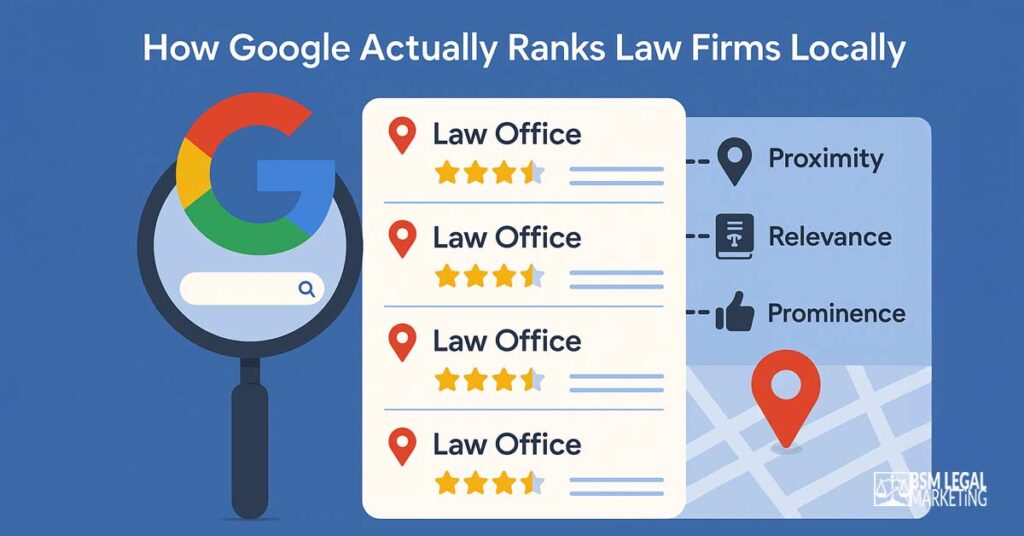
You need to understand what Google’s measuring before you start optimising.
When someone searches “divorce lawyer near me” in Manchester, three factors determine which firms appear. Google calls it RDP.[2]
Relevance
Does your firm do what they’re searching for? If your Google Business Profile says “law firm” and they want a personal injury solicitor, you won’t show. Be specific.
Distance
Physical proximity matters. Can’t change your address. But you can optimise service area settings and create location pages for nearby cities.
Prominence
How well-known is your firm online? Reviews, citations, links, content, this is where most work happens.
97% of people never click past page one.[3] Not in Google’s local pack, local services ads, or top organic results? You’re invisible.
| Factor | What It Means | What You Control | Impact |
|---|---|---|---|
| Relevance | Services match their search | Categories, descriptions, keywords | High |
| Distance | How far away you are | Service areas, location pages | High (but fixed) |
| Prominence | Reputation and authority | Reviews, citations, links, content | Very High |
The Benefits of Local SEO for Attorneys and Solicitors
46% of Google searches have local intent.[4] Higher for legal services where clients search for legal services in their area.
58% use voice search to find local businesses.[5] Someone asking “Hey Google, criminal defence lawyer near me open now” is ready to hire, not browsing. You need to attract high-intent local clients like these through local search.
Average ROI from local SEO: 526% over 14 months.[6] £5.26 back for every pound. Local SEO strategies deliver measurable results for law firms looking to attract local clients.
Now the work.
Google Business Profile Optimisation Checklist
Foundation of everything. Get this wrong, nothing else works. Here’s how to optimize your Google Business Profile properly.
| Task | Priority | Time Required | Impact |
|---|---|---|---|
| Claim and verify profile | Critical | 30 mins (plus verification wait) | Can’t do anything without this |
| Complete 100% of fields | Critical | 2-3 hours | High, incomplete profiles don’t rank |
| Choose right categories | Critical | 15 mins | Very High, determines search visibility |
| Upload quality photos | High | 1-2 hours | High, drives 42% more direction requests |
| Enable messaging | High | 5 mins | Medium, captures leads who prefer texting |
| Add services/pricing | Medium | 30 mins | Medium, helps specific service searches |
| Create Google Posts | Medium | 30 mins/week | Medium, shows you’re active |
| Seed Q&A section | Medium | 30 mins | Medium, answers common questions upfront |
☐ Claim and Verify
What to do: Go to business.google.com. Claim your profile. Verify through postcard, phone, email, or video.
Why: Can’t optimise what you don’t control. Unclaimed profiles show wrong information and you can’t update them.
Tip: Video verification’s available now for most businesses. Film a quick walk around your premises. You’ll get verified in hours instead of waiting a week for the postcard.
☐ Complete Every Field
What to do: Fill in everything. Not most things. Everything. This is fundamental for any local SEO for law firms strategy.
- Business name, your actual law firm name exactly as it appears on your signage
- Primary and secondary categories
- Full address with suite/floor numbers
- Phone number (local number, not your mobile)
- Website URL (your law firm website)
- Opening hours (including bank holidays)
- Service areas
- Business description (750 characters max)
- Attributes (free consultation, wheelchair access, etc.)
- Photos
| Field | Why It Matters | Common Mistake |
|---|---|---|
| Business Name | Exact match to signage – verified businesses rank better | Adding keywords (e.g., “Smith Law Manchester Solicitors”) |
| Primary Category | Determines which searches you appear for | Using “Law Firm” instead of specific practice area |
| Address | Location accuracy affects proximity rankings | Missing suite numbers or incomplete postcodes |
| Phone Number | Direct connection point for clients | Using mobile instead of office landline |
| Website URL | Drives traffic and validates legitimacy | Linking to homepage instead of relevant service page |
| Hours | Shows availability and impacts “open now” searches | Not updating for holidays or special hours |
| Service Areas | Expands your reach beyond office location | Being too broad or too narrow |
| Description | 750 characters to explain what you do | Generic descriptions lacking specificity |
| Attributes | Filters like “free consultation” appear in search | Not selecting any attributes |
Why: Complete profiles are 2.7 times more likely to be considered reputable.[7] Google explicitly ranks complete profiles higher. This will boost your law firm’s visibility in local search results.
☐ Choose the Right Primary Category
What to do: Select the most specific primary category. Don’t use “Law Firm” if you specialise. Use “Personal Injury Attorney,” “Divorce Lawyer,” “Criminal Defense Attorney.”
Why: Your primary category massively affects what searches you appear for. Pick “General Practice Attorney” and you’re competing against everyone. Pick “Personal Injury Attorney” and you’re targeting clients who need exactly what you do.
Tip: You can add up to 9 additional categories. Use them for secondary practice areas. But make your primary category the one that brings in most revenue.
| If You Primarily Do… | Use This Primary Category | Don’t Use |
|---|---|---|
| Personal injury claims | Personal Injury Attorney | Law Firm, Attorney |
| Family law/divorce | Divorce Lawyer or Family Law Attorney | Law Firm, Attorney |
| Criminal defence | Criminal Justice Attorney | Law Firm, Attorney |
| Property/conveyancing | Real Estate Attorney | Law Firm, Attorney |
| Employment law | Employment Attorney | Law Firm, Attorney |
☐ Write a Proper Business Description
What to do: Use all 750 characters. Include:
- Main practice areas
- Location and service area
- What makes you different
- Call-to-action
Example:
“Manchester’s trusted personal injury solicitors since 2005. We’ve recovered over £25 million for clients injured in road accidents, workplace incidents, and medical negligence. Free initial consultation. No win, no fee. Serving Greater Manchester and surrounding areas. Call us today on 0161 XXX XXXX or visit our office on King Street.”
Why: Appears in search results. Helps people decide if you’re right for them before clicking.
☐ Add High-Quality Photos
What to do: Upload at least 10-15 photos:
- Professional logo (720x720px minimum)
- Cover photo (1024x576px minimum)
- Office exterior with signage visible
- Reception and waiting areas
- Meeting rooms
- Team photos
- Community involvement
| Photo Type | Specifications | Why Upload It |
|---|---|---|
| Logo | Square, 720x720px min | Brand recognition in search results |
| Cover Photo | Landscape, 1024x576px min | First impression in profile |
| Office Exterior | Show signage clearly | Helps clients find you physically |
| Reception Area | Professional, well-lit | Sets expectation for visit |
| Meeting Rooms | Clean, professional | Shows you’re a real, established firm |
| Team Photos | Professional headshots | Humanises your firm |
| Community Events | Charity work, sponsorships | Demonstrates local involvement |
Why: Profiles with photos get 42% more direction requests and 35% more website clicks.[8] Photos improve your visibility in local search results significantly.
Tip: Update photos quarterly. Google favours fresh content.
☐ Enable Messaging
What to do: Turn on messaging in your GBP (Google My Business) settings.
Why: Some people prefer messaging for initial enquiries about sensitive legal matters. Don’t lose these leads.
Tip: Respond within 24 hours maximum. Quick responses improve your profile performance.
☐ Add Services and Pricing
What to do: List specific legal services. Add pricing for fixed-fee services like will writing or uncontested divorces.
Why: People search for specific services. Listing “road traffic accident claims” helps you appear for those searches.
☐ Create Weekly Google Posts
What to do: Publish posts weekly covering:
- Recent case results (with permission)
- Legal tips
- Team news
- Office updates
- Events
Why: Regular posts signal you’re active. They can appear in search results, giving you more visibility.
Tip: Posts expire after 7 days. Schedule them in advance. Use the “Call” button to drive phone calls.
☐ Seed the Q&A Section
What to do: Add questions and answers yourself. Don’t wait for clients to ask:
- “Do you offer free consultations?”
- “What areas of law do you specialise in?”
- “Do you work on a no win, no fee basis?”
- “What are your office hours?”
- “Do you offer home visits?”
Why: This section appears prominently. Addresses concerns before someone contacts you.
NAP Consistency and Citation Building Checklist
NAP = Name, Address, Phone Number.
Consistency means your NAP appears exactly the same everywhere it’s listed online. Sounds trivial. It’s not.
Inconsistent NAP confuses Google and tanks your rankings.
| Task | Priority | Time Required | Impact |
|---|---|---|---|
| Audit current NAP consistency | Critical | 1-2 hours | Identifies problems to fix |
| Establish official NAP format | Critical | 15 mins | Creates standard for future use |
| Claim legal directory profiles | Critical | 3-4 hours | Very High, authoritative sources |
| Build general directory citations | High | 2-3 hours | High, validates location |
| Target local citations | High | 2-3 hours | Medium, local relevance |
| Fix incorrect citations | High | Ongoing | High, bad citations hurt |
| Monitor quarterly | Medium | 1 hour/quarter | Medium, maintenance |
☐ Audit Your NAP Consistency
What to do: Search for your firm name on Google. Check the top 20-30 results. Note every variation of your NAP.
Common problems:
- “Smith & Jones Solicitors” vs “Smith and Jones Solicitors”
- “Suite 4, 123 High Street” vs “123 High Street, Suite 4”
- “0161 XXX XXXX” vs “+44 161 XXX XXXX”
- “Manchester M1 1AA” vs “Manchester, Greater Manchester M1 1AA”
Why: Inconsistent citations can reduce Local Pack rankings by 23%.[9]
Tip: Use a spreadsheet to track every citation. Note the URL and how your NAP appears.
☐ Establish Your Official NAP Format
What to do: Decide on one standard format. Document it. This becomes your official format forever.
Example:
Name: Smith & Jones Solicitors
Address: Suite 4, 123 High Street, Manchester M1 1AA
Phone: 0161 XXX XXXX
Why: You need a standard to work from when building or correcting citations.
☐ Claim Profiles on Legal Directories
What to do: Claim and optimise profiles on top legal directories.
| For UK Solicitors | For US Attorneys | Priority Level |
|---|---|---|
| Law Society Find a Solicitor | State Bar Association directories | Critical |
| Solicitors Regulation Authority | Avvo | Critical |
| Chambers and Partners | Justia | High |
| Legal 500 | FindLaw | High |
| Thomson Reuters | Lawyers.com | High |
| Lawyer Checker | Martindale-Hubbell | Medium |
| – | Super Lawyers | Medium |
Why: Most authoritative legal directories. Citations from these carry more weight than generic directories.
Tip: Don’t just claim them. Optimise fully, add descriptions, reviews, content.
☐ Build Citations on General Directories
What to do: Submit consistent NAP to major directories:
| UK Directories | US Directories | Global Directories |
|---|---|---|
| Thomson Local | BBB | Yelp |
| Yell.com | Yellow Pages | Bing Places |
| Scoot | Manta | Apple Maps |
| Hotfrog UK | Angie’s List | Facebook Business |
| – | Merchant Circle | LinkedIn Company Page |
Why: These directories help Google verify your location.
☐ Target Local Citations
What to do: Find local directories specific to your city:
- Local Chamber of Commerce
- City business directories
- Local news websites’ directories
- Regional legal associations
- Local blogs
Why: Local citations signal you’re genuinely embedded in your community.
Tip: Search “your city + business directory” to find these. Check where local competitors are listed.
☐ Fix Incorrect Citations
What to do: For every incorrect citation:
- Claim it and correct it yourself, or
- Contact the site owner requesting correction, or
- Request removal if it’s on a low-quality site you can’t fix
Why: One incorrect citation is worse than no citation. It actively harms rankings.
☐ Monitor Quarterly
What to do: Check citations every 3 months. New directories emerge, old ones shut down.
Why: Citation building isn’t one-time. It requires ongoing maintenance.
Review Generation and Management Checklist
Reviews directly impact rankings and conversions. 88% of consumers trust online reviews as much as personal recommendations.[10]
But you need to stay compliant with SRA regulations (UK) or State Bar rules (US).
| Task | Priority | Time Required | Impact |
|---|---|---|---|
| Understand legal/ethical rules | Critical | 30 mins | Avoids sanctions |
| Create review request process | Critical | 1 hour | Very High, systematic approach |
| Develop email templates | High | 30 mins | High, makes requesting easy |
| Diversify review platforms | High | 30 mins | Medium, builds broader presence |
| Respond to every review | Critical | 10 mins/review | High, shows you care |
| Monitor review velocity | Medium | 5 mins/week | Medium, avoids spam filters |
| Challenge fake reviews | High | As needed | Medium, protects reputation |
☐ Understand the Rules
UK Solicitors: SRA permits soliciting reviews but prohibits offering incentives or payment. You can’t edit or remove negative reviews unless they’re factually wrong or breach privacy.
US Attorneys: Rules vary by state. Most Bar Associations allow requesting reviews from satisfied clients. Check your state’s advertising rules.
Why: Violating professional conduct rules = sanctions, fines, or worse.
☐ Create a Review Request Process
What to do: Build a simple system:
- Identify the moment (after successful case conclusion)
- Ask personally (solicitor asks verbally during final meeting)
- Follow up via email within 24-48 hours
- Provide direct link to your GBP review page
| Step | When | Who | How |
|---|---|---|---|
| 1. Identify Moment | After successful case conclusion | Fee earner | Final meeting or phone call |
| 2. Ask Verbally | During final interaction | Fee earner | Personal request |
| 3. Follow Up | 24-48 hours later | Admin/marketing | Email with direct review link |
| 4. Make It Easy | In follow-up email | Admin/marketing | One-click link to GBP review page |
Why: Best time for reviews is when positive emotion is fresh. Wait a week, response rates drop 50%.
Tip: Create a Google review link: https://search.google.com/local/writereview?placeid=[YOUR_PLACE_ID]
Find your Place ID from your Google Maps URL.
☐ Develop Email Templates
What to do: Write templates for consistent review requests.
Example:
Subject: Would you mind sharing your experience?
Dear [Client Name],
I’m delighted we achieved [specific result] for you. It was a pleasure working with you.
If you were satisfied with our service, would you mind taking two minutes to share your experience on Google? Your feedback helps others in similar situations find us.
You can leave a review here: [direct link]
Thank you for trusting us.
Best regards,
[Solicitor Name]
Why: Templates ensure consistency and make it easy for every fee earner to request reviews.
☐ Diversify Review Platforms
What to do: While Google reviews are most important, also encourage reviews on:
- Legal-specific sites (Avvo, Lawyer.com, Legal 500)
- Trustpilot (UK)
- Your website
Why: Google looks at your review profile across the web, not just their platform.
☐ Respond to Every Review
What to do: Reply to all reviews, positive and negative, within 48 hours max.
Positive review response:
“Thank you for sharing your experience, [Name]. We’re pleased we could secure the compensation you deserved. If you need anything else in future, we’re here.“
Negative review response:
“I’m sorry you felt this way about your experience. We take all feedback seriously. Please contact me directly at [email] so I can understand what happened and see if there’s anything we can do.“
Why: 53% of customers expect responses within a week.[11] Responses show you care about client satisfaction.
Tip: Set up GBP notifications so you’re alerted immediately when reviews appear.
☐ Monitor Review Velocity
What to do: Track how many reviews you receive monthly. Aim for steady growth, 2-4/month for small firms, 5-10 for mid-sized.
Why: A sudden spike (20 reviews in one week) looks suspicious to Google. Steady, organic growth is what you want.
☐ Challenge Fake Reviews
What to do: If you receive a clearly fake review:
- Find it in your GBP
- Click the three dots menu
- Select “Flag as inappropriate”
- Provide evidence
Why: You can’t remove negative but legitimate reviews. But you can and should challenge fake ones.
For more on building compliant review strategies, see our local reviews guide.
On-Page Local SEO Checklist
Your website needs optimising for local search just like your GBP. On-page SEO refers to all the optimisations you make directly on your law firm’s website to improve search ranking.
| Task | Priority | Time Required | Impact |
|---|---|---|---|
| Optimise title tags | Critical | 2-3 hours | Very High, strong ranking factor |
| Write location meta descriptions | High | 2-3 hours | High, improves click-through |
| Use location in H1/H2 headings | High | 1-2 hours | High, relevance signal |
| Embed Google Maps | Medium | 15 mins | Medium, verifies location |
| Add schema markup | High | 2-4 hours | Medium, enables rich snippets |
| Create location pages | High | 3-4 hours/page | High, ranks in multiple cities |
| Optimise for mobile | Critical | Varies | Very High, most searches are mobile |
| Add click-to-call | High | 15 mins | Medium, removes friction |
| Create location-rich content | High | Ongoing | High, builds local authority |
☐ Optimise Title Tags
What to do: Every page needs a unique title tag with:
- Primary keyword
- Your location
- Firm name (if space)
| Page Type | Title Tag Example | Character Count |
|---|---|---|
| Homepage | Personal Injury Solicitors Manchester | Smith & Jones | 56 |
| Service Page | Road Traffic Accident Claims Manchester | Free Consultation | 59 |
| Location Page | Divorce Lawyers Altrincham | Covering Greater Manchester | 58 |
Examples:
Homepage: “Personal Injury Solicitors Manchester | Smith & Jones Law”
Service page: “Road Traffic Accident Claims Manchester | Free Consultation”
Location page: “Divorce Lawyers Altrincham | Greater Manchester Coverage”
Why: Title tags are one of the strongest on-page ranking factors. They appear as the blue link in search results.
Tip: Keep under 60 characters to avoid truncation. Put important info first.
☐ Write Location-Specific Meta Descriptions
What to do: Craft descriptions (155-160 characters) that include location and call-to-action:
Example:
“Manchester personal injury solicitors with 20+ years experience. Free initial consultation. No win, no fee. Call 0161 XXX XXXX today.”
Why: Not a direct ranking factor, but significantly impacts click-through rates.
☐ Use Location Keywords in Headings
What to do: H1 should include location and primary service. H2s cover related topics with location variations.
Examples:
H1: “Manchester’s Trusted Personal Injury Solicitors”
H2: “Serving Clients Across Greater Manchester”
H2: “Why Manchester Residents Choose Smith & Jones”
Why: Headings structure content for users and search engines. Strong relevance signals.
☐ Embed Google Maps
What to do: Add embedded Google Map on your contact page. Use embed code from your GBP.
Why: Helps Google verify your local business location. Better user experience.
☐ Add Schema Markup
What to do: Implement LocalBusiness schema with:
- Business name
- Address
- Phone number
- Opening hours
- Services offered
- Reviews and ratings
Why: Doesn’t directly boost rankings, but helps search engines understand your business. Can enable rich snippets.
Tip: Use Google’s Structured Data Markup Helper to generate code. Validate with Rich Results Test.
☐ Create Location-Specific Service Pages
What to do: If you serve multiple locations, create individual pages for each. Each page needs:
- Unique content (300+ words minimum)
- Local statistics or examples
- Specific landmarks or areas served
- Directions from that area to your office
- Testimonials from clients in that location
URL structure:
yourfirm.co.uk/locations/manchester/
yourfirm.co.uk/locations/altrincham/
yourfirm.co.uk/locations/stockport/
Why: Helps you rank in multiple cities without physical offices in each.
Tip: Don’t duplicate content and swap city names. Google penalises thin content. Make each page substantive and unique.
☐ Optimise for Mobile
What to do: Ensure your website is fully mobile-responsive. Test on actual devices. Check:
- Text readable without zooming
- Buttons large enough to tap
- Phone numbers click-to-call
- Forms work properly
- Page loads under 3 seconds
Why: 61% of mobile users leave if they can’t find what they’re looking for quickly.[12] Most local searches happen on mobile.
☐ Add Click-to-Call Functionality
What to do: Make phone numbers clickable on mobile:
<a href="tel:+441612345678">0161 234 5678</a>
Why: Removes friction. People on mobile want to call immediately.
☐ Create Location-Rich Content
What to do: Write posts and guides that mention specific locations:
- “What to Do After a Car Accident in Manchester”
- “Guide to Divorce Law in Greater Manchester”
- “Court Procedures at Manchester Civil Justice Centre”
Why: Content with location references ranks for long-tail local searches. This is part of local SEO, local SEO targets specific geographic areas where your local business operates. Positions you as a local expert.
Local Link Building Checklist
Links from other websites, especially local ones, pass authority and signal you’re embedded in your community.
Quality matters more than quantity.
| Link Source | Difficulty | Value | How to Get It |
|---|---|---|---|
| Local Chamber of Commerce | Easy | High | Join as member (£200-500/year) |
| Legal directories | Easy | Very High | Claim profiles, complete listings |
| Local news websites | Medium | Very High | Pitch guest articles, provide expert comments |
| Local sponsorships | Easy | High | Sponsor teams, events, charities (£500-5k) |
| Business associations | Easy | Medium | Join and get listed in member directory |
| Local universities | Medium | Medium | Guest lectures, sponsor societies |
| Complementary businesses | Medium | Medium | Build relationships, mutual recommendations |
☐ Sponsor Local Organisations
What to do: Identify sponsorship opportunities:
- Youth sports teams
- Charity events
- Community festivals
- Business associations
- University programmes
| Opportunity Type | Where to Find | Typical Cost | Link Quality |
|---|---|---|---|
| Youth Sports Teams | Local schools, sports clubs | £200-500/year | Medium |
| Charity Events | Local charities, fundraisers | £500-2,000/event | High |
| Community Festivals | City council, event organisers | £1,000-5,000 | High |
| Business Associations | Chamber of Commerce, BNI groups | £300-1,500/year | Medium-High |
| University Programs | Law schools, student societies | £500-2,000/year | High |
Why: Sponsorships typically include logo and link on organisation’s website. Demonstrates genuine community involvement.
Tip: Don’t just cut a cheque. Get involved. Attend events, take photos, write about it. Generates additional content and social media opportunities.
☐ Join Your Local Chamber of Commerce
What to do: Become a member. Most include member directory with link to your website.
Why: Chambers have high domain authority and strong local relevance. Link is valuable. Plus networking events can lead to referrals.
☐ Contribute Guest Articles to Local Publications
What to do: Pitch article ideas to:
- Local news websites
- Regional business journals
- Community blogs
- Local lifestyle magazines
Example pitches:
“5 Things Manchester Drivers Should Know About Personal Injury Claims”
“What the New Divorce Law Means for Stockport Families”
Why: Positions you as local expert while earning high-quality link. This helps your law firm attract potential local clients. Local news sites have strong authority and local relevance.
Tip: Make articles genuinely useful, not sales pitches. Educate readers, get better pickup from editors.
☐ Build Relationships with Complementary Businesses
What to do: Connect and collaborate with local businesses serving similar clients but not competitors:
- Estate agents (conveyancing referrals)
- Financial advisors (inheritance/probate)
- Insurance brokers (PI claims)
- Accountants (business clients)
- Medical practices (medical negligence awareness)
Why: Can lead to reciprocal links and actual client referrals. Networking that serves both SEO and business development.
☐ Get Listed on Local Resource Pages
What to do: Search for local resource pages and request inclusion:
- “[your city] + legal resources”
- “[your city] + business directory”
- “[your city] + professional services”
Why: Many local organisations maintain resource pages for residents. These are editorially curated, making them valuable links. Local SEO helps your firm appear on these trusted resource pages.
☐ Offer Free Legal Clinics
What to do: Organise free information sessions at:
- Local libraries
- Community centres
- Universities
- Business networking groups
Why: Organisations will promote your event on their websites, creating links and mentions. Builds genuine goodwill while demonstrating expertise.
Topics: “Understanding Your Rights After an Accident” | “Small Business Legal Essentials” | “Estate Planning Basics”
☐ Monitor Competitor Backlinks
What to do: Use Ahrefs or SEMrush to see where local competitors get links. If they’re on a local directory you’re not, that’s a gap to fill.
Why: Competitors’ backlink profiles reveal local link opportunities you might’ve missed.
For more strategies, see our guide on local link building.
Content Strategy for Local SEO Checklist
Content helps you rank for informational searches, demonstrates expertise, and provides shareable assets that attract links.
| Content Type | Difficulty | Time Required | SEO Value | Frequency |
|---|---|---|---|---|
| Location-specific guides | Medium | 4-6 hours | Very High | 1-2/quarter |
| FAQ answers | Easy | 30 mins each | High | 2-4/month |
| Local news commentary | Medium | 1-2 hours | Medium | As relevant |
| Neighbourhood guides | Medium | 2-3 hours | Medium | 1/month |
| Monthly legal updates | Easy | 1 hour | Medium | Monthly |
☐ Research Local Keywords
What to do: Use keyword tools to find local search terms:
- “[practice area] lawyer [city]”
- “[city] solicitor [specific service]”
- “solicitor near me [practice area]”
- Question-based searches (“can I claim for… in [city]”)
| Keyword Type | Example | Search Volume | Competition |
|---|---|---|---|
| Service + Location | “personal injury lawyer Manchester” | High | High |
| Near Me | “solicitor near me personal injury” | Very High | Very High |
| Neighbourhood | “divorce lawyer Altrincham” | Medium | Medium |
| Question-Based | “can I claim for car accident Manchester” | Low-Medium | Low |
| Long-Tail Local | “best solicitor for road accident Stockport” | Low | Low |
Why: You need real keyword data, not assumptions about what people search.
Tip: Check Google’s “People also ask” and “Related searches” for content ideas.
☐ Create Location-Specific Ultimate Guides
What to do: Write comprehensive guides combining expertise with local information:
- “Complete Guide to Personal Injury Claims in Manchester”
- “How to Buy a House in Cheshire: Legal Process Explained”
- “Divorce in Manchester: What You Need to Know”
Why: In-depth resources attract links, rank for multiple keywords, position you as the local expert.
Tip: Include local statistics, mention local courts and offices, reference local laws. This local specificity makes your guide valuable versus generic national resources.
☐ Answer Common Client Questions
What to do: Create posts answering questions you hear repeatedly. Structure answers for voice search:
Question: “How long does a personal injury claim take in the UK?”
Answer format: Start with direct answer, then elaborate: “Most personal injury claims in the UK settle within 6-12 months. However, complex cases involving serious injuries can take 2-3 years or longer…”
Why: Question-based content captures voice search traffic and featured snippets.
☐ Cover Local Legal News
What to do: Monitor local news for legal stories relevant to your practice. Write timely commentary:
- Local court decisions with wider implications
- Changes to local regulations
- High-profile local cases (where appropriate)
Why: Timely content can earn quick wins while topics trend. Demonstrates you’re current and engaged with local issues.
☐ Create Neighbourhood Guides
What to do: Write content about specific neighbourhoods, weaving in legal topics:
Example: “Legal Services in Altrincham: What WA14 Residents Need to Know About Buying, Selling, and Protecting Property”
Why: Hyperlocal content targets very specific searches (“solicitor in Altrincham”) with less competition.
☐ Publish Monthly Legal Updates
What to do: Create regular “Legal News from [City]” updates covering:
- Recent firm wins
- Team news
- Legal developments affecting local residents
- Community involvement
Why: Regular content signals site freshness to Google. Gives you something to share on social and in email newsletters.
☐ Optimise for Featured Snippets
What to do: Structure content to capture position zero:
- Use clear question headings
- Provide concise answers in first paragraph (40-60 words)
- Use numbered lists and tables
- Define terms clearly
Why: Featured snippets get massive visibility and clicks. Especially valuable for voice search, digital assistants read featured snippets aloud.
Technical SEO for Local Search Checklist
Technical issues can completely undermine your law firm SEO efforts. These behind-the-scenes elements ensure search engines can crawl, understand, and rank your site properly.
| Technical Element | Target Benchmark | Tools to Test | Impact if Broken |
|---|---|---|---|
| Page speed (mobile) | Under 3 seconds | Google PageSpeed Insights | Very High, affects rankings and conversions |
| Mobile-friendliness | Zero errors | Google Mobile-Friendly Test | Critical, most searches are mobile |
| HTTPS security | All pages secure | Browser address bar | High, ranking signal and trust factor |
| XML sitemap | Submitted and indexed | Google Search Console | Medium, helps discovery |
| Broken links | Zero 404 errors | Screaming Frog, Ahrefs | Medium, wastes crawl budget |
| URL structure | Clean, descriptive | Manual review | Medium, affects understanding |
| Robots.txt | Not blocking pages | yoursite.com/robots.txt | Critical, can hide entire site |
☐ Ensure Fast Loading
What to do: Test with Google PageSpeed Insights. Aim for:
- Mobile score above 90
- Desktop score above 95
- Largest Contentful Paint under 2.5 seconds
- First Input Delay under 100 milliseconds
| Metric | Target | Why It Matters |
|---|---|---|
| Mobile Score | Above 90 | Most local searches are mobile |
| Desktop Score | Above 95 | Desktop users expect fast sites |
| LCP | Under 2.5 seconds | Confirmed ranking factor |
| FID | Under 100ms | User interaction responsiveness |
Why: Page speed is a confirmed ranking factor, especially mobile. Slow sites kill conversions, 47% expect pages to load in 2 seconds or less.[13]
Tip: Common fixes: optimise images, enable browser caching, minimise JavaScript, use a CDN.
☐ Make Site Mobile-Friendly
What to do: Run Google’s Mobile-Friendly Test. Fix any issues with:
- Text too small
- Links too close together
- Content wider than screen
- Viewport not configured
Why: Google uses mobile-first indexing. Your mobile site determines rankings.
☐ Implement HTTPS
What to do: Ensure your site uses HTTPS. Purchase and install SSL certificate if needed.
Why: HTTPS is a ranking signal. Browsers flag HTTP sites as “Not Secure,” which terrifies potential clients.
☐ Create and Submit XML Sitemap
What to do: Generate XML sitemap listing all important pages. Submit to Google Search Console and Bing Webmaster Tools.
Why: Helps search engines discover and index pages efficiently. Important for new pages or sites with poor internal linking.
☐ Fix Broken Links
What to do: Use Screaming Frog or Ahrefs to identify broken links. Fix them or implement 301 redirects.
Why: Broken links frustrate users and waste crawl budget. Suggest poor site maintenance.
☐ Optimise URL Structure
What to do: Ensure URLs are:
- Descriptive and keyword-rich
- Short and readable
- Use hyphens (not underscores)
- All lowercase
Good: yourfirm.co.uk/services/personal-injury/manchester
Bad: yourfirm.co.uk/page?id=12345&cat=services
Why: Clear URLs help users and search engines understand page content.
☐ Set Up Google Search Console
What to do: Verify your site. Monitor weekly for:
- Indexing errors
- Mobile usability issues
- Security problems
- Manual actions
- Search performance data
Why: Shows exactly how Google sees your site. Alerts you to problems harming rankings.
☐ Check Robots.txt
What to do: Verify your robots.txt file (yoursite.com/robots.txt) isn’t blocking important pages.
Why: Misconfigured robots.txt can prevent Google crawling entire sections, making pages invisible.
Local SEO Tracking and Measuring Performance Checklist
Can’t improve what you don’t measure. These metrics show whether efforts are working and where to focus.
| Metric | Tool | Check Frequency | What Good Looks Like |
|---|---|---|---|
| Organic traffic | Google Analytics | Weekly | Steady month-over-month growth |
| Local Pack rankings | BrightLocal, Local Falcon | Weekly | Top 3 for main keywords |
| Organic rankings | Ahrefs, SEMrush | Weekly | Page one for target terms |
| GBP insights | Google Business Profile | Monthly | Increasing views and actions |
| Review count/rating | Manual check | Weekly | 2-4 new reviews/month, 4.5+ stars |
| Phone calls | Call tracking software | Daily | Increasing calls from organic |
| Form submissions | Google Analytics | Weekly | Increasing submissions |
| Citation consistency | BrightLocal, Whitespark | Quarterly | NAP correct everywhere |
☐ Set Up Google Analytics
What to do: Install GA4. Create custom reports tracking:
- Organic traffic from your city and surrounding areas
- Goal completions (forms, calls, emails)
- Time on site and bounce rates
- Top landing pages from organic
| Metric | What It Shows | How Often to Check |
|---|---|---|
| Organic Traffic by Location | Visitors from your target areas | Weekly |
| Goal Completions | Form submissions, calls, emails | Daily |
| Time on Site | Engagement quality | Weekly |
| Bounce Rate | Content relevance | Weekly |
| Top Landing Pages | What content performs | Monthly |
Why: Shows the real business impact of your local SEO efforts and local marketing, not just rankings, but actual local traffic and conversions.
☐ Implement Call Tracking
What to do: Set up call tracking to measure phone calls from organic search. Use either:
- Dynamic number insertion (shows different numbers based on traffic source)
- Unique numbers for different channels
Why: For law firms, phone calls are the primary conversion. Not tracking them = missing majority of ROI.
☐ Monitor GBP Insights
What to do: Check insights monthly to track:
- How customers found your profile (direct vs discovery)
- Number of views
- Actions taken (website visits, direction requests, calls)
- Photo views
- Search queries showing your profile
Why: Shows how people find and interact with your profile. Reveals optimisation opportunities.
☐ Track Local Pack Rankings
What to do: Use BrightLocal, Local Falcon, or Whitespark to track Local Pack position for target keywords across your service area.
Why: Local Pack rankings vary by searcher location. You might rank #1 in your office postcode but #15 three miles away. Grid tracking shows actual visibility across entire service area.
☐ Monitor Organic Rankings
What to do: Track positions for key terms:
- Core service + location terms
- “Near me” variations
- Long-tail question searches
Why: While Local Pack is crucial, traditional organic results still drive substantial traffic. Track both.
☐ Set Up Monthly Reporting
What to do: Create monthly report covering:
- Organic traffic and conversion trends
- Local Pack and organic ranking changes
- New reviews and rating changes
- Citation audit updates
- New content published
- Links acquired
Why: Regular reporting keeps you accountable. Helps spot trends, positive improvements and emerging problems.
For comprehensive breakdown of what to measure and how, see our guide on local SEO KPIs and reporting.
Local SEO for Multi-Location Law Firms Checklist
If your law firm has multiple offices, your strategy becomes more complex but also more powerful. Each location needs individual attention.
| Task | Single Location | Multi-Location (per office) |
|---|---|---|
| Google Business Profiles | 1 profile | 1 profile per location |
| Location pages | 1 main page | Individual page per office |
| Schema markup | LocalBusiness on contact page | LocalBusiness per page + Organization |
| Citations | One set | Separate listings per location |
| Review generation | Single profile | Per-location profiles |
| Local content | Focus on one city | Content for each market |
☐ Create Separate GBPs for Each Location
What to do: Every physical office needs its own GBP. Don’t try listing multiple addresses on one profile.
Why: Google can only show one location per listing. Multiple profiles let you appear in multiple cities’ Local Packs.
☐ Build Individual Location Pages
What to do: Create substantive, unique pages for each office. Each needs:
- Office-specific address, hours, contact details
- Meet the team at this location
- Services offered at this office
- Directions and parking
- Local landmarks and areas served
- Client testimonials from this location
- Embedded Google Map for this office
| Element | Why Include It |
|---|---|
| Office-specific address, hours, contact details | Essential information for visitors |
| Meet the team at this location | Personalises the office |
| Services offered at this office | May vary by location |
| Directions and parking | Practical visitor information |
| Local landmarks and areas served | Local relevance signals |
| Client testimonials from this location | Location-specific social proof |
| Embedded Google Map | Location verification |
Why: Each location page targets local searches in that specific area.
☐ Implement Location-Specific Schema
What to do: Add LocalBusiness schema to each location page with that office’s details. On homepage, use Organization schema listing all locations.
Why: Helps Google understand your firm’s structure and individual offices.
☐ Build Local Citations for Each Office
What to do: Every office needs its own citations on legal and local directories. List each location separately with its own NAP.
Why: Citations validate each location’s legitimacy. A Leeds office needs Leeds-specific directory citations.
☐ Encourage Reviews for Each Location
What to do: Route review requests to the specific GBP where client was served. Each office builds its own review profile.
Why: Reviews on Birmingham GBP don’t help Manchester GBP. Each location needs to build its own reputation.
Advanced Local SEO Tactics Checklist
Once fundamentals are nailed, these tactics give you an edge.
☐ Optimise for “Near Me” Searches
What to do: While you can’t specifically “optimise” for “near me” (Google determines this based on location), you can:
- Ensure NAP consistency everywhere
- Keep GBP fully optimised
- Use conversational language in content
- Have fast mobile page load times
- Make phone number prominently displayed
Why: “Near me” searches increased 200% in recent years and typically have higher intent.[14]
Our complete guide to “near me” optimisation goes deeper.
☐ Create Service-Area Pages
What to do: Beyond office locations, create pages for areas and local markets you serve:
yourfirm.co.uk/areas/cheshire/
yourfirm.co.uk/areas/north-west/
yourfirm.co.uk/areas/greater-manchester/
Why: These pages target broader geographic searches while location pages handle specific cities.
☐ Build Topic Clusters Around Local Terms
What to do: Create content clusters where pillar page covers broad topic and supporting articles cover specific aspects:
Pillar: “Personal Injury Claims in Manchester: Complete Guide”
Supporting:
- “Road Traffic Accident Claims in Manchester”
- “Workplace Injury Compensation in Manchester”
- “Medical Negligence Claims in Manchester”
- “Slip and Fall Claims in Manchester”
Why: Topic clusters demonstrate comprehensive expertise. Help you rank for hundreds of related long-tail keywords.
☐ Use Google Posts Strategically
What to do: Use different post types strategically:
- COVID/offer posts for limited-time free consultations
- Event posts for seminars or webinars
- Product posts to highlight specific services
- Update posts for general news
Why: Different post types get different formatting in GBP. Use most visually impactful format for important announcements.
☐ Use Video Content
What to do: Create short (30-90 second) videos for GBP and YouTube:
- Office tours
- Meet the team
- Client testimonials (with permission)
- Quick legal tips
- FAQs answered
Why: Videos increase GBP engagement. YouTube videos can rank in both YouTube and Google search, giving you additional visibility.
☐ Monitor and Respond to Q&A
What to do: Check Q&A section weekly. When someone asks a question, answer quickly. If common questions are missing, add them proactively.
Why: Q&A appears prominently. Unanswered questions create doubt, comprehensive answers build confidence.
Local SEO Software & Tools You’ll Need
Right tools make management significantly easier.
| Tool | What It Does | Cost | Priority |
|---|---|---|---|
| Google Business Profile Manager | Manage GBPs, insights, reviews, posts | Free | Essential |
| Google Search Console | Monitor crawling, indexing, technical issues | Free | Essential |
| Google Analytics 4 | Track traffic, behavior, conversions | Free | Essential |
| BrightLocal or Whitespark | Local rank tracking, citations, reviews | £29-99/mo | High |
| Ahrefs or SEMrush | Keyword research, backlinks, competitors | £99-399/mo | High |
| Yext or Synup | Manage NAP across hundreds of directories | £300-1,200/yr | Medium |
| GatherUp or Grade.us | Automate review requests, monitoring | £50-200/mo | Medium |
For detailed reviews and comparisons, check our complete guide to local SEO tools.
Common Mistakes to Avoid
I see these repeatedly. Avoid them:
❌ Using PO Box or Virtual Office as Primary Address
Google requires physical address where clients can visit. PO boxes don’t qualify. Virtual offices are risky unless you actually rent physical space and can receive clients.
❌ Keyword Stuffing Your Business Name
Don’t change your name to “Manchester Personal Injury Lawyers Smith & Jones Solicitors” in GBP. Google will suspend your profile. Your business name should match real-world signage.
❌ Creating Multiple Profiles for One Location
Don’t create separate GBPs for different practice areas at same address. Google will flag them as duplicates. One location = one profile.
❌ Neglecting Mobile
Most local searches happen on mobile. If your site doesn’t work well on smartphones, you’re losing majority of potential clients.
❌ Buying Fake Reviews
Google’s algorithms detect fake reviews. Penalties are severe. Build reviews organically.
❌ Ignoring Negative Reviews
Responding professionally to criticism shows potential clients you care. Ignoring bad reviews makes you look indifferent.
❌ Inconsistent NAP
Most common mistake. Every variation of your address or phone dilutes your local SEO power.
❌ Creating Thin Location Pages
Don’t copy-paste same content across location pages changing only city name. Google penalises duplicate content. Each page needs substantive, unique content.
❌ Forgetting Schema
Schema is easy to implement but often overlooked. Helps search engines understand your business. Can improve visibility in search results.
❌ Not Tracking Results
You need to know what’s working. Set up proper tracking from day one so you can prove ROI and identify what needs adjustment.
Your 90-Day Plan to Dominate Local Search Results & Google Maps
Doing everything at once is overwhelming. Here’s how to master local SEO systematically. Here’s how to prioritise over first three months:
| Month | Week | Focus Tasks | Expected Time |
|---|---|---|---|
| 1 | 1 | Claim/verify GBP, audit NAP, set up GSC & Analytics | 4-6 hours |
| 2-3 | Claim legal directory profiles, fix critical NAP issues, add schema | 6-8 hours | |
| 4 | Set up review process, create Posts schedule, run technical audit | 4-6 hours | |
| Month 1 Total: | 14-20 hours | ||
| 2 | 5-6 | Build 20 directory citations, optimise title/meta tags, create location pages | 8-10 hours |
| 7 | Publish first 2-3 local blog posts, add location content to service pages, create FAQ | 6-8 hours | |
| 8 | Generate first batch of reviews, identify link opportunities, set up call tracking | 4-6 hours | |
| Month 2 Total: | 18-24 hours | ||
| 3 | 9-10 | Pursue local links (sponsorships, guest posts), create additional location pages, publish 2-3 posts | 8-10 hours |
| 11 | Review first two months of data, adjust strategy, identify content gaps | 2-4 hours | |
| 12 | Set up monthly reporting dashboard, plan next quarter’s content, continue review generation | 4-6 hours | |
| Month 3 Total: | 14-20 hours | ||
| 90-Day Total Time Investment: | 46-64 hours | ||
After your initial local SEO campaign (90 days): Continue with 4-6 hours/week maintaining and expanding, responding to reviews, publishing content, building links, monitoring performance.
Priority Framework
| Priority Level | Tasks | Timeline | Impact |
|---|---|---|---|
| Critical | GBP optimisation, NAP consistency, Legal directory listings | Weeks 1-4 | Foundation for all other efforts |
| High | Review generation, Schema markup, Location pages | Weeks 4-8 | Direct ranking factors |
| Medium | Content creation, General citations, Local links | Weeks 6-12 | Builds authority over time |
| Ongoing | Posts, monitoring, responding to reviews, tracking | Weekly | Maintains and improves positions |
Frequently Asked Questions
How long does local SEO take to work for law firms?
Local SEO typically takes 3-6 months to show meaningful results. You’ll likely see improvements in GBP visibility within 4-8 weeks, but ranking well in Local Pack and organic results for competitive terms takes longer. Timeline depends on your starting point, competition level, and how consistently you implement tactics.
What’s more important: Google Business Profile or my website?
Both are essential, but your GBP should be first priority. Many potential clients never visit your website, they call directly from GBP or visit after seeing you in Local Pack. Your GBP can generate leads even if your website isn’t perfect. However, for long-term success and competitive terms, you need both optimised.
How many reviews do I need to rank well locally?
There’s no magic number, but research shows firms ranking in top 3 of Local Pack typically have at least 40-50 reviews with average rating above 4.5 stars.[15] That said, review quantity isn’t everything, review velocity (how recently you’ve received reviews) and your responses also matter significantly.
Should I target multiple practice areas in my local SEO?
Depends on firm size. Solo attorney practitioners or small firms should focus on 1-2 core practice areas to establish authority. Larger firms can target multiple practice areas, but each should have dedicated pages and content. Trying to rank for everything dilutes your message and makes it harder to rank well for anything.
Can I do effective local SEO myself, or should I hire an agency?
You absolutely can handle basic local SEO yourself, claiming your GBP, building citations, requesting reviews don’t require technical expertise. Basic local SEO for lawyers is quite straightforward. However, comprehensive local SEO services for law firms, including technical optimisation, link building, content strategy is time-consuming and requires specialised knowledge. Many firms start with DIY basics then hire help once they have a better understanding of local SEO and what’s involved. If your time is better spent practising law than learning local SEO for your law firm, hiring an experienced agency makes sense.
What’s the difference between local SEO and traditional SEO?
Local SEO is the process of optimising your law firm’s online presence to appear in local searches, increasing your presence to appear in local results and attract clients, specifically location-specific searches (typically within 10-20 mile radius) and targets Local Pack, Google Maps, and localised organic results (local results in your area). Traditional SEO targets broader, often national or international searches without geographic modifiers. Local SEO emphasises GBP, citations, and local content, while traditional SEO focuses more on overall domain authority and broader content topics. Law firms need both, but local SEO typically delivers better ROI for firms serving specific geographic areas.
Do I need to be in city centre to rank well locally?
No, but your office location affects your ranking radius. Offices in city centres typically rank better within that city, while suburban offices might rank better in surrounding areas. Google considers proximity to searcher’s location, so you’ll naturally rank better for searches near your office. You can still rank for nearby cities through location pages, content strategy, and strong overall optimisation, you just need to work harder than firms with central offices.
How do I handle negative reviews?
Respond professionally and quickly, within 24-48 hours. Acknowledge client’s frustration, apologise for their experience, offer to discuss offline. Never argue or get defensive publicly. If review violates Google’s policies (fake review, profanity, confidential information), flag it for removal. Remember: how you respond to criticism often matters more to potential clients than the criticism itself.
Is it worth creating location pages for cities where I don’t have an office?
Yes, if done properly. Local landing pages (service area pages) can help your law firm rank in nearby cities without physical offices there. However, these pages must contain substantial, unique content specific to that location, not just template content with city names swapped. Include local information, statistics, landmarks, explain how you serve clients in that area. Thin location pages can harm more than help.
Should I use my home address for GBP if I’m a sole practitioner working from home?
Google allows service-area businesses to hide their address if they don’t have a physical location where clients visit. If you meet clients at their locations or in neutral spaces (like coffee shops), you can set up as service-area business and hide your home address while still serving specific geographic areas. This protects your privacy while allowing you to appear in local search results.
Ready to Dominate Local Search Without Doing It Yourself?
Local SEO isn’t a one-time project. It’s ongoing. The law firms dominating local search do so because they consistently implement these tactics month after month.
Start with fundamentals:
- Get your GBP right
- Ensure NAP consistency
- Begin generating reviews.
These three alone will improve visibility significantly.
Then build from there:
- Create quality content
- Earn local links
- Optimise technical SEO
- Track what’s working.
Don’t try doing everything at once. Pick 2-3 high-impact tasks each week and execute them well.
Many law firms aren’t doing this properly. By using local SEO systematically and following this checklist, you’ll leapfrog competitors who are winging it or ignoring local search altogether.
Remember: 76% of people who search for something nearby visit a business within 24 hours, and 28% of those searches result in a purchase, or in your case, hiring a solicitor.[16] Those are clients you can’t afford to miss.
But Here’s the Reality
This checklist is comprehensive. Deliberately so.
You’re looking at 46-64 hours of work over 90 days just for the initial setup. Then 4-6 hours every single week maintaining and expanding your efforts. That’s before you account for the learning curve, the technical mistakes, the wasted time on tactics that don’t move the needle.
Your time is worth £200-500+ per hour practising law. Spending it on local SEO? That’s costing you tens of thousands in lost billable hours.
Here’s what most solicitors and attorneys discover: they tick off a few boxes, get overwhelmed, lose momentum, and six months later they’re still invisible in local search while competitors who hired experts are dominating the Local Pack.
Let the Experts Handle It
BSM Legal Marketing specialises exclusively in local SEO for law firms. Not generic businesses. Law firms.
We know the SRA compliance issues UK solicitors face. We understand State Bar advertising rules for US attorneys. We’ve built strategies for solo practitioners, mid-sized firms, and multi-office practices across dozens of practice areas.
While you’re focused on winning cases and serving clients, we’re:
- Optimising your Google Business Profile to the standard that actually ranks
- Building the exact citations that move the needle in legal directories
- Generating compliant reviews that don’t put your licence at risk
- Creating content that ranks and converts (not generic legal blog posts)
- Building local links that Google actually values
- Monitoring and adjusting based on what’s working in your specific market
We’ve seen it repeatedly: a solo practitioner spending 10 hours a week on DIY SEO gets worse results than spending 2 hours a month on strategy calls with us whilst we handle execution.
The maths is simple. You bill £250/hour. Those 10 weekly DIY hours cost you £2,500 in lost revenue. Our service? A fraction of that. And it actually works.
Free Local SEO Audit for Your Law Firm
Not sure where you currently stand? We’ll audit your local SEO and show you exactly:
- Why you’re not ranking in the Local Pack (or how to get from #3 to #1)
- Which citations are hurting you right now
- What your competitors are doing that you’re not
- The 3-5 highest-impact changes for your specific situation
- Realistic timeline and investment for your market
No sales pressure. No 47-page reports full of fluff. Just straight answers about what’s broken and how to fix it.
Book your free audit: Call 01689 602 248 or book an appointment here.
Tell us your firm name, location, and main practice area. We’ll review your local SEO and send you a video walkthrough of findings within 48 hours.
Whether you implement this checklist yourself or work with us, at least you’ll know exactly where you stand and what needs fixing.
But if you’d rather focus on practising law whilst experts handle your local SEO, that’s what we’re here for.
Evidence & Metrics
| Checklist Item | Metric / Tool | What to Track |
|---|---|---|
| Complete Google Business Profile | GBP Performance | Searches, views, interactions, calls, directions, website taps (weekly) |
| Consistent NAP + citations | BrightLocal / Whitespark | Duplicate/incorrect listings fixed; new authoritative citations added |
| Steady Google reviews | GBP reviews | 2–4/month/office; response rate 100%; review keywords and velocity |
| Location pages (per office) | GA4 + call tracking | Clicks from GBP to page; calls; form submissions; cost-per-instruction |
| Category hygiene | GBP categories | Specific primary + relevant secondary; quarterly review after service changes |
| Coverage proof | Geo-grid tracking | Average rank and Local Pack share across 5×5/7×7 grid, priority keywords |
| Compliance audit trail | SRA checklist | No unsolicited approaches; accurate publicity; introducer due diligence recorded |
Confidence & Verification
Notes: Local ranking is primarily relevance, distance, prominence (Google). GBP Performance metrics define searches, views and interactions (post-2023). Reviews are a major local factor. SRA prohibits unsolicited approaches and misleading publicity.
References
[1] Clio Legal Trends Report – https://www.clio.com/resources/legal-trends/
[2] Google Business Profile Help – https://support.google.com/business/answer/7091
[3] SISTRIX Google CTR Study – https://www.sistrix.com/blog/why-almost-everything-you-knew-about-google-ctr-is-no-longer-valid/
[4] Think with Google Consumer Insights – https://www.thinkwithgoogle.com/consumer-insights/consumer-trends/i-want-to-go-micro-moments/
[5] BrightLocal Voice Search Study – https://www.brightlocal.com/research/voice-search-for-local-business-study/
[6] Marketing Profs ROI Study – https://www.marketingprofs.com/articles/2023/49812/the-roi-of-local-seo-what-you-need-to-know
[7] BrightLocal Local Consumer Review Survey – https://www.brightlocal.com/research/local-consumer-review-survey/
[8] Google Business Profile Statistics – https://www.google.com/business/
[9] Moz Local SEO Ranking Factors – https://moz.com/learn/seo/local
[10] BrightLocal Local Consumer Review Survey – https://www.brightlocal.com/research/local-consumer-review-survey/
[11] ReviewTrackers Online Reviews Survey – https://www.reviewtrackers.com/reports/online-reviews-survey/
[12] Think with Google Mobile Page Speed Research – https://www.thinkwithgoogle.com/marketing-strategies/app-and-mobile/mobile-page-speed-new-industry-benchmarks/
[13] Hobo Web Website Load Time Study – https://www.hobo-web.co.uk/your-website-design-should-load-in-4-seconds/
[14] Think with Google Near Me Research – https://www.thinkwithgoogle.com/consumer-insights/consumer-trends/i-want-to-go-micro-moments/
[15] BrightLocal Local Consumer Review Survey – https://www.brightlocal.com/research/local-consumer-review-survey/
[16] Think with Google Local Search Statistics – https://www.thinkwithgoogle.com/consumer-insights/consumer-trends/i-want-to-go-micro-moments/
Previous Article
Call Tracking for Law Firms: How Tracking Calls from SEO and Local Search Maximizes Your Law Firm SEO Results and ROI